
Testing an MT5 trade panel: four bugs our 1,750 checks caught

A trade panel for MetaTrader 5 that's wrong about money is worse than no panel at all. You trust the number on the button, and the number lies.
So before RiskDeck by Dojiwave went on the Market, we built more than 1,750 automated checks around it, on MetaTrader 5 demo accounts, and ran them again before every release. Most of the time they pass. This post is about the times they didn't. Four real bugs, all caught before the first version reached a buyer, and what each one would have done to your account.
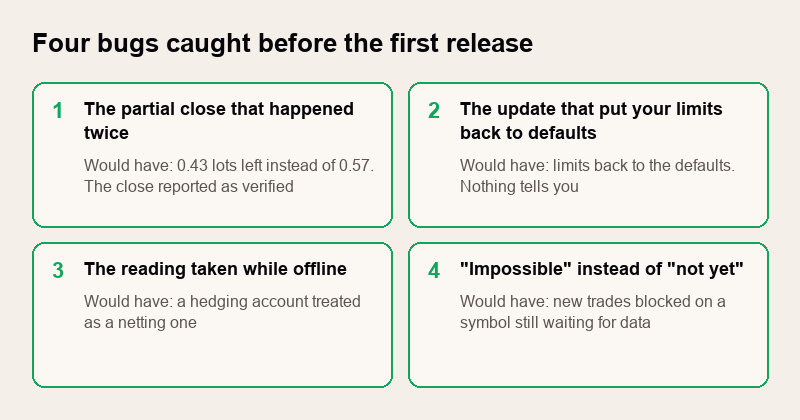
Four bugs caught before the first release, and what each would have done
1. The partial close that happened twice
What a trader would have seen: you planned three partial closes on a 0.75 lot position. Two copies of RiskDeck were running on the same account, after a restart or in a second terminal. Both saw the same level and both took their slice. Instead of 0.57 lots after the second step, you'd have 0.43. And the panel would have reported the close as verified.
What caught it: a test bench that deliberately runs two copies at once.
Today: every step compares the position's volume with a base saved after each partial close, its own or one it detects. The check runs in every test run. We still recommend one account, one terminal.
2. The update that quietly put your limits back to defaults
What a trader would have seen: you set your daily and weekly limits, then install an update. A setting saved by the older version is just outside the range the new version accepts, so the whole settings file is rejected. Your limits are back to the defaults, and nothing tells you.
What caught it: a code review before release.
Today: the panel tells you. If the settings file can't be used, a DEGRADED bar says your own limits are not in force and the defaults are running. The file is never overwritten, and settings added in later versions are clipped to the allowed range instead of rejected.
3. The reading taken while offline
What a trader would have seen: right after start, before the terminal connects, MetaTrader 5 answers some questions with zeros. In the field that says what kind of account you have, zero means netting. A hedging account could have been treated as a netting one.
What caught it: we went through 334 environment readings from 14 days of logs. Every wrong one was taken without a connection.
Today: a reading taken offline is not a reading. Without a connection the panel says OFFLINE and automation waits, while your stops stay on the server.
4. "Impossible" instead of "not yet"
What a trader would have seen: on a new broker, on a Saturday, a symbol didn't report its tick value for the first few minutes. RiskDeck decided the symbol could never be calculated, blocked new trades and wouldn't let you take over a position, although a few minutes later everything would have worked.
What caught it: running on a real broker's demo account, not only in a lab.
Today: there is a separate state for a symbol that's still waiting for data. It's the same rule we use for risk: when RiskDeck doesn't know a number, it says so. An unknown risk shows as UNKNOWN, never $0.00.
What the four have in common
None of them would have shown up on a quiet day with one terminal and a good connection. They live at the edges: a restart, an update, the first seconds after start, a broker that's slow on a weekend. That's exactly where real accounts get hurt, so that's where the checks are aimed.
We'll keep writing these up. If you find something in RiskDeck that doesn't behave as described, tell us in a private message. We read every message and fix what we can reproduce.