Why a stuck grid basket gets more expensive every night: swap, margin and time

Out of drawdown #2 – part 1 introduced Drawdown Minimizer. Before going through its logic piece by piece, this part looks at the problem itself: why an old grid basket that is "just waiting to come back" is not standing still. It costs something every night, it blocks margin every hour, and time works against it.
The situation
A grid or martingale EA opened its first position, the market kept moving in one direction, and the EA added level after level. Now the oldest positions are deep in loss. They did not come back for weeks, sometimes months. The usual answer is "it always comes back, just wait". Maybe it does. But waiting is not free, and the cost does not show up in one place where you would notice it. It is spread over three things.
Cost 1: swap, every single night
Every position that is still open at the daily rollover is charged or credited swap. For a grid basket that is stuck against the trend, the swap is often negative, and it is paid on the full open volume of the basket, not only on the newest level.
A few things make this worse than it looks:
- It is paid on every position in the basket. The more levels the EA has added, the larger the volume that pays swap each night.
- It adds up quietly. One night is small. Weeks and months are not. You only see it in the Swap column of the Trade tab, position by position.
- Most brokers charge triple swap once a week to cover the weekend, so the weekly cost is higher than five normal nights.
- It moves the break-even. Every night of negative swap means the basket needs a slightly better price to close at zero. "It only has to come back to where it was" stops being true after the first weeks.
This is exactly how Drawdown Minimizer started: one of our own grid EAs got stuck for months, the old positions did not come back, and they paid swap every single night.
Cost 2: margin that is not available for anything else
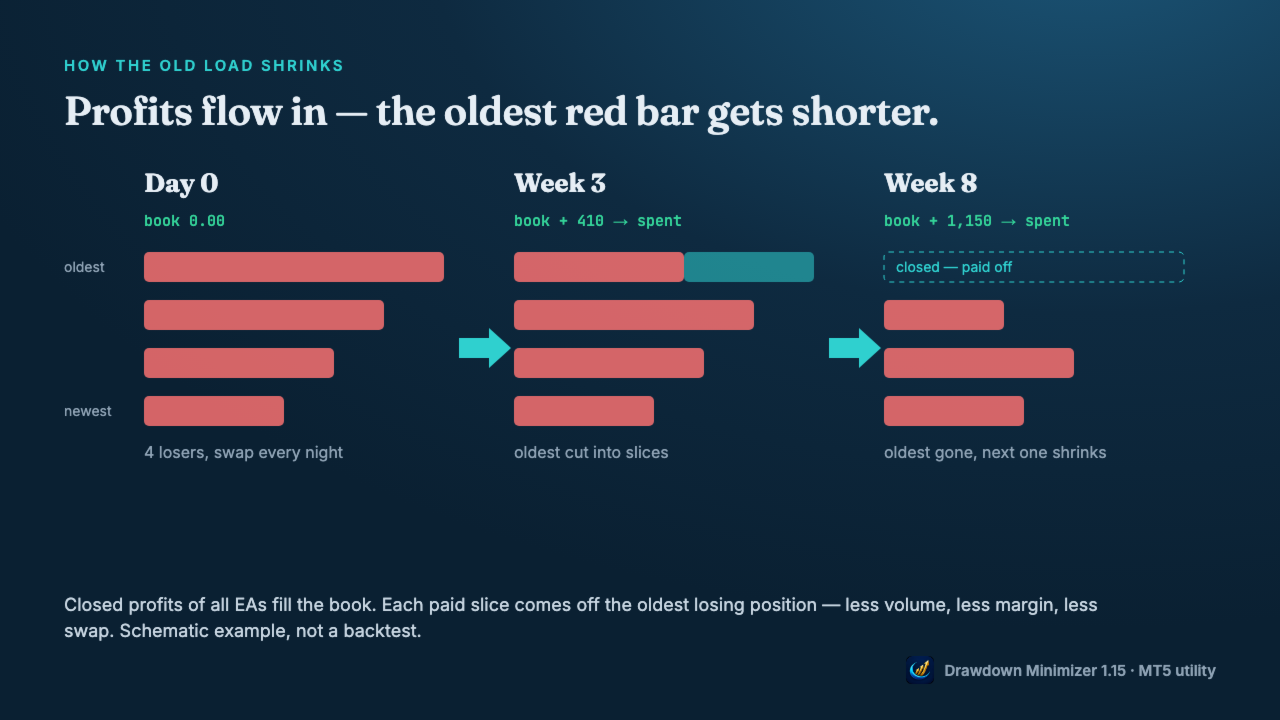
Every open lot ties up margin. A stuck basket holds its margin for as long as it is open, while the floating loss lowers the equity at the same time. Free margin is squeezed from both sides.
That matters in three ways:
- Less room for new levels. If the market keeps going, the grid EA wants to add more. Each new level needs margin that is shrinking.
- Less room for your other EAs. A breakout or index EA on the same account works with the free margin the old basket leaves over.
- The margin call level comes closer. Margin level = equity divided by used margin. A large open volume and a falling equity push it down together.
Cost 3: time
Time does not only add swap. The longer a basket stays open, the more market moves it has to survive: news, gaps over the weekend, a widened spread at rollover. An old basket is exposed to every one of them, for as long as it is open.
And there is a less visible cost. While the old positions sit there, the account keeps booking profits from other EAs, manual trades and the grid EA itself whenever a newer basket reaches its target. That money lands on the balance and simply sits there, while the old load keeps carrying the risk.
What you can check today
You do not need any tool for this, only the Trade tab:
- Look at the Swap column of the oldest positions of your grid EA. Compare it with their open time.
- Look at the Margin and Free margin in the account line. How much of the used margin belongs to positions older than a few weeks?
- Look at Margin level. Note it down and look again in a week.
- Ask yourself honestly: is the plan "wait" or is there a plan for the case that the market does not come back?
Where Drawdown Minimizer fits in
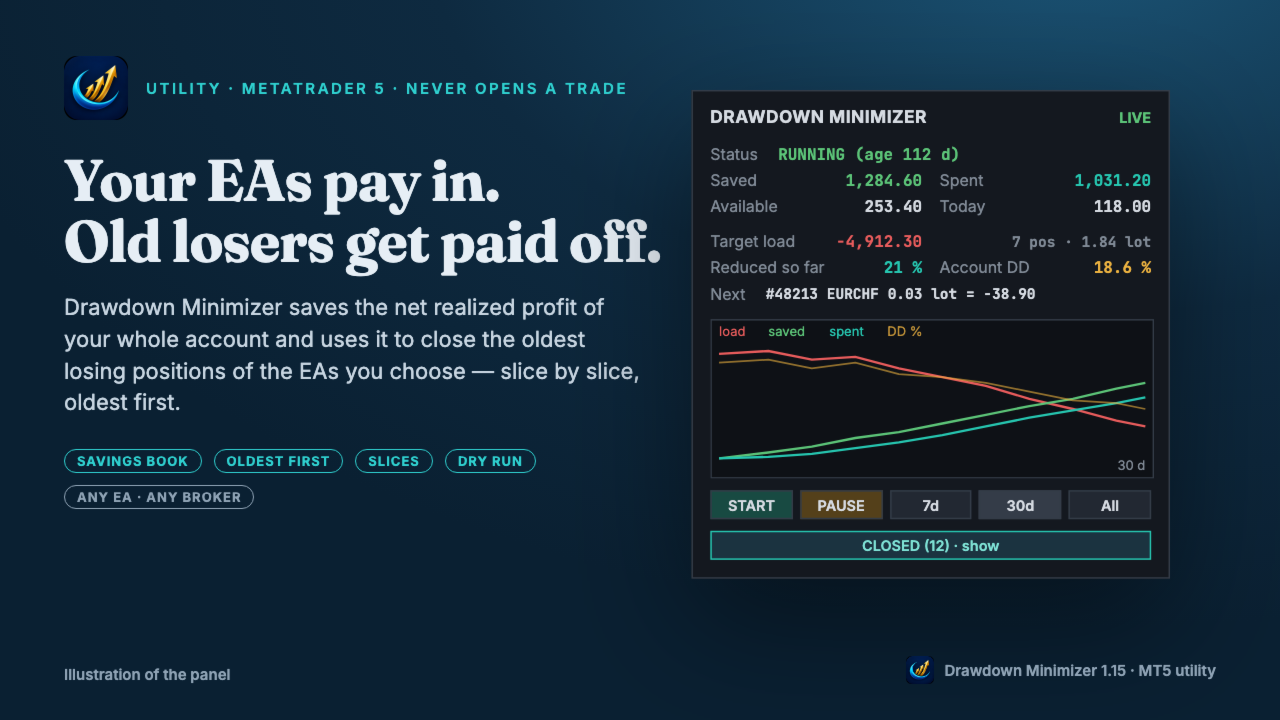
Drawdown Minimizer is a utility that runs next to your EAs and never opens a trade. It takes the net profit the account has already earned and uses it to close the oldest losing positions of the EAs you choose – slice by slice, oldest first.
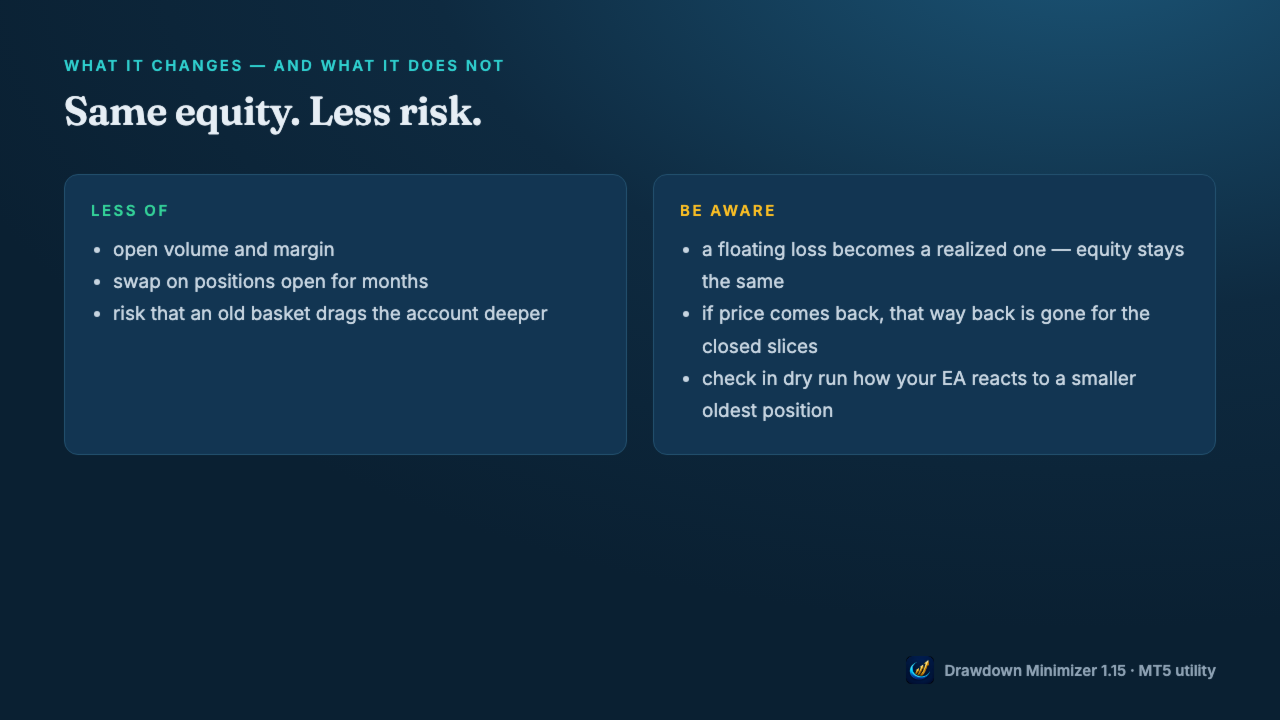
Be clear about what that does. Closing a loser with saved profit does not change your equity (apart from slippage): a floating loss becomes a realized one. What changes is the load: less open volume, less margin used, no more swap on the closed volume, and a smaller chance that an old basket drags the account deeper. The price: if the market would have come back, that way back is gone for the closed slices.
It does not predict the market and does not turn a loss into a profit. Check in dry run how your grid EA reacts when part of its oldest position is missing – some grid EAs size the next level from the open volume. Dry run is on by default.
The next part explains the savings book: where the money for each slice comes from, and why deposits, withdrawals, bonus and credit never count.
3-minute video: https://www.youtube.com/watch?v=0Mw6uRqK3K8
Complete guide with the video: https://www.mql5.com/en/blogs/post/778023
Drawdown Minimizer MT5: https://www.mql5.com/en/market/product/201728