What “Blocking New Trades” Actually Means in Drawdown Protection — COPYLATOR – MT5 Trade Copier

Product link:
https://www.mql5.com/en/ market/product/191385
Drawdown protection is usually described as a set of possible responses: block new copying, close open positions, and delete pending orders. The last two actions are visible and immediate—a position disappears or an order is removed. Blocking new trades is less visible, and because of that, it is often misunderstood.
“Blocking new trades” does not mean the copier stops working, loses its connection, or freezes the receiver account. It means that when a new signal or an eligible update arrives from the sender, the copier recognizes the record but does not execute the action while the drawdown block is active.
Understanding exactly which actions are blocked—and which are not—is essential when choosing a drawdown protection configuration.
What Is Blocked?
When the drawdown block is active, the copier can suppress the following categories of incoming actions:
- New market orders: If the sender opens a Buy or Sell position, the receiver does not open the corresponding position.
- New pending orders: If the sender places a Buy Limit, Sell Limit, Buy Stop, Sell Stop, or another supported pending order, the receiver does not place the corresponding order.
- Position modifications: Changes to stop loss, take profit, or other supported position parameters are not applied to the corresponding receiver position.
- Pending-order modifications: Changes to the entry price or protective levels of an existing pending order are not applied to the receiver's corresponding order.
The important distinction is that the copier remains operational. It can continue reading incoming records while deliberately suppressing actions covered by the drawdown block. This is an active risk-control decision, not necessarily a communication failure.
What Is Not Blocked?
This is where much of the confusion begins.
- Existing positions are not automatically closed: A position opened before the drawdown trigger can remain open. Closing positions is a separate protection action and depends on the configured settings.
- Existing pending orders are not automatically deleted: A pending order placed before the trigger may remain on the receiver account. It can still be activated by the broker if the market reaches its specified price.
- Position closures can still be copied: If the sender closes a position, the corresponding receiver position can also be closed. Blocking new exposure does not mean that all outgoing actions are suppressed.
- Manual trading is not disabled: The drawdown block controls copying from the sender. It does not freeze the receiver's trading account or prevent the account holder from placing manual trades.
Therefore, blocking new copying should not be confused with closing all exposure or making the receiver account completely inactive.
Why Does the Block Exist?
Blocking new copying is the basic response to a drawdown limit being reached. Its purpose is to prevent additional copied exposure from being introduced while the account is in a risk condition that the trader has chosen not to accept.
The trigger may result from one losing trade, a sequence of losses, correlated positions, or an adverse market movement. Whatever the cause, the block prevents eligible new copying actions from increasing exposure further.
However, it is important to understand its limitation: existing positions can continue to lose money, and existing pending orders can still be activated. Blocking new copying does not guarantee that the account's drawdown will stop increasing.
The Pending-Order Loophole
An existing pending order is one of the most important risks in a block-only configuration.
Imagine that the sender placed a Buy Limit order and the receiver copied it before the drawdown trigger. The receiver's broker is now holding that pending order. When the drawdown block activates, the copier may refuse to place additional pending orders, but the order already placed remains on the account unless pending-order deletion is enabled.
If the market reaches the order's entry price, the broker can activate it. A new receiver position is then opened even though the copier is blocking new copying actions.
This is not necessarily a failure of the block. The pending order was already accepted by the broker before the block became active. Removing existing pending orders is a separate protection action.
For traders who want to prevent previously copied pending orders from creating additional exposure after a trigger, enabling pending-order deletion is an important part of the configuration.
The Modification Gap
Suppressing modifications can also cause the sender's and receiver's positions to diverge.
Consider a sender position with a stop loss 50 pips from its entry. The receiver has copied that position. After the drawdown trigger, the block becomes active. The sender then moves the stop loss to break-even and later uses a trailing stop.
If those modifications are suppressed on the receiver, its position retains the previous stop-loss level. The sender and receiver are no longer managing the position in the same way.
If the market reverses, the sender's trailing stop may close the trade while the receiver's position remains open. The receiver may then experience a different result, potentially including a larger loss.
This illustrates an important trade-off: blocking modifications can prevent further changes from being copied, but it can also leave existing receiver positions with outdated protective levels.
When Is Block-Only the Right Choice?
Block-only protection can be appropriate when the trader deliberately wants to stop additional copied exposure while allowing existing positions to remain open.
- When the trader wants to avoid automatic liquidation: Closing positions at the trigger may realize losses that the trader would prefer to manage manually.
- When existing positions are close to their targets: The trader may decide that closing them immediately is not the preferred response, while accepting the possibility that the market could move against them.
- When manual intervention is planned: Some traders want copying to stop automatically but prefer to review and manage existing positions themselves.
These situations do not make block-only inherently safer. They represent a deliberate choice to retain existing market exposure after new copying has been blocked.
When Is Block-Only the Wrong Choice?
Block-only protection may be unsuitable in several circumstances:
- When existing positions are driving the drawdown: If open positions continue moving against the receiver, blocking new trades does not stop those losses from increasing.
- When margin pressure is already high: If the account is approaching the broker's margin call or stop-out level, leaving positions open may expose it to forced liquidation under the broker's rules.
- When nobody is monitoring the account: Existing positions and pending orders can remain active during the block. Without monitoring or an appropriate automated response, the account may continue accumulating risk.
Drawdown protection should be configured with the possibility of continued losses in mind. A block is not a substitute for managing existing positions, margin, or account exposure.
The Combination That Covers More Risks
For traders who want the strongest operational response when a drawdown limit is breached, the configuration can combine three actions:
- Block new copying: Prevent additional copied trades and supported modifications from being processed.
- Close open positions: Close existing copied exposure, subject to execution conditions.
- Delete pending orders: Remove existing pending orders so they cannot be activated later.
This combination is designed to leave the receiver without the copied positions and pending orders covered by the protection action.
There is an important trade-off. Closing positions realizes the result available at execution time, which may include a loss. Execution prices can differ because of slippage, gaps, liquidity, and broker conditions. The sender may subsequently recover, but the receiver will no longer participate in that recovery through the closed positions.
Even this configuration should not be treated as a guarantee of an exact maximum loss. Market execution and account conditions can affect the final result.
A More Selective Configuration
Some traders may prefer different responses for daily and total drawdown breaches.
For example, a trader might choose to:
- Block new copying when either drawdown limit is reached.
- Delete pending orders when the protection is triggered.
- Close open positions only when the total drawdown limit is breached.
Under this approach, a daily breach can leave existing positions open for further monitoring, while a total drawdown breach can trigger a more decisive response.
This is a configuration choice, not a universal rule. Whether it is appropriate depends on the strategy, account size, margin conditions, trading frequency, and the trader's tolerance for continued exposure.
The Visibility Problem
A receiver account under a drawdown block may look almost identical to an account where copying is still active.
Existing positions may remain visible. Pending orders may still appear. The absence of new trades does not necessarily indicate a connection problem or a stopped terminal.
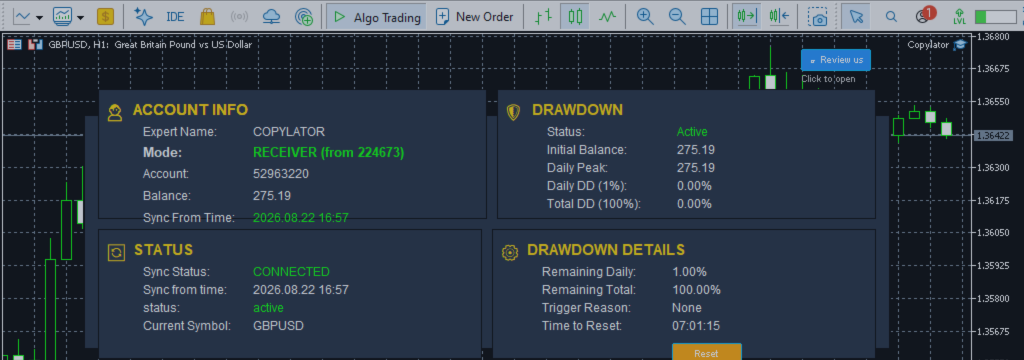
For this reason, traders should check the copier's drawdown status and dashboard rather than relying only on the positions displayed in the trading terminal.
The dashboard provides the relevant protection status. The terminal alone may not make it obvious that new copying actions are being suppressed.
What Happens When the Block Is Reset?
Copying can resume after the applicable reset process releases the drawdown block.
With automatic daily reset enabled, the daily drawdown status can reset at the configured hour and minute using broker server time. This daily reset does not automatically reset the total drawdown baseline.
A manual reset through the Drawdown Details section on the Receiver can reset the daily and total drawdown calculations and establish the current balance as the new initial balance.
However, resetting the protection status does not automatically repair the account's trading state.
- An existing position that remained open during the block may still be open after the reset.
- A pending order that was not deleted may still be active.
- A pending order that was filled during the block may have created a position that still requires attention.
- Any divergence between sender and receiver positions may remain.
A reset releases the copying restriction. It does not automatically close, synchronize, or otherwise resolve every position and order that existed during the blocked period.
Summary
Blocking new trades is a specific drawdown protection action. It prevents eligible new copying actions from being processed, including new market orders, new pending orders, and supported modifications to existing copied trades.
It does not automatically close existing positions, delete existing pending orders, or disable manual trading on the receiver account. Position closures from the sender can still be copied.
The distinction matters because existing exposure can continue to create risk after the block becomes active. Pending orders may still be filled, and suppressed modifications can cause receiver positions to diverge from the sender's positions.
Enabling position closure and pending-order deletion can address these gaps, although closing positions realizes the available result and does not guarantee a precise loss limit under all market conditions.
The right configuration depends on what the trader wants to happen after a drawdown breach: stop additional copied exposure, retain existing positions for manual management, or attempt to remove both open and pending exposure.
A block is a risk-control action—not a complete account shutdown. Understanding that difference is essential before relying on it.
Product link:
https://www.mql5.com/en/ market/product/191385