Most grid Expert Advisors see the market as a set of separate charts. Trident Pro is built differently: it trades three currencies rather than three pairs, and every decision it makes starts with one question: how much risk has already been taken in each of them? In this article I explain the ideas behind the EA and why it behaves the way it does.
Trident Pro is available for both platforms: MetaTrader 5 version and MetaTrader 4 version.
Why these three pairs
AUDCAD, NZDCAD and AUDNZD are made of three currencies: the Australian, New Zealand and Canadian dollars. These are currencies of countries with similar economies. All three depend on commodities and global demand, and they often react to news in the same direction.
Because of this, their cross rates behave more calmly than pairs with the US dollar or the yen. A strong move in one currency is partly offset by a similar move in the other, and price returns to its usual level more often than it runs into a long trend. The EA is built on this property: it waits until price has moved noticeably away from its channel and enters in the direction of the return.
There is a second reason. The three pairs form a closed triangle: the rate of any one of them is expressed through the other two. So positions in them cannot be judged separately, and the EA does not judge them separately.
A position is inventory, not a bet
A classic grid reasons simply: price went against us, so add more, and add bigger. Orders are placed at equal short intervals, volume grows fast, and the whole series ends up filled at the very start of the move.
Trident Pro looks at an open position the way a market maker looks at inventory: the larger it is, the more careful the next trade. Three rules follow from this.
- The step depends on the market. The distance between orders adapts to current volatility. It is smaller in a quiet market and larger in a turbulent one.
- Each next step is wider. The series is spread over a large distance, and the last orders are opened only when price has gone really far.
- Volume grows slowly. The depth of the series comes from the step, not from a sharp increase in lot size.
Every order has its own take profit, so the inventory shrinks on each pullback, not only at the end. When price returns to the calculated level, the whole series is closed.
Count currencies, not pairs
Imagine the EA has bought AUDCAD and bought NZDCAD. On screen these are two different trades in two different pairs. In reality it is one and the same bet against the Canadian dollar, made twice. If the Canadian dollar strengthens sharply, both positions go into drawdown at once.
It is exactly these overlaps that give multi-currency EAs their deepest drawdowns. So before every order Trident Pro adds up all open positions and checks how much of each currency is bought or sold in total: AUD, NZD and CAD. If a new order would push the position in a currency above the limit, it is reduced or skipped. If an order reduces the position, there are no restrictions.
A second safeguard watches the account as a whole. The EA does not open new orders if margin would take up too large a share of equity. Neither limit closes anything: they simply do not let the EA add where adding is no longer wise.
Knowing how to wait
A large part of the EA’s work is not opening an order. It has several reasons to wait.
- Confirmation before adding. An averaging order is opened no more than once per bar, and only after a bar that closed in the direction of the position. The EA does not catch a falling price; it waits until the move starts to run out of steam. This removes the worst scenario, when the whole series is filled within an hour on news.
- Spread and time of day. Orders are not opened when the spread is wide. Starting entries during the Asian session can be switched off, so that a series does not begin in a thin market.
- Protecting profit. While the series consists of one order, a trailing stop protects its profit. If the bounce turns out to be short, the EA takes what it has managed to get, and the trade does not turn into a series.
- Re-entry only on better terms. After a trailing exit the EA does not go straight back into the market. A new entry is possible only at a price better than the exit price, and after a new confirmation.
The common idea is simple: the EA does not have to be in the market all the time. A missed trade costs nothing, while an unnecessary one is expensive.
What the trader sees
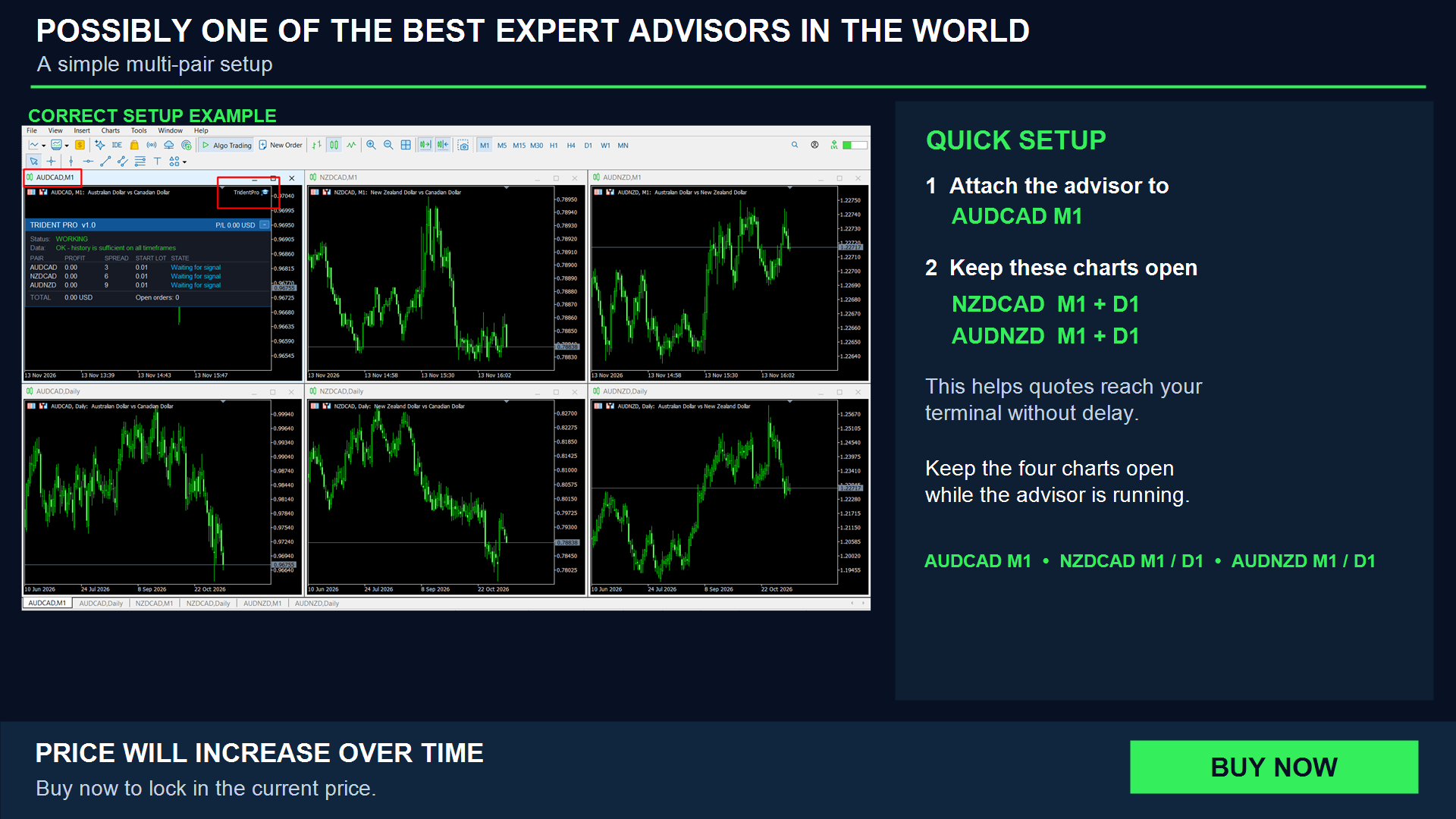
An EA that often waits must explain what it is waiting for. Otherwise a pause looks like a malfunction. That is why the Trident Pro panel shows the current state of each pair: waiting for a signal, an open series with the number of orders, a pause for the Asian session, a spread that is too wide. If an order is postponed, the reason is shown there as well: no confirming bar, the currency limit or the deposit load limit has been reached.
All key decisions are available in the settings. You can change the lot size, the step and its expansion, the number of orders in a series, both risk limits and the trailing parameters. The EA is attached to one chart and manages all three pairs by itself, in both the MT5 and MT4 versions.
If the philosophy of Trident Pro had to fit into one sentence, it would be this: first count how much risk has already been taken, and only then decide whether to take more.
Get Trident Pro
- MetaTrader 5: https://www.mql5.com/en/market/product/207953
- MetaTrader 4: https://www.mql5.com/en/market/product/207974
Subscribe to my channel so you do not miss updates and new articles: https://www.mql5.com/en/channels/algotrader