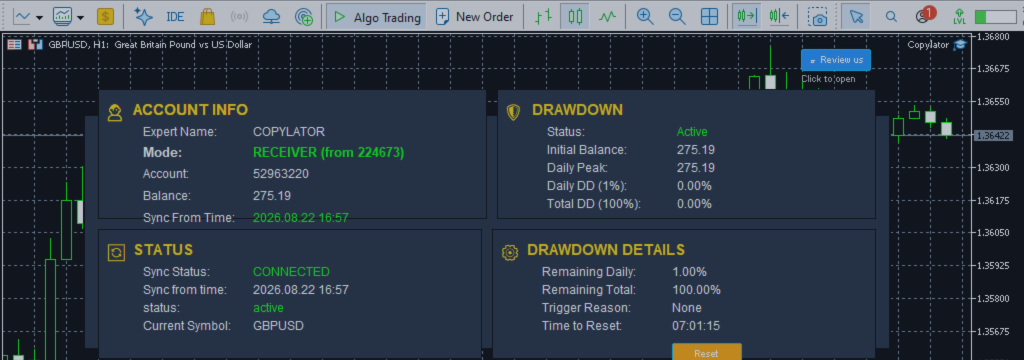
MT5 Trade Copier: Reverse Mode in Trade Copiers – Practical Applications and Strategies

Product link:
https://www.mql5.com/en/ market/product/191385
Reverse Mode is one of the most useful and frequently misunderstood features available in an MT5 Trade Copier. Its basic function is simple: it changes the direction of copied trades. A Buy from the Sender can become a Sell on the Receiver, while a Sell can become a Buy.
However, the practical use of Reverse Mode goes beyond simply switching Buy and Sell. When correctly configured, it can be used in different copy-trading structures, including directional inversion, portfolio offsetting, alternative strategy implementation, and multi-account configurations.
At the same time, Reverse Mode should not be treated as an automatic method for turning an unsuccessful strategy into a profitable one. Reversing a trade also changes the position's relationship with spread, execution, Stop Loss, Take Profit, market conditions, and account-specific trading rules.
1. What Does Reverse Mode Actually Do?
When Reverse Mode is enabled on a Receiver, the Receiver interprets the direction of the Sender's trade in the opposite direction.
| Sender | Receiver with Reverse Mode |
|---|---|
| Buy | Sell |
| Sell | Buy |
The Sender itself is not changed. Its original position remains exactly as it was.
The transformation happens on the Receiver side, before the Receiver executes the copied trade.
Sender | | Buy 1.00 lot v Receiver | | Reverse Mode = ON v Sell 1.00 lot
This distinction is important because Reverse Mode is a Receiver-side execution setting, not a modification to the Sender's strategy.
2. Why Reverse Mode Must Be Configured on the Receiver
A single Sender can be connected to multiple Receivers, and each Receiver may have a completely different objective.
For example:
- Receiver A may copy trades normally.
- Receiver B may use Reverse Mode.
- Receiver C may copy only Buy trades.
- Receiver D may use a fixed lot size.
If Reverse Mode were imposed by the Sender, all connected accounts would be forced to use the same direction. Receiver-side Reverse Mode avoids that limitation.
3. Reverse Mode and Stop Loss / Take Profit
Simply changing Buy to Sell is not enough.
The protective levels must also be interpreted correctly.
Consider a normal Buy trade:
             Take Profit
                  ↑
                  |
              Entry Price
                  |
                  ↓
              Stop Loss
After reversing the trade to Sell, the directional relationship changes:
Stop Loss ↑ | Entry Price | ↓ Take Profit
A properly designed copier must therefore handle the SL/TP transformation together with the direction change.
COPYLATOR supports Reverse Trade Mode with automatic adjustment of the associated SL/TP logic for the reversed trade, subject to the trading conditions and account type.
4. Why Correct SL/TP Reversal Matters
Suppose the Sender opens:
Buy
Entry = 100.00
SL    = 99.00
TP    = 102.00
If the Receiver reverses the position, simply copying those numerical prices would not create the equivalent opposite-direction structure.
The Receiver instead needs the reversed relationship:
Sell Entry = 100.00 SL = above entry TP = below entry
This is one of the most important technical differences between a simple Buy/Sell switch and a properly implemented Reverse Mode.
5. What Reverse Mode Does Not Do
Reverse Mode has a specific purpose. It changes trade direction. It does not automatically improve the underlying strategy.
It does not:
- Improve a poor entry automatically
- Remove spread costs
- Remove commissions
- Eliminate slippage
- Correct poor risk management
- Guarantee profitability
- Predict future market direction
- Fix inappropriate Stop Loss placement
- Make a losing strategy automatically profitable
If the original strategy loses because of excessive trading costs, poor timing, inappropriate position sizing, or unfavorable execution conditions, reversing the direction does not necessarily solve those problems.
6. Reverse Mode as an Alternative Directional Configuration
One practical use of Reverse Mode is to allow a Receiver to follow the timing and instruments of a Sender while taking the opposite directional position.
For example:
Sender:
EURUSD Buy

Receiver:
EURUSD Sell
This can be useful when the Receiver has a deliberately different directional approach but wants to use the Sender's trade events as the source of execution timing.
However, this should be treated as a separate trading approach rather than assuming that every losing Sender trade will become a profitable Receiver trade when reversed.
7. Reverse Mode for Portfolio Offsetting
Reverse Mode can also be used as part of a broader portfolio structure.
For example, a trader may already have long exposure to a particular symbol and may use a Receiver configured to take opposite-direction trades from a Sender.
Existing Exposure | | Long v Portfolio Receiver | | Reverse Mode v Short Exposure
The resulting positions may offset some directional exposure, depending on their size, timing, instrument, and correlation.
However, this should not automatically be described as a perfect hedge. Different entry prices, position sizes, instruments, spreads, and execution times can create residual risk.
8. Reverse Mode in Multi-Sender / Multi-Receiver Systems
Reverse Mode becomes especially interesting in a multi-account environment.
Consider a structure where several Senders provide trading events:
Sender A -------- Receiver
Sender B -------- Receiver
Sender C -------- Receiver
The Receiver configuration can determine how each source is handled according to the available copier architecture and account configuration.
Where separate Receiver instances are used, one can operate normally while another uses Reverse Mode.
This allows different MT5 accounts to implement different directional interpretations without changing the original Sender account.
9. Reverse Mode with Pending Orders
Pending orders require additional care because their price relationships are directional.
The common MT5 pending order types include:
- Buy Limit
- Sell Limit
- Buy Stop
- Sell Stop
When direction is reversed, the corresponding pending-order type and its price relationship must be handled correctly.
| Sender | Reversed Direction |
|---|---|
| Buy Limit | Sell Limit |
| Sell Limit | Buy Limit |
| Buy Stop | Sell Stop |
| Sell Stop | Buy Stop |
The Receiver must also consider its own market price, symbol specifications, and broker restrictions when processing the reversed pending order.
10. Why Pending Orders Cannot Always Be Copied Numerically
A pending order's validity depends on its relationship to the current market and the broker's trading rules.
When a pending order is reversed, the Receiver cannot simply assume that every numerical parameter can be copied unchanged.
The Receiver may need to consider:
- Current Bid and Ask
- Pending order type
- Entry price
- Stop Loss
- Take Profit
- Stop Level
- Freeze Level
- Symbol digits
- Broker trading restrictions
This is particularly important when the Sender and Receiver use different brokers.
11. Reverse Mode on Hedging Accounts
Hedging accounts allow multiple positions on the same symbol, including positions in opposite directions.
For example:
EURUSD Buy 1.00 lot Sell 1.00 lot
These positions can coexist independently.
This makes a Hedging account particularly suitable for configurations where independent reversed trades need to exist alongside other positions.
COPYLATOR detects the account type and applies the applicable synchronization behavior.
12. Reverse Mode on Netting Accounts
Netting accounts operate differently. Generally, only one net position per symbol is maintained.
As a result, opening an opposite-direction trade can affect the existing net position rather than creating a completely independent opposite ticket.
For example, if a Netting account already has:
EURUSD Buy 1.00 lot
and a reversed copied event attempts to create:
EURUSD Sell 1.00 lot
the result may be a reduction or closure of the existing net position rather than a separate Sell position.
This behavior is fundamental to the Netting account model and should be tested carefully before live deployment.
13. Reverse Mode and Partial Close
Partial closes are another important consideration.
Suppose a reversed Receiver position is:
Sell 1.00 lot
If the Sender partially closes 0.40 lot, the Receiver must process the corresponding volume reduction correctly.
Original Receiver Position = 1.00 lot Partial Close = 0.40 lot Remaining = 0.60 lot
COPYLATOR includes Partial Close Support, allowing copied positions to be reduced while keeping the remaining position open.
This is particularly important for strategies that take partial profits or reduce exposure during an active trade.
14. Reverse Mode and Real-Time SL/TP Changes
A trade's Stop Loss and Take Profit can change after the position is opened.
For example, the Sender may:
- Move the Stop Loss to breakeven
- Move the Take Profit
- Add an SL after opening
- Add a TP after opening
- Partially close the position
When Reverse Mode is active, the Receiver must process these events using the reversed directional relationship.
COPYLATOR supports real-time SL/TP synchronization, including modifications made after the original position has been opened, subject to the applicable account-type limitations.
15. Reverse Mode and Broker Restrictions
The Receiver broker remains responsible for accepting the final trading request.
A reversed trade may therefore encounter the Receiver broker's own:
- Stop Level
- Freeze Level
- Minimum volume
- Maximum volume
- Volume step
- Trading-session restrictions
- Symbol-specific requirements
This is another reason why Reverse Mode should be tested on the actual Receiver broker rather than assuming that Sender and Receiver conditions are identical.
16. Reverse Mode and Lot Management
Changing direction does not automatically determine the appropriate position size.
COPYLATOR can combine Reverse Mode with its available lot-management methods, depending on the configuration.
These include:
- Fixed Lot Size
- Lot Multiplier
- Balance-Ratio Scaling
- Maximum Lot Cap
For example:
Sender:
Buy 1.00 lot

Receiver:
Reverse Mode = ON
Balance Ratio = configured

Result:
Sell with Receiver-calculated volume
The final monetary risk can still differ from the Sender because account balance, Stop Loss distance, leverage, symbol specifications, and execution conditions may differ.
17. Reverse Mode and Drawdown Protection
Drawdown protection remains a Receiver-side risk-management mechanism.
If the Receiver reaches its configured daily or total drawdown threshold, copying can be blocked according to the configured protection settings.
Depending on the configuration, COPYLATOR can also close COPYLATOR-opened positions and delete COPYLATOR pending orders when the applicable drawdown protection action is enabled.
This means Reverse Mode does not bypass the Receiver's risk controls.
18. Reverse Mode Is Not a Guaranteed Strategy-Reversal System
It is tempting to think that:
Sender loses → Reverse Receiver wins
But actual trading results do not work that simply.
Suppose a Sender loses because of:
- Late entries
- Wide spreads
- Slippage
- Poor Stop Loss placement
- Overtrading
- Large transaction costs
- Unfavorable market regime
Reversing the direction does not automatically remove these problems.
For example, if an entry is consistently too late, the reversed trade is also being opened at the same late moment. The directional change does not correct the timing problem.
19. Historical Performance Requires Caution
A trader may observe that a particular Sender performed poorly over a historical period and conclude that Reverse Mode should therefore be profitable.
That conclusion is not guaranteed.
A strategy's behavior can change as:
- Market conditions change
- Volatility changes
- The strategy parameters change
- Trading frequency changes
- Transaction costs change
- The Sender changes its methodology
Historical performance should therefore be treated as historical evidence, not as a guarantee of future results.
20. Practical Reverse Mode Testing
Before using Reverse Mode with real funds, a structured demo test can provide useful information.
- Select the exact Sender that will be copied.
- Set up a separate Receiver in Reverse Mode.
- Confirm that Buy trades become Sell trades.
- Confirm that Sell trades become Buy trades.
- Verify the reversed SL and TP relationships.
- Test market orders.
- Test pending orders.
- Test SL/TP modifications.
- Test partial closes.
- Test complete closures.
- Test the configuration on the intended Hedging or Netting account type.
- Check MT5 trading logs for rejected requests.
- Review the resulting volume and risk configuration.
21. A Practical Example
Consider the following Sender trade:
| Parameter | Sender |
|---|---|
| Symbol | EURUSD |
| Direction | Buy |
| Volume | 1.00 lot |
| SL | Below entry |
| TP | Above entry |
With Reverse Mode enabled on the Receiver, the intended directional transformation is:
| Parameter | Receiver |
|---|---|
| Symbol | Mapped Receiver symbol |
| Direction | Sell |
| Volume | Calculated according to Receiver settings |
| SL | Above entry |
| TP | Below entry |
This illustrates an important point: Reverse Mode changes the direction, but the Receiver's own configuration still determines the final volume and applicable trading controls.
22. Reverse Mode with Multi-Account Trading
For users managing multiple MT5 accounts, Reverse Mode can provide another layer of configuration flexibility.
                  Sender
                    |
          +---------+---------+
          |         |         |
          v         v         v
       Receiver  Receiver  Receiver
          A         B         C
          |         |         |
       Normal    Reverse   Buy Only
Each account can therefore have a different execution configuration while receiving information from the same source architecture.
23. Common Reverse Mode Mistakes
Mistake 1: Enabling Reverse Mode on the Sender
Reverse Mode is intended as a Receiver-side execution transformation. Changing the Sender's role does not create a universal reverse configuration for every Receiver.
Mistake 2: Checking Only the Direction
It is not enough to verify that Buy became Sell. The SL, TP, pending-order logic, volume, and account-type behavior must also be tested.
Mistake 3: Ignoring Hedging vs. Netting
The same reversed signal can have very different consequences on a Hedging account compared with a Netting account.
Mistake 4: Assuming Reversal Guarantees the Opposite Result
A reversed position is not mathematically guaranteed to produce the exact opposite financial result because execution costs, spreads, slippage, timing, and other factors affect the outcome.
Mistake 5: Using Historical Losses as a Guaranteed Reversal Signal
A strategy's historical losing period does not establish that reversing it will produce future profits.
24. Best Practices
- Use Reverse Mode deliberately rather than automatically.
- Configure Reverse Mode on the Receiver.
- Test both Buy-to-Sell and Sell-to-Buy transformations.
- Verify SL and TP after every type of reversal.
- Test pending orders separately.
- Test partial closes and volume changes.
- Understand the difference between Hedging and Netting accounts.
- Review the Receiver's lot-sizing configuration.
- Use a maximum lot cap where appropriate.
- Configure Receiver-side drawdown protection.
- Monitor MT5 trading-server messages.
- Run a meaningful demo test before live deployment.
25. Reverse Mode Configuration Checklist
| Item | What to Verify |
|---|---|
| Mode | Receiver mode is correctly configured |
| Reverse Mode | Enabled on the intended Receiver |
| Buy → Sell | Correctly reversed |
| Sell → Buy | Correctly reversed |
| SL | Correct directional relationship |
| TP | Correct directional relationship |
| Pending Orders | Tested independently |
| Partial Close | Remaining volume synchronized correctly |
| Lot Management | Receiver volume rules verified |
| Account Type | Hedging or Netting confirmed |
| Drawdown Protection | Configured independently on Receiver |
| Broker Rules | Stop Level and other restrictions tested |
Conclusion
Reverse Mode is more than a simple Buy/Sell switch. In an MT5 Trade Copier, it is a Receiver-side mechanism that changes the directional interpretation of copied trades while requiring the associated SL/TP, pending-order, volume, and account-type behavior to be handled correctly.
COPYLATOR supports Reverse Trade Mode together with features such as real-time SL/TP synchronization, partial close support, flexible lot management, symbol mapping, drawdown protection, and multi-account configurations.
Reverse Mode can be useful in deliberately designed copy-trading structures, including alternative directional execution and portfolio exposure management. However, it should not be treated as a guaranteed method for converting losses into profits.
The most reliable approach is to understand exactly what is being reversed, test the complete trade lifecycle on the intended Receiver account, and verify that the resulting position size, protective levels, broker restrictions, and risk controls all behave as expected.
Product link:
https://www.mql5.com/en/ market/product/191385