MSX AI Multi Symbol Scalper — Understanding the 12-Symbol Strategy Tester Analysis Series

Why Individual Symbol Reports Are Published and How to Interpret Them Correctly
The 12-Symbol Strategy Tester Analysis Series was created to provide a transparent way for visitors to study the historical behavior of MSX AI Multi Symbol Scalper across different supported markets.
The series is based on an important characteristic of the MetaTrader 5 Strategy Tester:
A published test is performed for the selected symbol and configured test environment.
The complete MSX AI Multi Symbol Scalper architecture, however, is designed for flexible single-EA, multi-EA and multi-symbol portfolio deployment.
This difference should be understood before interpreting the published results.
1. Why Test Symbols Individually?
A complete multi-symbol portfolio environment cannot be represented simply by adding together individual symbol Strategy Tester reports.
Therefore, this series studies selected symbols separately.
Each report documents relevant information such as:
- Symbol
- Timeframe
- Test period
- EA version
- Input configuration
- Tester conditions
- Historical statistics
- Relevant screenshots
This allows visitors to examine the documented behavior of each market independently.
2. One EA Instance Per Symbol in the Reference Series
The current reference series uses:
One independently configured EA instance per symbol
with:
Trade Both Side = BUY + SELL
Therefore, each published symbol report represents the Both-Side configuration for that individual symbol.
It does not represent separate BUY-ONLY and SELL-ONLY engines running simultaneously for that symbol.
The EA architecture also supports:
- Trade Both Side
- Trade Only Buy
- Trade Only Sell
Therefore, users can select the deployment structure according to their own requirements.
3. What the Individual Reports Can Demonstrate
The individual reports allow visitors to study:
- EA version and configuration
- Selected symbol and timeframe
- Historical test period
- Strategy Tester conditions
- Trading inputs
- Risk configuration
- Per-EA capital allocation settings
- Free Margin Reserve settings
- Projected Margin Level requirements
- Adaptive lot-reduction behavior
- Partial Profit configuration
- Trade statistics
- Drawdown statistics
- Profit Factor and other tester metrics
- BUY/SELL activity
- Historical equity or balance behavior
- Execution assumptions
The objective is to provide a documented historical reference that visitors can independently examine and reproduce.
4. What an Individual Symbol Test Cannot Demonstrate
A single-symbol Strategy Tester report does not reproduce the complete operating environment of a larger multi-symbol portfolio.
For example, it does not fully reproduce:
- Simultaneous positions across multiple symbols
- Multiple independent EA instances competing for account resources
- Dynamic Free Margin interaction between EA instances
- The complete multi-symbol capital-allocation environment
- Portfolio-level account resource interaction
- Complete account-level protection interaction across a live multi-EA deployment
- The combined performance of multiple symbols
Therefore:
Individual Symbol Result ≠ Complete Portfolio Result
This distinction is fundamental when reading the series.
5. Understanding Per-EA Capital Allocation
One important point is that Per-EA Capital Allocation should not be interpreted as a permanent cash amount assigned to each EA instance.
It operates as part of the EA's dynamic margin-management framework.
In risk-based operation, the general sequence is:
Current Account Equity → Initial Risk-Based Lot
while available account resources are evaluated through:
Current Free Margin → Free Margin Reserve → Per-EA Margin Budget
The resulting position size is then checked against the current trading conditions, including:
- Required margin
- Available margin budget
- Projected margin level
- Broker volume constraints
- Maximum permitted adaptive lot reduction
If the initial calculated lot cannot satisfy the configured margin conditions, the EA can progressively reduce the lot until a valid volume is found or the trade is rejected.
Therefore, the configured Per-EA percentage is a dynamic margin-budget constraint, not a separate cash account.
6. Understanding Partial Profit and Margin Recycling
The portfolio architecture also includes Multi-Stage Partial Profit Management.
When an open position reaches its configured Partial Profit Trigger, the EA can close a portion of the current position volume while continuing to manage the remaining position.
Reducing the open position volume can reduce the margin occupied by that position.
This can make previously occupied margin available again within the trading account.
Consequently, another EA instance may subsequently be able to use the available margin when its own:
- Trading setup is valid
- Entry conditions are satisfied
- Margin requirements are satisfied
- Capital-allocation conditions are satisfied
- Other execution and protection conditions permit the trade
The operating concept can therefore be represented as:
Valid Setup → Margin Check → Position Opened → Partial Profit Event → Partial Volume Reduced → Margin Released → Another Valid Setup May Use Available Margin
This is why a simple calculation such as:
100% ÷ Per-EA Allocation %
should not automatically be interpreted as the maximum number of EA instances that can participate in the portfolio.
Actual participation depends on the dynamic account state, open positions, margin requirements, partial-profit events, broker conditions and configured protection rules.
If sufficient margin is temporarily unavailable, the EA does not need to force an entry. The normal entry and margin conditions remain applicable.
7. Why the Same EA May Behave Differently Across Symbols
Different markets have different trading characteristics.
Historical behavior can vary because of factors such as:
- Volatility
- Spread
- Liquidity
- Contract specifications
- Trading sessions
- Market structure
- Historical price movement
- Broker data
- Execution assumptions
Therefore, the historical statistics of one symbol should not automatically be assumed to apply to another symbol.
Each published report should be considered in the context of its own symbol, timeframe, period and configuration.
8. The Reports Are Historical Strategy Tester Studies
Every report in this series should be understood as:
Historical Strategy Tester Analysis
The reports are not:
- Live account statements
- Broker account records
- Guaranteed future results
- Predictions
- Complete portfolio performance reports
Actual trading results can differ because of execution conditions, spread, commission, slippage, liquidity, broker specifications, account conditions and future market behavior.
9. Reproducing the Published Tests
Visitors can study the documented settings and screenshots accompanying each report.
They can then reproduce the test using:
Option A — Manual Configuration
Enter the documented EA inputs manually in the MetaTrader 5 Strategy Tester.
Option B — Default .SET File
Request the corresponding Default .SET file through MQL5 Private Chat.
The Default .SET files are provided free of charge.
This allows interested users to reproduce the documented configuration in their own MT5 environment.
10. The 12-Symbol Reference Set
The series is organized around a planned reference set of 12 supported symbols/assets.
The number 12 refers to the scope of this documentation series.
It is not a hard-coded 12-symbol limitation of the EA.
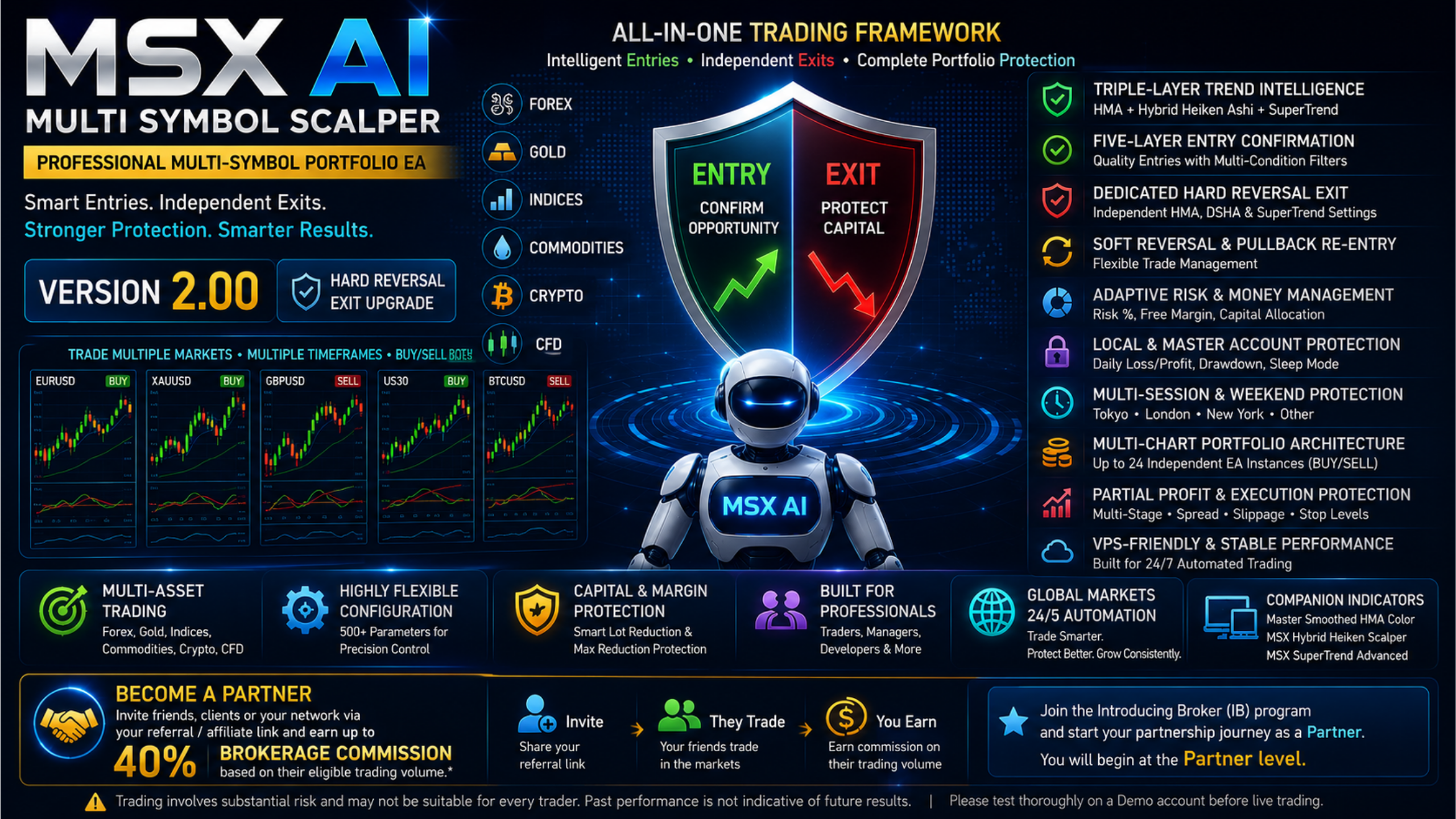
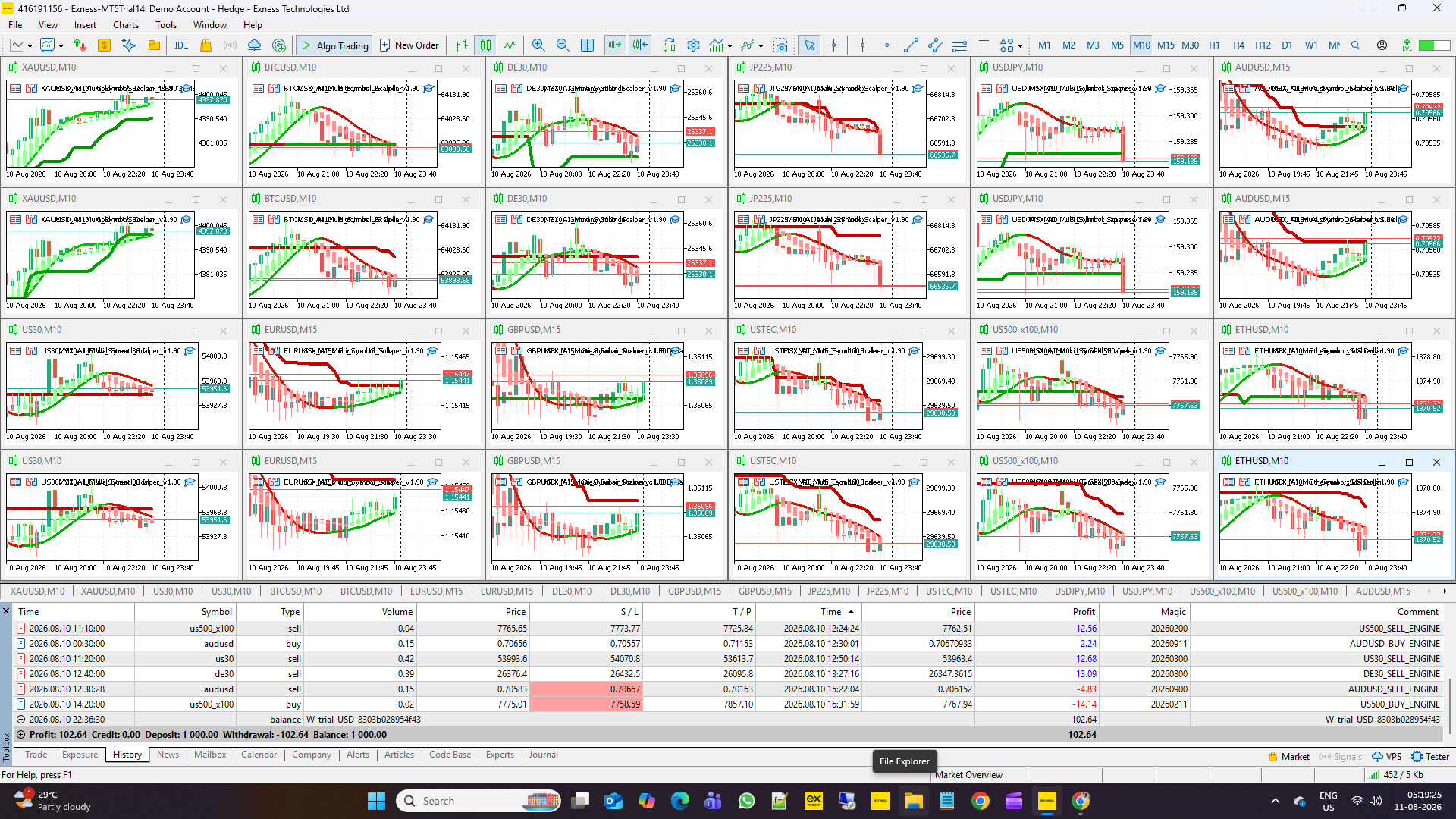
MSX AI Multi Symbol Scalper can be deployed as:
Single EA
Multiple EA Instances
Multi-Symbol Portfolio
according to the user's trading environment, account resources, broker conditions and configuration.
The practical number of simultaneously active EA instances depends on factors such as:
- Available account resources
- Free Margin
- Free Margin Reserve
- Per-EA Capital Allocation
- Maximum Tradable Equity settings
- Projected Margin Level requirements
- Position volume
- Number of symbols
- Broker specifications
- VPS/MT5 terminal resources
11. Current Published Reports
The 12-Symbol Strategy Tester Analysis Series is being developed progressively.
Current published reports include:
BTCUSD — Strategy Tester Analysis
XAUUSD — Strategy Tester Analysis
USDJPY — Strategy Tester Analysis
Additional symbol reports will be added as the series develops.
The Master Series index provides the central navigation point for the complete collection.
12. Why This Documentation Approach Matters
The purpose of this series is not to present one isolated tester number as a complete representation of the EA.
Instead, each report provides a documented view of:
Configuration → Historical Test → Statistics → Reproduction → Further Evaluation
Visitors can therefore examine individual markets independently while also understanding that the EA is designed for a broader multi-symbol portfolio architecture.
Conclusion
The 12-Symbol Strategy Tester Analysis Series provides symbol-by-symbol historical documentation of selected MSX AI Multi Symbol Scalper configurations.
Each report should be read as an individual historical research document, not as a substitute for complete multi-symbol portfolio testing.
The broader MSX AI Multi Symbol Scalper architecture supports flexible deployment through:
Single-EA
Multi-EA
Multi-Symbol
Trade Both Side
Trade Only Buy
Trade Only Sell
Same Time Frame for all charts or Different-different mt5 standard Time Frame for every chart/symbol/assets ie. M1 to MN range
with dynamic account-resource and margin management.
The key point is that Per-EA Capital Allocation is a dynamic margin-management constraint rather than a permanent cash compartment, while Partial Profit Management can reduce open volume and potentially release margin for subsequent eligible trading activity elsewhere in the account.
The individual reports therefore provide documented market-by-market evidence for study and reproduction, while actual portfolio behavior must be evaluated at the portfolio level.
Master Series
MSX AI Multi Symbol Scalper — 12-Symbol Strategy Tester Analysis Series
#MSXAI
#StrategyTester
#BacktestAnalysis
#MultiSymbolTrading
#TradingSystemAnalysis
#MT5EA
#MetaTrader5
#AlgorithmicTrading
#PortfolioTrading
#EAResearch