How to Avoid FOMO in Trading: A Beginner’s Guide to Stop Chasing Price

Fear of missing out (FOMO) can turn normal market movement into a personal emergency. A candle accelerates, a breakout appears to be working, traders post screenshots of profits, and suddenly it feels as if you must enter immediately. For beginners, this is one of the fastest ways to take trades that were never part of the original plan.
The goal is not to catch every move. The goal is to execute a repeatable trading process where risk is known before entry. A missed opportunity may feel frustrating, but repeatedly entering late with poor risk-to-reward can damage both an account and confidence.
This article explains why FOMO happens, how it changes the quality of a trade, and how to build practical rules that help you wait for valid entries. Treat this as educational material, test rules on a demo account first, and use risk appropriate for your situation.
What Is FOMO in Trading?
FOMO is the fear that a profitable market move will happen without you. In trading, it often appears when price begins moving quickly and you believe that entering late is better than being left out.
FOMO does not always look dramatic. It can show up as a small rule violation:
- Buying after price has already moved far above the planned entry zone.
- Selling after a large bearish candle has already reached nearby support.
- Moving a stop-loss farther away because the original stop looks too large after a late entry.
- Increasing lot size to “make up” for a move that was missed.
- Entering because a social-media post, signal group, or screenshot created urgency.
- Taking a trade that does not meet your written setup rules.
FOMO is not solved by predicting markets better. It is managed by creating a process that makes impulsive entries harder to take.
Why Chasing Price Changes the Trade
A trade is not just a direction. It is a complete structure: entry, invalidation level, stop-loss distance, target, position size, and reason for taking the trade. When price has already moved away from your planned entry, that structure changes.
For example, imagine you planned to buy EURUSD from a pullback zone near 1.0800, with a stop-loss at 1.0780 and a target at 1.0840. The planned risk is 20 pips and the potential reward is 40 pips, giving a 1:2 risk-to-reward ratio.
Now imagine price rallies directly to 1.0832 before you enter. If you buy there:
- The original stop at 1.0780 is now 52 pips away.
- The original target at 1.0840 is only 8 pips away.
- The planned 1:2 risk-to-reward structure is gone.
- Nearby resistance may limit further upside.
- You may feel pressured to widen the target or tighten the stop without a tested reason.
The late entry is therefore not the original trade. It is a new setup with different probabilities, different risk, and different market context. Unless you have separately tested that kind of momentum entry, it is usually better to let it go.
The Core Principle: Missing a Trade Is Not the Same as Losing
Beginners often treat a missed move as a loss because they imagine the profit they could have made. But no money was lost simply because you did not participate. The market will provide more opportunities, while a poor late entry can create a real financial loss.
A useful mindset is this: your job is to take qualified trades, not every profitable move. You can execute your plan correctly and still miss a strong trend. You can also enter every exciting move and still lose money because the entries were late and poorly structured.
Professional consistency comes from accepting that many valid-looking moves will occur without you. Your edge is not participation. Your edge is selective, disciplined execution.
Build an Entry Plan Before Price Moves
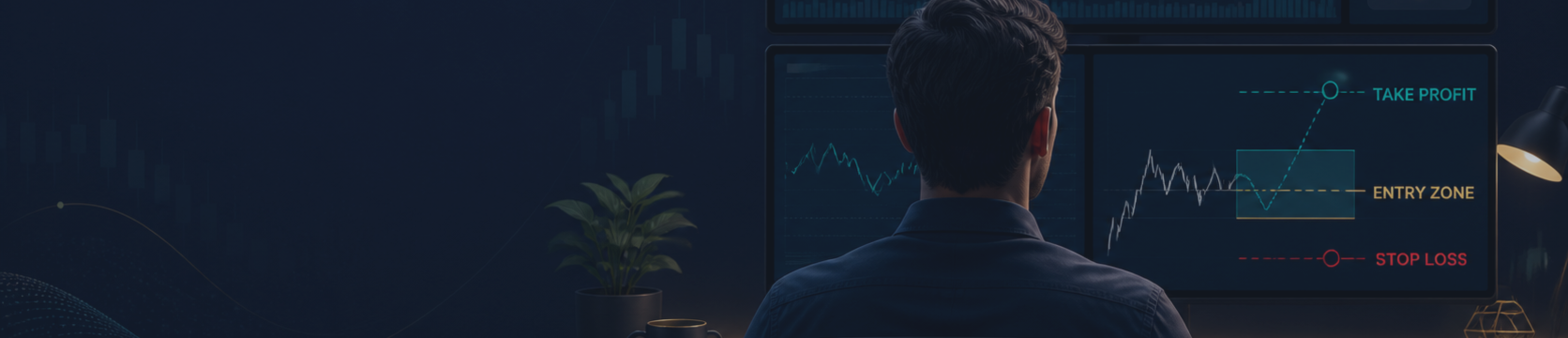
The best time to make trading decisions is before the market reaches your level, not while candles are moving quickly. Before entering any trade, define the following items.
1. Entry Zone
An entry zone is the price area where your strategy allows a trade. It may be based on a support or resistance level, moving average, Fibonacci retracement, breakout retest, supply and demand area, indicator signal, or another tested method.
A zone is usually more realistic than one exact price because spreads, volatility, and fast market conditions can prevent perfect fills. However, the zone must have boundaries. “I will buy somewhere during the rally” is not an entry rule.
Example:
- Instrument: XAUUSD
- Direction: Buy
- Entry zone: 2,340 to 2,345 after bullish confirmation
- Invalidation: Below 2,332
- Target area: 2,360 to 2,370
2. Invalidation Level
Your invalidation level is the price that proves your trade idea is wrong. This is where the reason for the trade no longer applies. It should be chosen from market structure and your tested strategy, not from the amount of money you are willing to lose.
For a long trade, invalidation may be below a recent swing low. For a short trade, it may be above a recent swing high. The exact approach depends on the strategy, but the important point is that the stop-loss is determined before entry.
3. Profit Target or Exit Plan
Before entering, know where you will take profit, reduce risk, trail a stop, or exit if momentum changes. A target can be a fixed multiple of risk, a prior high or low, a support or resistance level, or a rule-based trailing method.
Without an exit plan, traders often chase an entry and then make a second emotional decision after entering.
4. The “Too Late” Boundary
This is one of the most important anti-FOMO rules. A too-late boundary is the price beyond which you will not enter the original setup. It tells you when the trade has changed enough that it no longer qualifies.
For example, if you planned to buy a pullback at 1.0800 to 1.0805, you might decide that any price above 1.0812 invalidates the original pullback entry. If price moves from the zone to 1.0820 without filling you, the trade is missed. You do not chase it.
This rule removes negotiation. Instead of asking, “Should I still get in?” you follow a decision made while calm.
Use Risk-to-Reward as a FOMO Filter
Risk-to-reward compares what you may lose if the stop-loss is hit with what you could gain if the target is reached. It does not guarantee a winning trade, but it helps you avoid entries where the remaining potential reward is too small relative to the required risk.
The basic calculation is:
Risk-to-reward ratio = potential reward divided by potential risk.
If a trade risks 20 points to potentially make 40 points, the ratio is 2:1 in reward-to-risk terms. If you risk 40 points to potentially make 10 points, the ratio is poor unless your strategy has tested evidence that supports it.
When you chase price, risk-to-reward often deteriorates because:
- Your logical stop-loss remains near the original invalidation point, so it becomes farther away.
- Your target may remain near the next support or resistance level, so it becomes closer.
- You may enter after an extended candle, where a pullback is more likely.
Before clicking Buy or Sell, calculate the real distance to the stop-loss and the realistic distance to the target. If the ratio no longer meets your plan, skip the trade.
Create a Simple Pre-Trade Checklist
A checklist converts discipline from a feeling into an action. It is especially useful during fast markets, when emotions can override memory.
Use a checklist such as this before every manual entry:
- Is this instrument on my watchlist?
- Does this trade match one of my tested setups?
- Is price inside my predefined entry zone?
- Has price crossed my too-late boundary?
- Where is the logical invalidation level?
- Is the stop-loss distance acceptable for my risk limit?
- Is the realistic reward sufficient for my plan?
- Is high-impact news likely to affect this trade?
- Have I calculated position size from the stop-loss, rather than choosing lot size emotionally?
- Would I take this trade if nobody else knew about it?
If one required condition is missing, do not enter. A checklist is only useful when “no” means no trade.
Set Alerts Instead of Watching Every Tick
Constant chart watching can make every small movement feel meaningful. When you stare at price, your mind may start interpreting ordinary volatility as proof that you need to act immediately.
MetaTrader 5 allows you to create price alerts, and you can also use alerts from other charting platforms. Set alerts at:
- The top and bottom of your entry zone.
- Your breakout level.
- Your confirmation level.
- Your too-late boundary.
- Important support and resistance areas.
Once the alert is set, step away from the chart. When the market reaches the level, return and assess the setup according to your rules. This reduces the temptation to enter halfway through a move simply because you watched it develop.
Separate Pullback Entries From Breakout Entries
Many FOMO trades happen because a trader planned a pullback but then enters a breakout after price runs away. These are different trade types and should be treated as separate setups.
| Feature | Pullback Entry | Breakout Entry |
|---|---|---|
| Basic idea | Enter after price retraces into a value area | Enter after price closes or confirms beyond a key level |
| Typical risk | Often placed beyond the pullback structure | Often placed beyond the breakout or retest structure |
| Main danger | Entering before confirmation or against momentum | Buying or selling an exhausted false breakout |
| FOMO mistake | Chasing when the pullback never happens | Entering after the breakout is already extended |
If your pullback entry is missed, do not automatically convert it into a breakout entry. Only take a breakout if it satisfies a separately defined and tested breakout rule.
Control Position Size, Not Your Stop-Loss
One common FOMO error is widening a stop-loss after entering late. Traders may do this because the correct structural stop feels too far away, or because they do not want to accept that the late entry created a worse trade.
The safer approach is to keep the stop where the trade idea is invalidated and adjust position size to keep money at risk within your limit. If the required stop is too wide for your strategy or account risk, the correct action may be to skip the trade.
For a fixed percentage-risk approach, position size decreases as stop distance increases. This protects the account from taking a larger monetary loss simply because market volatility increased.
Never move a stop-loss farther away just to avoid being stopped out. Any stop adjustment should be part of a tested management plan, not an emotional response to price.
Build an Environment That Reduces Urgency
FOMO is not caused only by charts. It is often amplified by the environment around your trading.
Reduce Social Pressure
Live profit screenshots, trade-call groups, influencer posts, and urgent headlines can make trading appear easier and more immediate than it is. They rarely show full risk, drawdown, entry quality, or the larger strategy behind the result.
During your active trading session, consider muting trading groups and avoiding social feeds. Review educational material outside your execution window, when it cannot influence an open decision.
Limit Your Watchlist
A watchlist that is too large creates noise and encourages impulsive trades. Start with a small group of instruments you understand well, such as a few major currency pairs and one or two instruments you have tested.
At the same time, avoid relying on only one chart for opportunity. If you believe you must trade a single instrument every day, you may force entries when conditions are not present. A balanced watchlist gives you alternatives without overwhelming you.
Set Trading Hours
Choose the sessions and times when your strategy performs best, and avoid monitoring markets all day without a plan. Fatigue and boredom can make a trader more likely to chase movement.
A rule as simple as “I only trade the first two hours of my chosen session” can reduce random entries outside your best conditions.
Use a Trading Journal to Turn Missed Moves Into Data
A journal is not only for reviewing losing trades. It should also track trades you correctly avoided and opportunities you missed.
Create a separate category called “missed trade” or “skipped trade.” Record:
- Date, instrument, and timeframe.
- The original planned setup.
- The planned entry zone and too-late boundary.
- Why you did not enter.
- Whether the trade was missed because of discipline, timing, distraction, or a platform issue.
- What price did afterward.
- Whether a valid second setup later appeared.
This creates an important distinction. If you skipped because price exceeded your too-late boundary, that is not a failure. It is correct execution. Write it down as a successful rule-following decision, even if the market continued in the expected direction.
Over time, your journal may also reveal useful patterns. For example, you may discover that your best entries occur on retests rather than first breakouts, or that most of your chased entries happen after a specific time of day.
Build Confidence Through Backtesting
FOMO is often strongest when a trader believes that the current move is a rare, once-in-a-lifetime opportunity. Backtesting helps replace that feeling with evidence.
Review historical charts or test an Expert Advisor strategy over a meaningful sample. Track how often your setup appears, how frequently it wins, the typical drawdown, the average risk-to-reward, and what happens when entries are taken late.
When you have data showing that your setup appears repeatedly, missing one trade becomes easier to accept. You understand that a single outcome does not determine the performance of a strategy.
For MetaTrader 5 users, the Strategy Tester can help evaluate rule-based Expert Advisors and indicators. Manual traders can also use chart replay, screenshots, spreadsheets, or a structured journal to study setup frequency and execution quality.
Create “If/Then” Rules for Fast Markets
Fast price movement is where vague plans break down. Create simple if/then rules before the trading session so you do not have to invent decisions under pressure.
- If price reaches my entry zone and confirmation appears, then I calculate size and enter according to plan.
- If price moves beyond my too-late boundary before I enter, then I mark the setup as missed and do nothing.
- If price breaks out without my pullback entry, then I wait for my separate breakout or retest criteria.
- If the stop-loss required by market structure exceeds my risk limit, then I skip the trade.
- If I feel urgency, frustration, or a need to recover missed profit, then I step away for a defined cooling-off period.
These rules work because they remove the need to debate with yourself when emotion is high.
A Practical Anti-FOMO Routine
Use this routine before, during, and after your trading session.
Before the Session
- Check your economic calendar and identify events that may create abnormal volatility.
- Review only the instruments on your watchlist.
- Mark support, resistance, entry zones, invalidation levels, targets, and too-late boundaries.
- Set price alerts.
- Write your maximum daily loss and maximum number of trades.
During the Session
- Wait for price to come to your level.
- Use the checklist before placing an order.
- Calculate position size based on stop-loss distance.
- Do not change the plan because a candle is moving quickly.
- Mute distractions, screenshots, and chat rooms that increase urgency.
After the Session
- Save screenshots of every trade and every important skip.
- Journal whether each action followed your plan.
- Review mistakes without changing rules impulsively.
- Reward yourself for following rules, not only for making profit.
Common Beginner FOMO Mistakes
Entering After a Large Candle
A large candle may signal momentum, but it can also mean that much of the move has already occurred. Entering at the end of an extended candle can place you near a short-term exhaustion point. Wait for your tested confirmation, pullback, retest, or continuation structure.
Ignoring Nearby Support or Resistance
Before entering, look left on the chart. If a major support or resistance area is very close, the available reward may be limited. FOMO often causes traders to focus only on the current candle and ignore the next obstacle.
Changing Rules After Seeing Other Traders Profit
Another trader’s profitable result does not prove that their entry was appropriate for your account, timeframe, risk tolerance, or strategy. You may be seeing only one outcome, not their full history.
Trying to Win Back a Missed Opportunity
You cannot recover a profit you never earned. Entering the next random move to compensate for a missed trade is revenge trading in a different form. Reset, wait for the next valid setup, and follow the plan.
How Automation Can Support Discipline
Automation cannot remove emotion completely, but it can reduce the number of decisions you make while under pressure. In MetaTrader 5, traders can use tools such as alerts, pending orders, trade-management utilities, indicators, scripts, and Expert Advisors to support predefined rules.
Examples include:
- Price alerts when an instrument reaches a marked zone.
- Pending orders placed only after you have defined entry, stop-loss, and take-profit.
- Position-sizing tools that calculate volume from account risk and stop distance.
- Expert Advisors that enforce entry conditions and risk limits from a tested rule set.
- Trade-management tools that apply predetermined break-even or trailing-stop rules.
Use automation carefully. A tool should enforce a strategy you understand; it should not become a way to place unplanned trades faster. Always test any Expert Advisor or utility on a demo account and understand its settings before using it on a live account.
Action Checklist
Use the following checklist as a final reminder when you feel tempted to chase price:
- Mark the entry zone before price arrives.
- Mark the invalidation level and too-late boundary.
- Use alerts instead of watching every tick.
- Do not widen risk to chase a move.
- Calculate risk-to-reward again if price moves away from the planned entry.
- Keep position size tied to your stop-loss distance and risk limit.
- Treat missed trades as journal entries, not financial losses.
- Reward correct decisions to skip.
- Wait for the next setup.
Final Thoughts
FOMO is not eliminated by willpower alone. It becomes manageable when you build rules that define where to enter, where the idea is wrong, when the entry is too late, and how much you can risk.
A market can move strongly without you, and that is acceptable. Your long-term progress depends less on catching every trend and more on consistently avoiding trades that no longer meet your criteria. Let missed moves remain missed moves. Protect your capital, record the lesson, and wait for the next valid opportunity.
Risk disclaimer: Trading foreign exchange, CFDs, commodities, and other leveraged products involves significant risk and may not be suitable for all investors. This article is for educational purposes only and is not financial or investment advice. Past performance and backtesting results do not guarantee future results. Test strategies and automated tools on a demo account before considering live use.