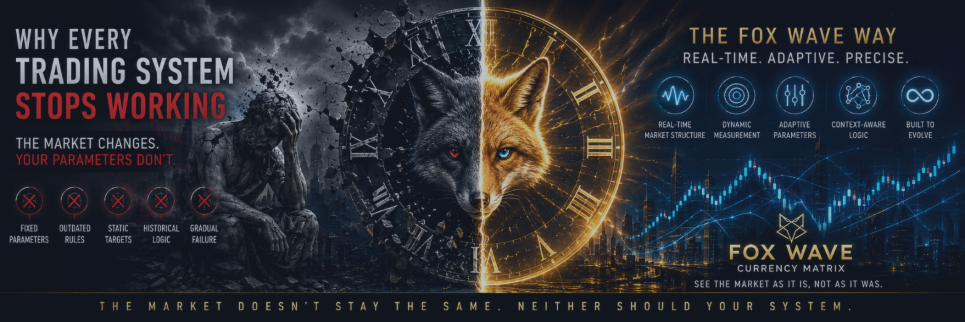

The Market Changes. Your Parameters Don’t. — The Hidden Reason Strategies Stop Working
Why a trading system can be logically correct, technically flawless, and still slowly become obsolete — and how Fox Wave approaches the problem by continuously recalibrating the market’s scale.
There is a dangerous assumption hidden inside almost every trading strategy:
If the rules worked in the past, the same rules should continue to work in the future.
It sounds reasonable.
It is not.
A trading system can be carefully designed.
It can be extensively backtested.
It can produce a beautiful equity curve.
A discretionary trader can spend years refining the same methodology.
And yet, over time, performance can deteriorate.
The code may still be correct.
The strategy may still follow its rules perfectly.
The trader may still execute the setup exactly as before.
But the market around those rules has changed.
And when the market changes, the meaning of a fixed parameter can change with it.
This is one of the least appreciated problems in trading.
THE NUMBER WAS NEVER THE REALITY
Consider a simple strategy:
Stop Loss: 100 points
Take Profit: 200 points
Entry Retracement: 50 points
The system was developed under a particular market environment.
Those numbers worked.
But what does 100 points actually mean?
Nothing by itself.
A distance only becomes meaningful when it is compared with the market that produced it.
A 100-point movement can be:
- a significant movement,
- a normal movement,
- a tiny fluctuation,
- or an extreme event.
The number remains 100.
The market does not.
And this is where the problem begins.
THE SAME PARAMETER CAN REPRESENT A COMPLETELY DIFFERENT MARKET
Imagine a strategy developed during a period of relatively high volatility.
Its 100-point Stop Loss may have represented a reasonable portion of the market's normal movement.
Its 200-point Take Profit may have been realistically reachable.
Its 50-point entry retracement may have represented a meaningful correction.
Then the market changes.
Volatility contracts.
The average movement becomes smaller.
The strategy continues using exactly the same values.
Nothing has changed inside the system.
But everything has changed around it.
The 100-point Stop Loss may now be unnecessarily large.
The 200-point target may become unrealistic.
The 50-point retracement may no longer represent a meaningful structural movement.
The strategy did not suddenly become stupid.
Its measuring scale became outdated.
AND THIS IS NOT ONLY AN EA PROBLEM
It is tempting to think this is a problem belonging to algorithmic trading.
It isn't.
A manual trader can make exactly the same mistake.
A trader may say:
“I always use a 20-pip Stop Loss.”
But why 20?
Because it worked?
Because it has always been used?
Because it was optimized?
Because it feels right?
Now imagine the market has entered a substantially different volatility regime.
Those same 20 pips may no longer represent the same amount of market movement.
The trader is still looking at the same chart.
The candles still look familiar.
The symbol has the same name.
But the meaning of the distance has changed.
The human trader has simply become a manual version of a fixed-parameter algorithm.
THE MARKET DOES NOT KNOW YOUR STOP LOSS
This is perhaps the most brutal truth.
The market does not know that your Stop Loss is 25 pips.
It does not know that your Take Profit was optimized to 50.
It does not care that your backtest showed the best results with a particular entry distance.
The market creates its movement independently.
The trader or system decides how that movement will be measured.
That distinction is fundamental.
PRICE CHANGES. SCALE CHANGES. MEANING CHANGES.
There is another layer to the problem.
An instrument does not necessarily remain at the same price level forever.
Suppose a strategy was designed when an instrument traded around one price range.
Years later, the instrument trades at a substantially different level.
A fixed distance can therefore represent a different relative proportion of the underlying price.
The parameter itself has not changed.
Its relationship with the instrument has changed.
This is why absolute values can be deceptively dangerous.
PIPS ARE NOT IMMORTAL EITHER
There is also a technical problem.
Traders often think in pips.
Trading platforms operate using points and symbol specifications.
Different instruments can have different:
- digits,
- point sizes,
- tick sizes,
- price scales,
- contract specifications.
Therefore:
The same numerical value does not automatically represent the same physical price distance across markets.
A value of:
100
is not a universal trading measurement.
It must be interpreted through the actual specification of the instrument.
But even perfect conversion between points and pips does not solve the deeper problem.
Because the problem is not merely the unit.
It is the scale of the market itself.
50 PIPS ARE STILL 50 PIPS
But what do those 50 pips represent?
During one period:
50 pips = major movement
During another:
50 pips = ordinary noise
During another:
50 pips = insignificant relative to current volatility
The number has not changed.
The context has.
And that is the central problem.
THE REAL QUESTION IS NOT:
“WHAT IS THE CORRECT PARAMETER?”
The better question is:
“WHAT DOES THIS PARAMETER MEAN RIGHT NOW?”
That is a completely different way of looking at trading.
Instead of asking:
“Should my Stop Loss always be 100 points?”
we ask:
“What does 100 points represent in the current market?”
Instead of:
“Is 200 points the correct Take Profit?”
we ask:
“Is 200 points still proportional to the market environment?”
Instead of:
“Should I always wait for a 50-point retracement?”
we ask:
“Does 50 points still represent the same structural event?”
This is the transition from fixed parameters to dynamic relationships.
THIS IS WHERE FOX WAVE BEGINS
Fox Wave is built around a simple principle:
Do not force a changing market to live inside a permanent measuring scale.
The objective is not to find one magical number.
The objective is to maintain a meaningful relationship between the parameter and the market being measured.
This is the philosophy behind Wave Distance.
Rather than treating distance as an eternally fixed number, Fox Wave can derive the distance from the current price basis and a defined coefficient.
Conceptually:
Current Price → Market Scale → Derived Distance → Trading Parameter
The important idea is not the number itself.
It is the relationship behind the number.
FROM FIXED NUMBERS TO LIVING MEASUREMENTS
A traditional approach might say:
Use 100 points.
An adaptive approach asks:
What distance corresponds to the current market scale?
That difference may look small.
It isn't.
It changes the philosophy of the entire system.
The first approach assumes:
The parameter is stable.
The second assumes:
The market is changing, therefore the measurement must be continuously reconsidered.
THE SAME PROBLEM EXISTS IN MANUAL TRADING
A human trader has one enormous advantage over a rigid algorithm:
the ability to adapt.
But that advantage only exists if the trader actually adapts.
A trader can visually recognize:
- expanding candles,
- contracting volatility,
- changing average ranges,
- deeper retracements,
- faster movement,
- slower movement,
- altered market structure.
But there is another danger.
Habit.
A trader can become attached to a mental template.
“This is what a good setup looks like.”
“This is where my stop belongs.”
“This is a normal candle.”
“This is a large movement.”
“This is how far price usually retraces.”
But what if “normal” has changed?
The trader may unknowingly be comparing today's market with a mental photograph of yesterday's market.
THE MOST DANGEROUS ILLUSION IS STABILITY
The chart still looks familiar.
The symbol still has the same name.
Candlesticks still move from left to right.
Indicators still calculate.
Support still looks like support.
Resistance still looks like resistance.
And yet the underlying scale can change dramatically.
This creates one of the most dangerous illusions in trading:
“Because the chart looks the same, my rules must mean the same thing.”
They don't necessarily.
WHY STRATEGIES GRADUALLY BREAK
Most strategies are born inside a particular environment.
A developer discovers:
- an entry condition,
- a Stop Loss,
- a Take Profit,
- a retracement,
- a filter,
- a volatility condition,
- a specific relationship between distances.
The strategy is then tested.
Perhaps the results are excellent.
But the backtest describes a historical environment.
When that environment changes, the relationships that produced the original results can weaken.
This does not necessarily mean the original idea was wrong.
It can mean something more subtle:
The strategy was calibrated to a market regime that no longer exists in exactly the same form.
OPTIMIZATION CAN CREATE ANOTHER TRAP
And then traders often respond in the obvious way.
They optimize again.
New parameters.
New backtest.
New equity curve.
New settings.
Then the market changes again.
Another optimization.
And the cycle repeats.
This can create a dangerous feedback loop:
Market changes → strategy fails → parameters are optimized → strategy fits recent history → market changes again.
The system gradually becomes dependent on the past it was supposed to escape.
The objective should not be to discover the perfect historical number.
The objective should be to understand how the number relates to the market.
FOX WAVE: LOOK AGAIN
This is the core philosophy.
Not:
“What parameter worked then?”
But:
“What is the market telling us now?”
Not:
“How many points have I always used?”
But:
“What does that distance represent under today's conditions?”
Not:
“What was optimal in the backtest?”
But:
“Is this measurement still representative of the market I am actually trading?”
That question applies equally to an EA and to a human trader.
THIS IS NOT ABOUT PREDICTING THE FUTURE
Fox Wave does not need to claim that the future can be known.
That is not the objective.
There is a fundamental difference between:
“I know where the market will go.”
and:
“I recognize that the market has changed, therefore I need to reassess the scale with which I measure it.”
The second statement is far more grounded.
It is not prediction.
It is adaptation.
THE MARKET DOES NOT GROW OLD
OUR MEASUREMENTS DO.
This may be the most important idea in the entire article.
A trading system can become outdated.
A manual method can become outdated.
A parameter can become outdated.
A backtest can become outdated.
Even a trader's intuition can become outdated if it stops questioning what “normal” means.
The market itself does not promise to remain compatible with our assumptions.
THE FOX WAVE PRINCIPLE
DON'T MEASURE TODAY'S MARKET WITH YESTERDAY'S RULER.
Price changes.
Volatility changes.
Scale changes.
Market behavior changes.
And when the environment changes, the measurement must be capable of being reconsidered.
That is the fundamental idea behind Fox Wave.
FROM A STATIC SYSTEM TO A CONTINUOUS VIEW
The philosophy can be expressed simply:
PRICE → SCALE → DISTANCE → RELATIONSHIP → DECISION
If price changes, the scale can change.
If the scale changes, the meaning of distance can change.
If the meaning of distance changes, the quality of the trading decision can change.
Therefore, finding a “perfect” parameter once is not necessarily enough.
The more important question is whether that parameter continues to represent what it was designed to represent.
THE FUTURE OF TRADING MAY NOT BE ABOUT FINDING THE PERFECT NUMBER
Perhaps the obsession with optimization has always asked the wrong question.
Perhaps the real objective is not:
“What is the best Stop Loss?”
but:
“What should the Stop Loss represent?”
Not:
“What is the best Take Profit?”
but:
“What proportion of the current market movement should the Take Profit represent?”
Not:
“What is the perfect entry distance?”
but:
“What distance currently represents the structural condition I am trying to trade?”
That is a fundamentally different architecture.
FOX WAVE
THE MARKET CHANGES. YOUR SYSTEM MUST SEE IT.
Fox Wave is not based on the belief that one fixed parameter can remain perfect forever.
It is based on a different premise:
A changing market requires a continuously recalibrated view of scale, distance and relationships.
For an automated system, that means the architecture must be capable of measuring the current environment rather than blindly repeating historical values.
For a manual trader, it means refusing to turn yesterday's measurements into permanent laws.
Because the greatest mistake may not be using the wrong parameter.
It may be something much more subtle:
Using the right parameter for far too long.
THE FINAL QUESTION
Every trader eventually faces the same question.
Not:
“Did my strategy work?”
But:
“Does it still mean the same thing?”
Because a number can remain identical while its meaning completely changes.
A Stop Loss can remain 100 points.
A Take Profit can remain 200 points.
An entry can remain 50 points away.
And yet the market surrounding those numbers can become something entirely different.
That is why Fox Wave keeps looking.
Not because the market can be controlled.
Not because the future can be guaranteed.
But because the market should never be assumed to be frozen in the moment when our strategy was created.
FOX WAVE
STOP TRADING THE PAST.
START MEASURING THE PRESENT.
The market changes.
Your parameters can remain frozen.
Fox Wave was built around the idea that they shouldn't have to.