
The Global Race to Tokenize Everything
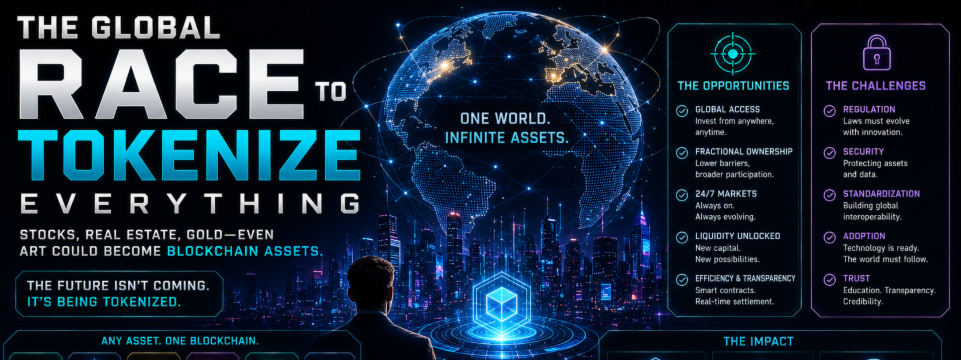
Stocks, real estate, gold, even art could become blockchain assets. The tokenization of traditional securities such as stocks, ETFs and government bonds is already moving through real regulatory approval at major exchanges, covered in structural depth elsewhere. This article goes further, into asset classes where the promise is genuinely bigger, the current reality is genuinely more modest, and the honest challenges deserve real attention rather than being glossed over in favor of dramatic forecasts.
What Tokenization Means Across Any Asset Class
Tokenization converts ownership of an underlying asset into a digital token recorded on blockchain infrastructure, enabling fractional ownership, faster settlement and, in principle, more efficient trading than the legacy paper and intermediary based systems most assets have relied on for decades. The core mechanics are consistent across asset types. What differs enormously, and what most coverage glosses over, is how naturally that mechanic actually fits each specific underlying asset.
Real Estate Tokenization: Genuine Promise Meets Genuine Immaturity
The promise is compelling and easy to state. Real estate has historically demanded enormous capital, high transaction costs and painfully slow settlement, locking out smaller investors from an asset class that has ranked among the most reliable long term stores of value for generations. Tokenization promises to convert a single property into digital fractions purchasable for a small fraction of the traditional entry cost, with automated compliance and dramatically faster settlement replacing lengthy, paperwork heavy closings.
Here is the honest complication most coverage skips. Forecasts for the future size of tokenized real estate vary by staggering, almost incoherent margins depending on the source and methodology, with projections ranging from a few billion dollars to well over a trillion within similar timeframes. When credible sounding forecasts disagree by two or three orders of magnitude, that disagreement itself is the real signal, this remains a genuinely immature market where actual, currently verifiable value locked in tokenized property sits meaningfully below the more dramatic projections regularly circulated in coverage of the space. Major financial institutions have begun building genuine fund servicing infrastructure specifically for tokenized property, a real signal of institutional interest, but real signal and mature market are not the same thing yet.
There is also a deeper, structural irony worth understanding. Tokenizing an asset does not automatically create genuine trading liquidity for it. A token representing a specific commercial property remains tied to a fundamentally unique, illiquid underlying asset with real world legal transfer complexities, meaning genuine secondary market liquidity has to be actively built through real trading activity, not simply assumed to follow automatically from the act of digitizing ownership.
Gold and Commodity Tokenization: A Structurally Easier Case
Gold tokenization sits on meaningfully more solid ground than real estate, for a specific, structural reason worth understanding rather than assuming. Gold is fungible, standardized and already highly liquid in its traditional form, one ounce of investment grade gold is functionally identical to any other ounce, unlike a specific commercial property that is inherently unique. This fungibility is precisely what allows a gold backed token to represent genuinely interchangeable underlying value, avoiding much of the valuation and liquidity complexity that makes real estate tokenization structurally harder. Recent data on the broader tokenized asset market shows gold specifically among the categories gaining genuine traction alongside tokenized stocks and bonds, a meaningfully more mature position within the overall trend than real estate currently occupies.
Art and Collectibles: The Hardest Case of All
If gold represents the easiest case for tokenization and real estate a genuinely harder one, art and unique collectibles represent the hardest case discussed in this article, for reasons that compound rather than merely add to real estate's challenges. Every artwork is fundamentally unique, non fungible by nature rather than merely illiquid, and valuation remains genuinely subjective even within traditional art markets long before blockchain enters the picture at all. Fractional ownership of a single, unique physical object also raises genuine governance questions traditional fractional ownership structures still have not fully solved, who decides whether and when the physical piece is eventually sold, and how fractional token holders meaningfully exercise any control over that decision. This remains the most conceptually interesting and least practically proven category covered here, worth watching rather than treating as a near term reality.
The Honest Opportunities and Challenges
Stepping back across all three asset classes, several genuine opportunities and genuine challenges apply consistently.
- Opportunity: fractional access to previously high barrier asset classes. Real estate, and eventually art, become accessible to investors who could never previously afford direct ownership.
- Opportunity: faster settlement and automated compliance. Blockchain based settlement can compress traditionally slow, paperwork heavy processes into a fraction of the time, with programmable compliance reducing manual overhead.
- Challenge: regulatory classification remains genuinely unresolved in many jurisdictions. Real estate tokens in particular are frequently treated under existing securities frameworks that were never designed with this specific structure in mind, creating real restrictions on who can invest and how.
- Challenge: tokenization does not automatically create genuine liquidity. A digitized ownership record for a fundamentally illiquid or unique underlying asset does not, by itself, produce an active, liquid trading market, that has to be genuinely built through real participation.
- Challenge: keeping on chain tokens synchronized with real world legal ownership. The technical and legal complexity of ensuring a blockchain token accurately and continuously reflects genuine legal ownership and compliance status remains a real, unresolved engineering and regulatory challenge across every asset class discussed here.
Effects on Exchanges and Investors
For exchanges, tokenization represents both genuine opportunity and genuine competitive pressure simultaneously. Traditional exchanges building tokenization infrastructure gain a path toward modernized settlement and expanded product offerings, but they now face real competition from crypto native platforms capable of moving considerably faster in this specific space, a genuine strategic tension already shaping how major exchanges are positioning themselves.
For investors, the practical implication is a genuinely expanded due diligence burden rather than a simple, frictionless new access point. Understanding a tokenized asset now requires evaluating not only the underlying asset's own fundamentals, but also the specific legal structure wrapping it, the custody arrangements protecting it, and whether genuine, active trading liquidity actually exists for that specific token, rather than assuming liquidity automatically follows from the fact that an asset has been tokenized at all.
Frequently Asked Questions
Is real estate tokenization already a mature market? Not yet. While genuine institutional interest and infrastructure investment are real, current actual market value remains meaningfully more modest than many of the more dramatic forecasts circulating in coverage of the space, and forecasts for future growth vary by staggering margins depending on source and methodology.
Why does gold tokenize more easily than real estate? Gold is fungible and standardized, meaning any unit is functionally interchangeable with another, unlike a unique commercial property, which avoids much of the valuation and liquidity complexity that makes real estate tokenization structurally harder.
Does tokenizing an asset automatically make it more liquid to trade? No. Tokenization creates a digital ownership record, but genuine trading liquidity has to be actively built through real market participation, and a token representing a fundamentally illiquid or unique underlying asset does not automatically become liquid simply through digitization.
What is the biggest challenge facing art and collectible tokenization specifically? Every artwork is fundamentally unique and non fungible, valuation remains genuinely subjective even in traditional markets, and fractional ownership raises unresolved governance questions about who controls decisions regarding the physical asset.
Real Progress, Honestly Measured
The race to tokenize everything is genuinely underway, but its current shape is considerably more uneven than the dramatic framing suggests. Gold sits on relatively solid structural ground. Real estate shows genuine institutional interest alongside genuine immaturity and wildly inconsistent forecasts. Art remains the most speculative frontier of all. Understanding these differences precisely, rather than treating tokenization as a single, uniform trend, is what separates informed positioning from chasing headlines.
Explore the broader ICONIC.FX ecosystem, built around exactly this kind of honest, evidence grounded approach to evolving market structure, at iconicfx.tech.
Risk Disclaimer. Trading foreign exchange, cryptocurrencies, commodities and other leveraged financial instruments carries a high level of risk and may not be suitable for all investors. The high degree of leverage can work against you as well as for you. Past performance is not indicative of future results. Automated trading systems, indicators and Expert Advisors do not guarantee profits and can produce losses. ICONIC.FX provides software tools only and does not provide investment advice, portfolio management or financial recommendations. You are solely responsible for your own trading decisions. Seek advice from an independent licensed financial advisor if you have any doubts.