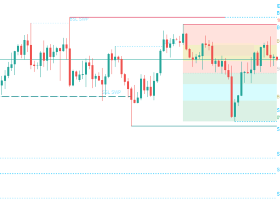
10 Reasons Why Pivot Breakout Will Always Work on Gold — And Why It Will Only Get Stronger

10 Reasons Why Pivot Breakout Will Always Work on Gold — And Why It Will Only Get Stronger
I have traded Gold for three decades. I have seen every strategy come and go. Martingale systems that looked brilliant for a year, then destroyed accounts in a single week. Grid systems that worked in ranging markets until Gold spiked $200 in a day and wiped the entire grid. Neural networks trained on five years of data that became useless the moment market structure changed.
But through all of it — the crashes, the bull runs, the panic spikes, the institutional manipulation, the geopolitical shocks — one approach never stopped working. Confirmed Pivot Breakout.
It is not the flashiest strategy. It does not produce a trade every day. But it has been generating profit for serious Gold traders for decades, and here is exactly why it will continue doing so long into the future.
■ Reason 1 — Gold Is Structurally a Breakout Market
Most Forex pairs mean-revert. They oscillate around a central value, bounce off moving averages, and respect range structures for extended periods. Gold does not behave this way. Gold is a momentum market. When it moves, it moves in sustained, directional waves driven by macroeconomic forces — inflation expectations, central bank policy, geopolitical risk, USD strength, and global safe-haven demand.
These macro waves do not reverse cleanly at round numbers or simple moving averages. They accelerate through resistance and build on themselves. Pivot Highs and Pivot Lows are the natural reference points where institutional participants, central bank traders, and algorithmic systems all watch to see if a move has genuine commitment behind it. When price breaks and holds a Pivot, it is not a random event — it is a structural shift that serious money is confirming in real time.
The Gold market's fundamental nature makes Pivot Breakout a logical, not arbitrary, approach.
■ Reason 2 — Institutional Traders Use Pivot Structures Globally
Banks, hedge funds, and commodity trading desks do not use RSI or MACD as their primary tools for positioning. They use market structure — Pivot Highs, Pivot Lows, swing points, and order block zones. These are the levels at which large orders are clustered.
When retail breakout traders and institutional systems are both watching the same Pivot levels, the resulting breakout has real volume and momentum behind it. A breakout that is confirmed — meaning price closes beyond the Pivot rather than just touching it — has institutional validation. That is why confirmed Pivot Breakout setups carry a fundamentally different probability than breakouts of arbitrary indicator lines.
As long as large-capital participants use market structure as a framework for positioning, Pivot Breakout will remain a viable and meaningful strategy.
■ Reason 3 — The Strategy Self-Corrects as Market Participants Learn It
One of the most persistent concerns about any well-known strategy is that once too many traders use it, it stops working. This is true for many indicator-based strategies. But Pivot Breakout has an inherent self-correcting mechanism.
When too many traders take premature breakout entries, the market punishes them with false breakouts. This creates a natural selection pressure toward waiting for confirmation. Traders who learn to wait for a confirmed Pivot — a full close beyond the level — survive. Those who jump on anticipation do not. Over time, the strategy evolves toward more disciplined, confirmation-based entries, and those entries continue to work because they align with where institutional money is actually positioned.
The strategy is not static. It adapts through the behavior of the participants using it. That is a rare and valuable property.
■ Reason 4 — False Breakouts Filter Themselves Out on Higher Timeframes
On M5 or M15, Gold generates dozens of noise breakouts every day. Most of them are stop hunts, spread manipulation, and low-volume whipsaws designed to shake out weak hands. This is why Pivot Breakout on lower timeframes has a notoriously poor reputation among newer traders.
On the Daily timeframe, the calculation changes fundamentally. A Daily close beyond a confirmed Pivot High or Low represents eight hours of market agreement. Every London session, every New York session, every Asian session has had the opportunity to reject that move — and chose not to. A D1 confirmed breakout carries the weight of the full global trading day behind it.
False breakouts on D1 exist — this is trading, not mathematics — but their frequency is dramatically lower, and the true breakouts that follow carry significantly larger reward potential. The higher timeframe is where the strategy genuinely earns its edge.
■ Reason 5 — Gold's Long-Term Trend Bias Rewards Breakout Participants
Over any ten-year window in the past fifty years, Gold has been in a structural uptrend. Geopolitical instability, monetary debasement, and reserve diversification away from the USD ensure that long-term demand for Gold remains. In a structurally trending asset, breakout strategies that capture directional moves consistently outperform mean-reversion approaches over time.
This does not mean every trade goes in the trend direction — Gold has significant counter-trend moves. But a well-designed Pivot Breakout system that operates on D1 captures a disproportionate share of the large, sustained moves that define Gold's long-term character. The structural bias of the asset itself works in favor of the strategy's underlying logic.
■ Reason 6 — Risk-to-Reward Mathematics Favor Breakout Systems on Gold
Professional trading is not about win rate. It is about expectancy — the product of win rate and average reward, minus the product of loss rate and average loss.
A confirmed Pivot Breakout on D1 Gold typically offers Stop Loss placement at the recent Pivot (a natural, logical level) and Take Profit extension into the next structural zone. On Gold, these distances are substantial. A stop of $8 to $15 per ounce combined with a profit target of $20 to $40 per ounce produces a Risk-to-Reward ratio of 1.8 to 2.5.
At that reward ratio, a system needs to win approximately 35 to 40 percent of trades just to break even. A well-filtered Pivot Breakout system winning 45 to 55 percent produces strongly positive expectancy even during difficult market phases. The mathematics of the strategy are sound, and sound mathematics do not become unsound because markets evolve.
■ Reason 7 — Macro Events Create New Pivot Levels Continuously
Gold is uniquely sensitive to macroeconomic events — Fed rate decisions, CPI data, geopolitical escalations, central bank reserve changes, and currency crises. Each major event creates a new swing high or swing low in market structure. These become the next generation of Pivot reference points that the strategy can work from.
This is different from Forex markets where central bank intervention can suppress volatility for extended periods. Gold is never suppressed for long. The global forces that drive it ensure a constant renewal of market structure. New Pivots are always being formed. New confirmed breakouts will always follow.
The strategy has an endless supply of setups as long as Gold continues to react to the world.
■ Reason 8 — Drawdown Periods Are Temporary, Not Terminal
Every serious strategy has drawdown periods. Pivot Breakout on Gold can produce multiple consecutive losing trades when the market enters a low-volatility, choppy consolidation phase. This is where undisciplined traders exit the strategy and declare it broken.
Experienced traders understand that consolidation is not the end of the strategy — it is the compression phase that precedes the next major breakout. The volatility contraction that produces losing trades is building the energy for the setup that recovers them. A trader who maintains discipline and proper position sizing through the drawdown captures the recovery.
This property — that drawdown periods are temporary contractions before expansion — is one of the most important reasons why the strategy survives over the long term while impatient traders abandon it.
■ Reason 9 — The Strategy Scales With Any Account Size
Breakout strategies on higher timeframes do not require tight spreads, ultra-fast execution, or ECN-level infrastructure. A confirmed D1 Pivot entry has a Stop Loss measured in dozens of dollars per ounce — the execution cost of a few pips spread is essentially irrelevant to the trade outcome.
This means the strategy works equally well on a $1,000 personal account and a $1,000,000 institutional account. Position size scales, but the edge does not erode with account growth. This is fundamentally different from scalping strategies that lose their edge as capital increases and market impact grows.
A strategy that works at all capital levels is a strategy that will always have participants using it — which reinforces its continued viability.
■ Reason 10 — AI and Algorithmic Tools Enhance It Without Replacing It
Modern algorithmic trading did not destroy Pivot Breakout — it strengthened it. Algorithmic systems identify and act on the same structural levels that manual traders have used for decades, but faster and more consistently. High-frequency algorithms cluster at Pivot levels, increasing the significance of those breakpoints.
Meanwhile, AI-based filtering has solved the original weakness of the strategy — the false breakout problem. By evaluating market structure quality, momentum context, and risk-to-reward parameters before allowing an entry, AI systems can systematically avoid the low-quality breakout environments that historically produced losing trades. The strategy itself remains unchanged. The filter layer becomes more sophisticated.
This is not disruption — it is evolution. The Pivot Breakout strategy enters the AI era more powerful, not weaker.
■ Where This Leads in Practice
Understanding why a strategy works permanently is only useful if you can execute it consistently over years. Manual execution of a D1 Pivot Breakout strategy is genuinely difficult. You need to monitor the close of every Daily candle across multiple sessions, evaluate whether a confirmed breakout is structurally clean or a false move, manage position sizing precisely, and hold trades that may not resolve for days.
Over three decades of trading Gold manually, I have watched disciplined traders succeed with this approach and I have watched equally disciplined traders fail — not because their strategy was wrong, but because human execution introduces emotional variables that erode a mathematically sound edge over time.
This is where systematic automation, done correctly, makes a meaningful difference.
■ AI Aurum Pivot — The Same Logic, Executed Without Compromise
When I evaluated AI Aurum Pivot against the principles I have described above, it stood out as one of the few automated systems that genuinely reflects how a serious Pivot Breakout trader actually thinks.
The core design matches the strategy I have described in every meaningful way:
- Confirmed Pivot only — entries require full confirmation of a Pivot High or Low before triggering. No anticipation, no premature entry.
- Daily timeframe (D1) — operates exactly where the false breakout rate is lowest and the reward potential is highest.
- Hard Stop Loss on every trade — no martingale, no grid, no averaging. Each trade is independent with predefined risk.
- AI quality filter — an internal module evaluates market structure and setup quality before approving any entry, directly addressing the false breakout problem that is the strategy's primary weakness.
- Positive expectancy design — targets win rate around 45–55% with Risk-to-Reward of 1.8–2.0+, which is exactly the expectancy framework I described above.
The EA does not trade frequently. It does not generate signals every day. That is not a limitation — that is the strategy working correctly. Patience and selectivity are the source of edge in this approach, not activity.
"Lose small on Gold. Win big when Gold truly moves."
— AI Aurum Pivot design philosophy
This is how professional Gold traders have always thought about Pivot Breakout. The EA simply automates that discipline without the emotional variables that compromise human execution.
■ What Real Users Are Observing
★★★★★ Rudy Jean Louis Bompeix — February 2026
"I am currently running it on the D1 timeframe, alongside several other gold breakout EAs. Despite all of them being breakout-based systems, Aurum Pivot clearly operates with a different internal logic and structure. The correlation with my other gold EAs is extremely low, and more importantly, drawdowns do not occur at the same time. This is a major advantage. What makes the difference, in my opinion, is the AI filtering layer. While many classic breakout systems can be trapped during certain market conditions, Aurum's algorithm tends to avoid lower-quality setups. I genuinely believe this EA is currently one of the most underestimated breakout systems available here."
★★★★★ Aller Uja — March 2026
"The system shows a very clean and structured approach, with disciplined entries and solid risk management. It clearly avoids risky methods like martingale or grid and focuses on quality setups, which is exactly what I look for as a long-term trader."
★★★★★ Fares3D — April 2026
"AI Aurum Pivot EA is well-balanced and delivers profits during certain periods, making it a strong overall choice for traders who value consistency. Excellent for those who focus seriously on proper risk management and disciplined execution."
■ A Closing Thought
I have seen traders lose accounts chasing perfect win rates. I have seen others build wealth steadily over years with strategies that were right less than half the time — because they managed the losses small and let the winners run.
Pivot Breakout on Gold is not a magic system. It will have losing trades. It will have quiet months. But the ten reasons I have outlined above explain why the underlying logic is structurally sound — rooted in Gold's nature, in institutional behavior, and in mathematical expectancy that does not depend on market conditions remaining static.
If you are looking for a system that reflects these principles in automated form — honest about what it is, not overpromising, built for the long term — AI Aurum Pivot is worth a serious look.
👉 View AI Aurum Pivot on MQL5 →
518 traders have already downloaded the demo. The rating stands at a perfect 5.0 from verified buyers. The live signal is publicly accessible and verifiable.
Take your time. Test the demo. Evaluate the live signal yourself. That is how a real decision should be made.
⚠ Trading involves significant risk. Past performance and live signal results are not a guarantee of future returns. All content in this post represents the author's personal analysis and experience. Always apply proper risk management and never risk capital you cannot afford to lose. AI Aurum Pivot is a trading tool, not a profit guarantee.