52% Win Rate, +8.79% Gain: Why Your EA Doesn't Need to Win Every Trade

A 52% win rate.
That's what Alpha Pulse AI has after 116 live trades on Myfxbook. And with that "mediocre" EA win rate, it's gained +8.79% with a profit factor of 1.14.
Meanwhile, on MQL5, there are EAs showing 90%+ win rates with beautiful equity curves. And most of them will blow your account within 6 months.
The difference? The 52% win rate EA has been designed to survive. The 90% win rate EA has been designed to sell.
If you've ever rejected an EA because its win rate wasn't high enough, this post is going to change how you evaluate everything.
Why a High EA Win Rate Is Usually a Red Flag
A 95% win rate sounds incredible until you understand how it's achieved. There are exactly three ways to get a very high win rate:
- Wide stop losses, tight take profits. You win 19 small trades and lose 1 trade that wipes out all 19 wins plus some. Net result: negative. But the win rate looks amazing
- No stop losses at all (martingale). You never close a losing trade — you add to it, or you wait until it recovers. Your win rate is 100% until the one trade that doesn't recover. Then it's 0% and your account is gone
- Curve-fitted backtest. The EA was optimized specifically for the test period. Every parameter was adjusted to maximize win rate on historical data. Live? It falls apart within weeks because the overfitting problem is real
A high win rate is not an achievement. It's a design choice. And in most cases, it's a choice that sacrifices long-term survival for short-term marketing appeal.
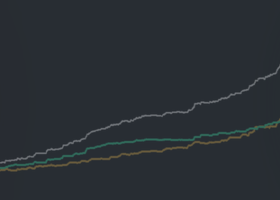
Win rate doesn't save you. Drawdown does:
The Metric That Actually Matters: Profit Factor
Profit Factor = Total Gross Profit ÷ Total Gross Loss.
That's it. One number that tells you if the system makes more than it loses. Anything above 1.0 means the EA is profitable. Above 1.5 is good. Above 2.0 is excellent.
Alpha Pulse AI's profit factor: 1.14. That means for every $1 lost, the system makes $1.14. Not spectacular? It's $7,668 in balance from $7,046 in deposits. Over 116 trades. With 8.60% maximum drawdown.
Compare that to a 95% win rate EA with a profit factor of 0.8. It wins almost every trade but loses more than it makes. Which one survives 12 months?
Win rate tells you how often you're right. Profit factor tells you if being right actually makes you money. These are completely different questions.
The Real Numbers: 116 Trades, No Filter
Here's what 52% win rate actually produced on a live account (Myfxbook verified, not backtest):
- Total gain: +8.79% (absolute +9.83%)
- Monthly average: 2.31%
- Maximum drawdown: 8.60%
- Total trades: 116
- Longs won: 48% (63 trades)
- Shorts won: 59% (53 trades)
- Profit factor: 1.14
- Expectancy: 105.1 pips / $5.36 per trade
- Best trade: $881.14
- Worst trade: -$165.00
- Average win: $81.14 (2,141.77 pips)
- Average loss: -$79.68 (2,153.85 pips)
Look at those averages. The average win ($81.14) and average loss ($79.68) are almost identical. The edge isn't in how much you win per trade — it's in winning slightly more often than you lose, consistently, over 116 trades. That's how real edges work.
This isn't exciting. It doesn't make for a good Instagram post. But at 2.31% monthly, that's 31.5% annualized with compounding. While the 95% win rate EA has already blown up twice.
Every number, verified. No filter.
Alpha Pulse AI runs on live Gold with real AI analysis (GPT-5.4, Gemini 3.1 Pro). 116 trades, 52% win rate, 8.60% max drawdown. The full data is on Myfxbook — including every losing trade. See the complete 116-trade breakdown.
Why 52% Feels Terrible (But Works)
Here's the psychological trap. With a 52% win rate, you WILL have:
- Losing streaks of 5-7 trades (mathematically certain)
- Weeks where you're in the red
- Months where the equity curve looks flat or declining
And during those moments, your brain screams: "This EA doesn't work. Turn it off." That's the drawdown psychology that destroys more accounts than any bad strategy.
A 52% win rate means you lose 48% of your trades. Almost half. That's a LOT of losing trades to sit through without panicking. And that's exactly why running a single EA is a psychological experiment nobody survives — because one strategy with a 52% win rate will test your patience beyond what willpower can handle.
The solution isn't finding a higher win rate EA. It's building a portfolio where multiple strategies smooth the equity curve so you never have to white-knuckle through a 7-trade losing streak alone.
How to Actually Evaluate EA Win Rate and Performance
Stop looking at EA win rate first. Here's the order that matters:
1. Is it live? (Not backtest, not demo)
If there's no Myfxbook or equivalent live verification, nothing else matters. Backtests can be manufactured. Live results can't.
2. What's the maximum drawdown?
This tells you the worst pain you'll experience. 8.60% drawdown means at some point your account was down almost 9%. Can you handle that without touching anything? If not, the win rate is irrelevant because you'll turn it off before the statistics play out.
3. What's the profit factor?
Above 1.0 = profitable. Above 1.2 on live = genuinely good. Above 1.5 = excellent. Anything claiming 3.0+ on live for more than 100 trades is suspicious — check what those numbers are hiding.
4. How many trades?
30 trades means nothing statistically. 100+ trades starts to be meaningful. 500+ trades gives you real confidence. Alpha Pulse at 116 trades is entering the zone where the numbers start to mean something.
5. THEN look at win rate
Win rate is context-dependent. A 40% win rate with a 3:1 reward-to-risk ratio crushes a 90% win rate with a 1:10 ratio. Always combine win rate with average win vs. average loss.
Start building the portfolio that smooths the 52% reality.
One EA with a 52% win rate will test your psychology. A portfolio of uncorrelated strategies won't. Start free with the USDJPY module and see how portfolio-style trading feels. Download free — zero risk, proper risk management built in.
The Uncomfortable Truth About Trading Expectations
You're not going to find an EA with 80% win rate, 3% drawdown, and consistent monthly returns on live trading. If someone shows you those numbers, they're either:
- Using a backtest (not live)
- Using martingale (ticking time bomb)
- Showing a 3-month sample size (meaningless)
- Lying
Real trading looks like 52% win rate, 8.60% drawdown, 1.14 profit factor, and 2.31% monthly. It looks boring. It looks "mediocre" to someone used to Instagram trading culture. And it's the kind of performance that, compounded over 2-3 years, changes your financial trajectory.
The EAs that look exciting are usually the ones that kill accounts. The EAs that look boring are usually the ones that build wealth. Choose your side.
The honest data, every week.
Win rates, drawdowns, AI model comparisons, and the uncomfortable numbers nobody else publishes. No hype. No beach photos. Just data. Join the newsletter.
FAQ: Win Rate and EA Performance
Is a 50% win rate good for a trading EA?
It depends entirely on the reward-to-risk ratio. A 50% win rate where winners are twice as large as losers gives you a profit factor of 2.0 — that's excellent. A 50% win rate where winners and losers are equal is break-even. Always look at profit factor alongside win rate.
What win rate do professional funds target?
Most systematic hedge funds operate between 45-60% EA win rate. The edge comes from risk management and position sizing, not from winning every trade. A 52% win rate with proper risk control is fund-level performance.
Why do high win rate EAs blow up?
Because they achieve high win rates by either removing stop losses (martingale) or using very wide stops with tiny take profits. Both approaches guarantee many small wins and rare catastrophic losses. The math always catches up — usually after the vendor has already sold the EA.
How many trades do I need to trust win rate data?
At minimum 100 trades for any statistical significance. At 30 trades, a 60% win rate could easily be random chance. At 116 trades (like Alpha Pulse AI), the data starts to be meaningful. At 500+, you have real confidence.
Should I choose an EA based on win rate or profit factor?
Profit factor first, always. A profitable system can have any win rate. An unprofitable system can have a 95% win rate. Check profit factor, then drawdown, then trade count, then win rate. In that order.