• Information
2 Jahre
Erfahrung
4
Produkte
97
Demoversionen
0
Jobs
1
Signale
0
Abonnenten
Fachmann für Finanzen und internationales Geschäft mit Spezialisierung auf Finanzmanagement. Autodidaktischer MQL5- und Python-Entwickler mit Schwerpunkt auf algorithmischem Handel, Multi-Asset-Portfoliokonstruktion und quantitativem Risikomanagement.

Meine Arbeit konzentriert sich auf das Design, die Optimierung und die Validierung von Expert Advisors, die als koordiniertes Portfolio funktionieren und nicht als isolierte Strategien. Ich wende Korrelationsanalyse, zeitliche Abdeckungsanalyse und Diversifikation nach Anlageklassen an, um Systeme aufzubauen, die nicht von einem einzelnen Instrument oder einem einzelnen Ansatz abhängig sind.

Derzeit verwalte ich algorithmische Portfolios, die Forex, Indizes, Edelmetalle, Energie und US-Aktien umfassen und gleichzeitig über mehrere Handelssitzungen und Zeitrahmen hinweg operieren.

Ich teile meine Erfahrung durch technische Artikel und Open-Source-Tools in dieser Community. Ich bin überzeugt, dass der Übergang vom „Erstellen einzelner EAs" zum „Engineering von Portfolios" die Grenze ist, die das Denken von Privatanlegern vom institutionellen Denken trennt, und dieses Prinzip leitet alles, was ich hier veröffentliche.
Cristian David Castillo Arrieta
Introduction AbacuQuant Portfolio is a multi-configuration Expert Advisor for MetaTrader 5. Instead of running one strategy with one set of parameters on one instrument, it runs up to 48 independent configurations at the same time, across EURUSD, GBPUSD, USDJPY and AUDUSD, from a single H1 chart...
Cristian David Castillo Arrieta
After months of research, I've published AbacuQuant Portfolio — a multi-configuration Expert Advisor for MetaTrader 5, and I wanted to share it here first.

Why it's different

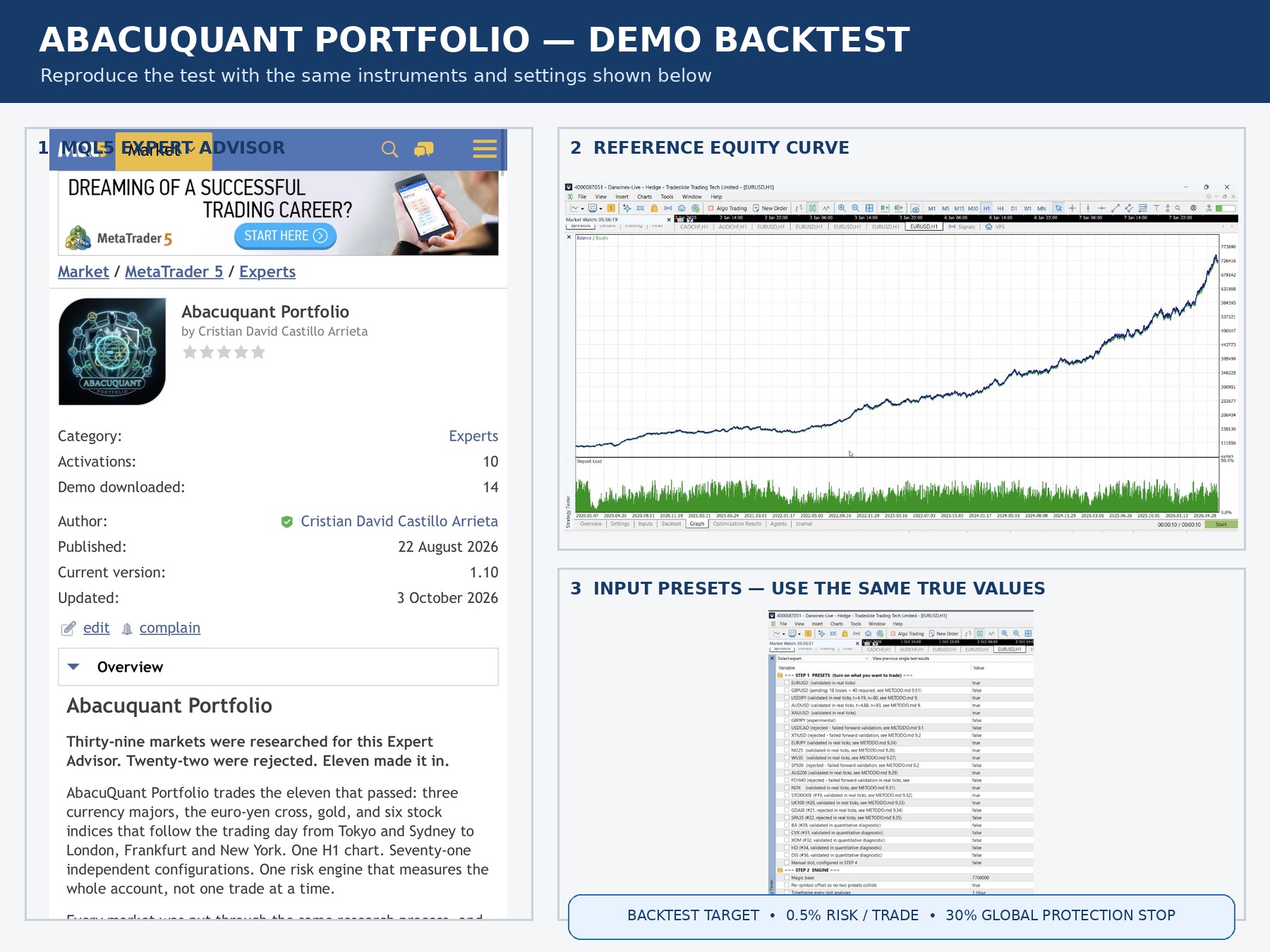
Most EAs run one strategy with one set of parameters on one instrument. This one runs up to 48 independent configurations at once, across EURUSD, GBPUSD, USDJPY and AUDUSD, from a single chart. Each configuration owns its own trading hours, its own combination of ten built-in strategies, and its own ATR-based stop and target. A configuration built for the London session simply doesn't trade outside it — and risk is measured across the whole account, not per configuration, so running four instruments together doesn't quietly multiply your exposure.

And it's built the honest way: no martingale, no grid, no averaging into a losing position, no hidden loss-recovery logic. Every stop is attached the moment the trade opens. If you've been burned by an EA with a beautiful equity curve that fell apart the first time the market disagreed with it, this was built specifically against that failure mode.

How it decides a trade

Each active configuration waits for its window, reads only completed H1 bars (never the forming candle), requires several of its enabled strategies to agree, and sizes the position from the stop distance rather than a fixed lot — so a wider stop always means a smaller position, and the money at risk stays constant. Every configuration passed the same acceptance procedure on real-tick data before it shipped: statistical significance over its own break-even line, a minimum number of losing trades to actually measure it, and stops that were genuinely reached rather than just theorized.

Try it before you take my word for it

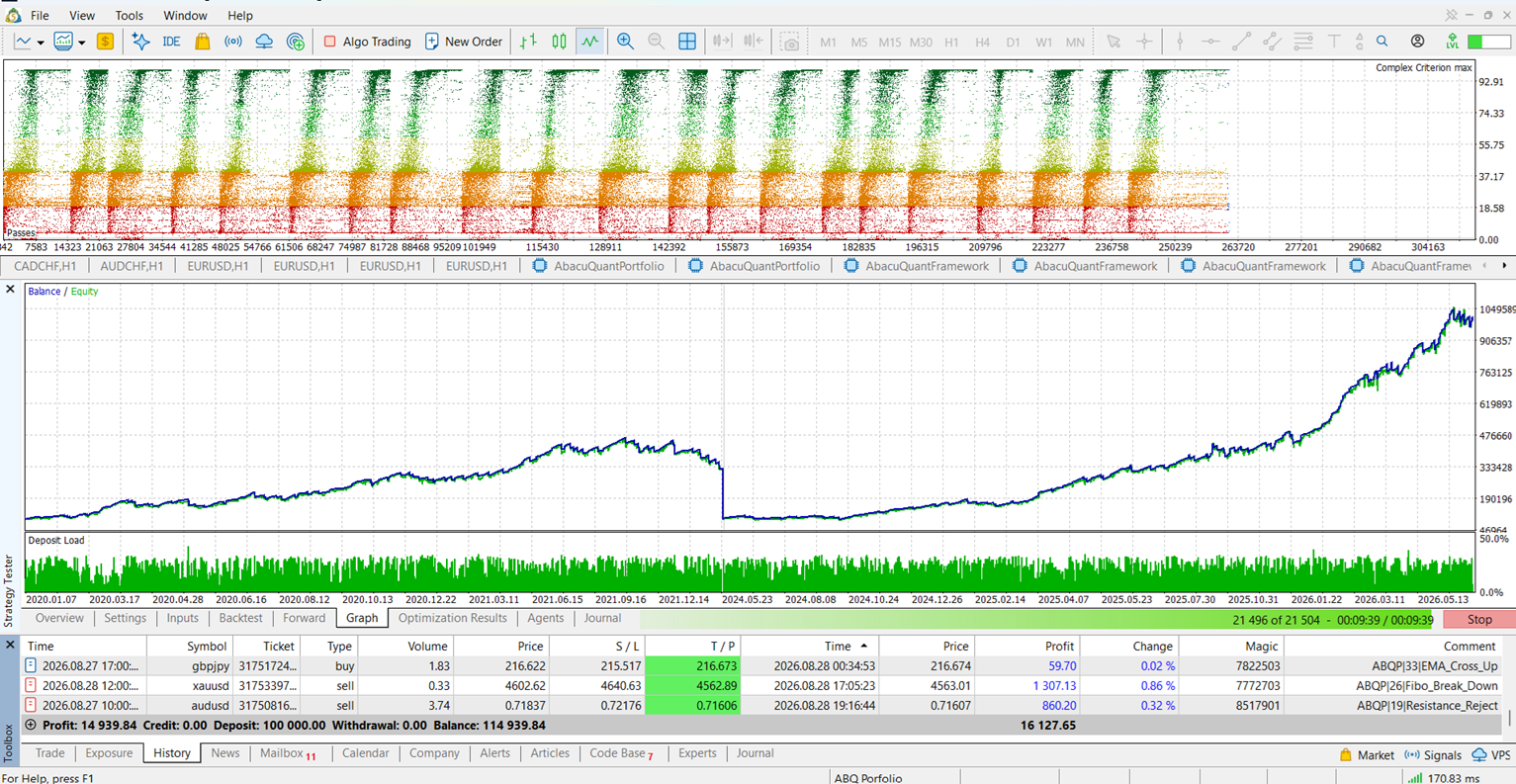
The demo runs in full inside the Strategy Tester — same presets, same logic, no time limit. Turn on the validated instruments, select "Every tick based on real ticks," and look at the trade list yourself: the stops, the position sizing, the risk ceilings holding across instruments. I'd rather you find out in the tester, for free, than after committing real money.

Link to the product page: https://www.mql5.com/en/market/product/191885
Cristian David Castillo Arrieta Hat ein Produkt angeboten

AbacuQuant Portfolio: Multi-Konfigurations-Expert Advisor Bis zu 48 unabhängige Konfigurationen. Mehrere Instrumente. Ein Chart. Kontoweites Risikomanagement. Expert Advisor für MetaTrader 5, der EURUSD, GBPUSD, USDJPY und AUDUSD über einen einzigen H1-Chart handeln kann. Enthält validierte Presets und einen vollständigen manuellen Modus. Kein Martingale, kein Grid, kein Averaging Down und keine Verlust-Recovery-Systeme. Jede Konfiguration verfügt über ein eigenes Handelsfenster, eine eigene

Cristian David Castillo Arrieta
Hat den Artikel Building a Hidden Risk of Ruin Auditor in MQL5 veröffentlicht
Building a Hidden Risk of Ruin Auditor in MQL5

Aggregate metrics alone do not reveal how a trade sequence manages risk. This MQL5 tool analyzes closed positions to flag four structural patterns: post-loss volume escalation, overlapping same-direction entries, asymmetric payoffs, and a classical risk-of-ruin figure. The results are merged into a configurable A-F grade with concise recommendations to guide further review.

Cristian David Castillo Arrieta
Hat den Code Scale Out Value Analyzer veröffentlicht
A native MQL5 tool that reconstructs closed positions from deal-level history, flags the ones closed through more than one exit, and reprices each one at its own first, last, and best exit rates to measure whether scaling out actually added value. Reports a Value-Add Ratio, a Scale Out Win Rate, an Efficiency figure, and a single-trade dependence check, combined into an A+ to F score with recommendations. Runs out of the box against a built-in demonstration data set; a companion script exports the real input file from your own account history. Pure MQL5, no external libraries.
45
Cristian David Castillo Arrieta
Hat den Code Hidden Risk of Ruin Auditor veröffentlicht
Reads a closed-position trade history (a CSV file, or one generated automatically from the current account's deal history by the companion RuinExport.mq5 script) and reports four independent risk fingerprints: volume escalation after a loss, overlapping same-direction exposure that averages into a worse price, payoff asymmetry between wins and losses, and a classical risk-of-ruin estimate at a stated risk per trade. The four scores combine into a single A-to-F grade with plain-language recommendations. If no CSV is found, the script generates a reproducible demonstration book automatically, so the report is visible on the first run.
81
Cristian David Castillo Arrieta
Hat den Artikel Execution Cost and Slippage Sensitivity Analyzer veröffentlicht
Execution Cost and Slippage Sensitivity Analyzer

Backtests often understate spread, commission, and slippage. This MQL5 analyzer loads closing deals and simulates rising execution costs to measure robustness. It computes the breakeven cost per deal, the cushion over an assumed cost, the net profit and profit factor at that cost, and how many winners turn into losers, then summarizes the result with an A+ to F grade and targeted guidance.

Cristian David Castillo Arrieta
Hat den Artikel Creating a Profit Concentration Analyzer in MQL5 veröffentlicht
Creating a Profit Concentration Analyzer in MQL5

Net profit and win rate tell you how much a strategy made, not how the result is distributed. This article builds a native MQL5 script that reads your closed trades and measures profit concentration: the top-N trade share, the Gini coefficient of the winners, an outlier-dependence stress test that removes the best few winners, and the largest day against a prop-firm consistency limit. It combines these into one A+ to F score with recommendations, running inside MetaTrader 5.

Cristian David Castillo Arrieta
Hat den Code Portfolio Correlation and Margin Risk Calculator veröffentlicht
Berechnet die historische Pearson-Korrelation zwischen einer beliebigen Gruppe von Instrumenten und der Gesamtmarge, die Ihr Konto benötigen würde, um alle diese Instrumente gleichzeitig zu halten, ausgedrückt als Prozentsatz Ihres Eigenkapitals. Läuft nativ in MetaTrader 5 ohne externe Bibliotheken, ohne Python und ohne KI – geben Sie Ihre Symbolliste und Lotgrößen als Eingabewerte ein, und das Tool zeigt die vollständige Matrix auf der Registerkarte „Experten“ sowie im Chart an, wobei die Daten zeitgesteuert aktualisiert werden.
Cristian David Castillo Arrieta
Why the same trailing stop breaks the moment Gold changes character

I was in a forum thread today about trailing stops on XAUUSD, and it made me put into words something I've been building my whole approach around for a while: almost every trailing method traders compare — EMA cross, Chandelier, ATR multiples, swing-structure trails — gets judged on a single backtest run over one continuous chunk of history. The "best" multiplier or ladder step that wins that test isn't actually the best method. It's the method that happened to fit whatever mix of trend and chop was sitting in that sample.

The fix I use is simple to describe and annoying to implement properly: split the history into volatility regimes first (I use ATR percentile over a rolling window, expansion vs. compression), then optimize and validate each piece of logic separately per regime instead of once over the whole dataset. A structural trail wins clearly in expansion. In compression it just gets chopped up by noise, and something tighter does better there. Neither method is "the winner" — the regime decides which one applies.

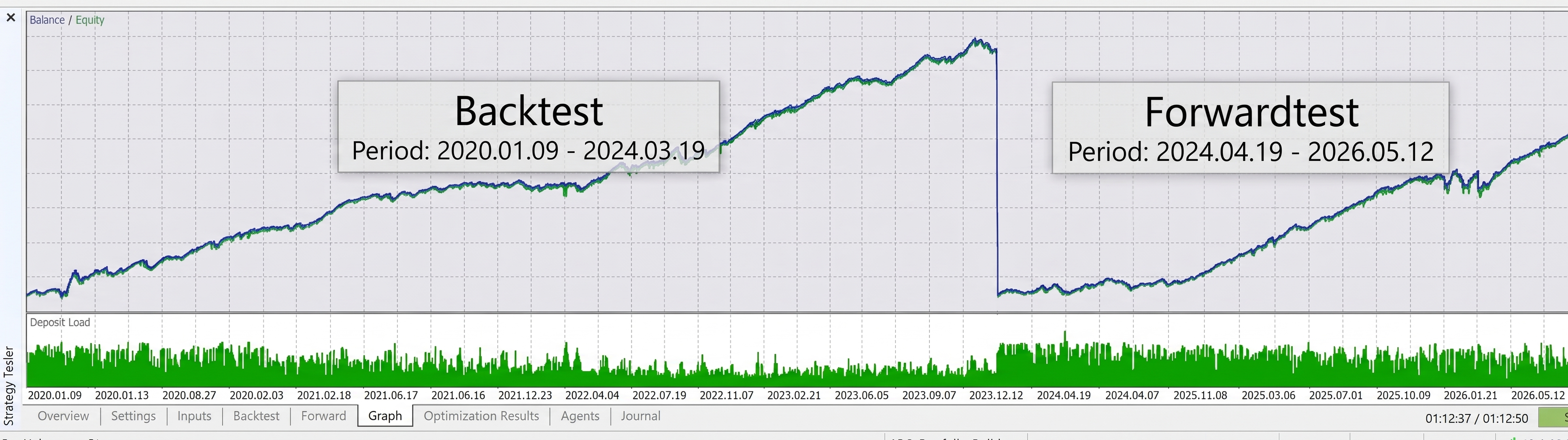
That's the same principle I ended up building AbacuQuant around, just scaled up from one exit rule to an entire portfolio. Instead of one strategy tuned to look good on one backtest, the logic behind each strategy is walk-forward tested and optimized (genetic optimization, not a single curve-fit) across different market regimes and asset classes, forex, metals, indices, energy, ETFs, individual stocks — and then combined into a portfolio specifically to keep cross-asset correlation low (the current version sits under 0.4 correlation across most pairs in the book). The idea isn't "find the one strategy that beats the market." It's "find enough structurally different, regime-validated pieces that the portfolio doesn't fall apart when one regime ends," which is exactly the failure mode people are describing in that XAUUSD thread, just at the position level instead of the portfolio level.

It also runs entirely inside your own MetaTrader account nothing custodial, your funds never move to a third party and the newer version adds the drawdown/consistency rules prop firms check for, since that's become how a lot of people are actually trading it live.

If any of this is useful for how you're thinking about your own trailing logic or portfolio construction, happy to go deeper in the comments. And if you want to see what the regime-validated approach looks like applied across a full portfolio rather than one exit rule, it's at abacuquant.com.

Cristian David Castillo Arrieta
Build your own portfolio and connect it to your demo (free) or live account.

www.abacuquant.com
Cristian David Castillo Arrieta
Hat den Code Execution Cost Sensitivity Analyzer veröffentlicht
Ein reines MQL5-Skript, das misst, wie robust der Vorteil einer Strategie gegenüber den Ausführungsgebühren ist. Es liest eine CSV-Datei mit den Daten „Date“, „Profit“ und „Volume“ zu abgeschlossenen Geschäften ein und modelliert die Kosten jedes Geschäfts als festen Anteil plus einen Anteil pro Lot. Es gibt die Breakeven-Kosten pro Trade, den Puffer (das Vielfache der angenommenen realistischen Kosten, bei denen der Nettogewinn null erreicht), den Nettogewinn und den Gewinnfaktor bei den angenommenen Kosten, den Anteil der Gewinner, die durch die Kosten zu Verlierern werden, sowie eine zusammengesetzte Bewertung der Kostenrobustheit von A+ bis F mit Empfehlungen aus. Ist keine Datei vorhanden, generiert das Programm ein reproduzierbares Beispiel und analysiert dieses, sodass die Ausgabe bereits beim ersten Durchlauf sichtbar ist. Keine externen Bibliotheken, kein Python, keine KI.
Cristian David Castillo Arrieta
Hat den Artikel Beyond Maximum Drawdown: Building a Drawdown DNA Analyzer in MQL5 veröffentlicht
Beyond Maximum Drawdown: Building a Drawdown DNA Analyzer in MQL5

Maximum drawdown is one number that hides what really matters: how often an equity curve declines, how long it stays below a previous peak, and how quickly it recovers. This article builds a native MQL5 tool that reconstructs the underwater curve, breaks it into individual drawdown episodes (depth, duration, recovery time), computes the Ulcer Index, Pain Index, and Recovery Factor, and combines them into a single resilience grade with practical recommendations. No external libraries, no Python, no AI.

Cristian David Castillo Arrieta Hat ein Produkt angeboten

Funded Trade Manager MT5 Die meisten finanzierten Konten gehen nicht aufgrund einer schlechten Strategie verloren. Sie gehen an einem einzigen Tag verloren, an dem es zu weit gegangen ist: eine überdimensionierte Position, ein Rache-Trade, eine Überschreitung des täglichen Verlustlimits. Prop Firm Guard ist ein Chart-Panel, das dieselben Limits anwendet, die Ihr Finanzierungsunternehmen anwendet – noch bevor das Unternehmen dies tut. Funktionen Verfolgt Ihr tägliches Verlustlimit und Ihren

Cristian David Castillo Arrieta
Hat den Code Profit Concentration Analyzer veröffentlicht
Ein natives MQL5-Skript, das misst, wie konzentriert der Gewinn einer Strategie ist – ob der Vorteil breit gestreut ist oder auf wenigen glücklichen Trades beruht. Es liest eine CSV-Datei mit Daten pro Trade (Datum, Gewinn) ein und gibt den Anteil des Nettogewinns aus den größten Trades an, den Gini-Koeffizienten der Gewinner, ein Konzentrationsprofil, einen Überlebenstest, bei dem die besten wenigen Trades entfernt und Nettogewinn sowie Gewinnfaktor neu berechnet werden, sowie den größten Einzel-Tagesgewinn im Vergleich zu einem konfigurierbaren Konsistenzgrenzwert – zusammengefasst in einer Konzentrations- und Konsistenzbewertung (A+ bis F) mit Empfehlungen. Wird keine Datei gefunden, generiert das Programm einen Beispielsatz, sodass es sofort einsatzbereit ist. Keine externen Bibliotheken, kein Python, keine KI. Das Hilfsprogramm „ExportTrades.mq5“ schreibt die Datei aus Ihrem Handelsverlauf.
Cristian David Castillo Arrieta
Hat den Code Drawdown DNA Analyzer veröffentlicht
Ein natives MQL5-Skript, das die Struktur der Drawdowns eines Kontos analysiert und sich nicht nur auf den einzelnen Wert des „maximalen Drawdowns“ beschränkt. Es liest eine tägliche Equity-Kurve (Date,DailyPnL CSV) ein, rekonstruiert die „Underwater“-Kurve und unterteilt diese in einzelne Drawdown-Episoden mit deren Tiefe, Dauer und Erholungszeit. Anschließend gibt es den Ulcer-Index, den Pain-Index, den Recovery-Faktor und die im „Underwater“-Bereich verbrachte Zeit aus und fasst diese zu einem einzigen Resilienz-Score (A+ bis F) mit Empfehlungen zusammen, die auf der Registerkarte „Experts“ angezeigt werden. Es werden keine externen Bibliotheken benötigt; wird keine Datei gefunden, generiert es eine Beispielkurve, sodass es sofort einsatzbereit ist.
Cristian David Castillo Arrieta
Introduction: The Context-Blind Expert Advisor Problem A carefully optimized Expert Advisor completes six months of profitable forward testing. The equity curve is smooth, the drawdown is bounded, and the trade distribution looks healthy. On the first Friday of the seventh month, the EA opens a 0...
Cristian David Castillo Arrieta
This is the most power full EA
Cristian David Castillo Arrieta
Hat den Artikel Building a Correlation-Aware Multi-EA Portfolio Scorer in MQL5 veröffentlicht
Building a Correlation-Aware Multi-EA Portfolio Scorer in MQL5

Most algo traders optimize Expert Advisors individually but never measure how they behave together on a single account. Correlated strategies amplify drawdowns instead of reducing them, and coverage gaps leave portfolios blind during entire trading sessions. This article builds a complete portfolio scorer in MQL5 that reads daily P&L from backtest CSV files, computes a full Pearson correlation matrix, maps trading activity by hour and weekday, evaluates asset class diversity, and outputs a composite grade from A+ to F. All source code is included; no external libraries are required.

1
123