
What banks and institutions see in the chart – and how you can see it too What exactly is Market Profile? Market Profile was developed in the 1980s by J. Peter Steidlmayer and the Chicago Board of Trade. The basic idea is quite simple: Markets spend more time at price levels that are considered fair by buyers and sellers, and less time at levels that are considered too expensive or too cheap.
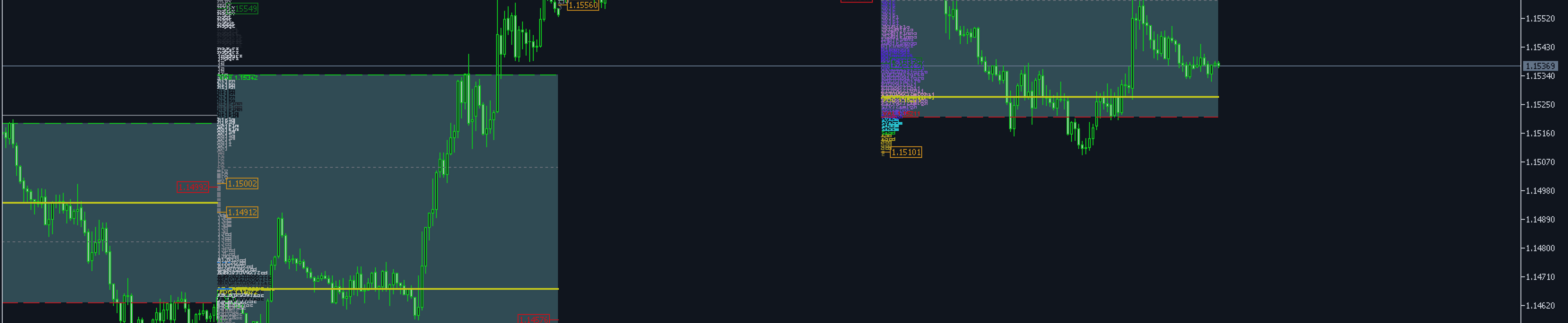
Instead of a classic candlestick chart displaying only the opening, high, low, and closing prices, Market Profile builds a vertical profile for each time period. Each price level is assigned a letter label (TPO – Time Price Opportunity) for each time block in which the price touched that level. The result is a horizontal histogram that immediately shows where the market was truly active.
four central concepts
Control point The price level with the highest TPO value. This is where most of the trading took place. The POC is the fair price of the session and often serves as a magnet for rebounds. | Value range The zone around the point of control (POC), where 70 percent of trading volume occurs. Breakouts from the value zone indicate strong movements; a return to the value zone is normal. |
Individual prints Price zones where trading was limited to a single time frame. The market quickly and aggressively broke through these levels. Typical reversal zones and frequently visited target levels in subsequent trading sessions. | Initial balance The price range of the first trading blocks of a session. Statistically, approximately 80 percent of all sessions close within the IBR. Breakouts signal strong price direction. |
What exactly does DRX Market Profile Master v4 offer?
The indicator fully and automatically implements these four concepts. It runs directly within MetaTrader 5 and requires no external software, data feed, or manual post-processing.
Session types and historical depth
Five pre-configured session types are available: hourly, daily, weekly, monthly, and a freely configurable custom interval. Up to 20 historical sessions can be displayed simultaneously on the chart, each calculated completely independently.
Two display modes
In the classic letter mode, the TPO letters (A, B, C, etc.) are displayed at the corresponding price level for each 30-minute block. The font size automatically scales depending on the chart zoom level.
In block mode, each active time block is displayed as a filled rectangle. The brightness is proportional to the trading volume in that block—levels with high trading activity are displayed brighter. In this mode, time, price, and volume are displayed simultaneously.
Checkpoint and assessment area
The Point of Confirmation (POC) is displayed as a horizontal line running through the entire session and can be additionally marked with a precise price. The Value Area is highlighted by a customizable fill between the VAH and VAL. The Value Area percentage is freely adjustable; the default value of 70 percent corresponds to the classic market profiling methodology.
Initial balance range
The number of time blocks considered as the initial balance is adjusted using a parameter. Furthermore, the indicator calculates additional extensions: potential breakout targets above and below the initial balance are predicted based on a configurable multiplier.
Single fingerprint detection
Individual prints are automatically identified and visually marked. If desired, they can be extended as a continuous line across the entire session area to emphasize the horizontal impact zone.
Interactive navigation
Three buttons on the chart (Back, Forward, Reset) allow you to move the displayed time period without opening the settings menu. Alternatively, you can use the arrow keys on your keyboard. Each time you zoom in on the chart, the font size and profile width automatically adjust.
For instruments with very large daily ranges—such as gold or the Nasdaq—the indicator automatically scales the price level based on the instrument's tick size. This means the same setting works for both EURUSD and XAUUSD without manual adjustments.
Technical specifications
| parameter | Value |
|---|---|
| platform | MetaTrader 5, build 2361 or higher |
| Session types | Hourly, daily, weekly, monthly, user defined |
| Historic meetings | up to 20 at a time |
| Display modes | Booklets (TPO) and blocks (volume heat map) |
| Maximum number of levels per session | 500 (auto scaling) |
| navigation | Chart buttons + arrow keys |
| Recommended charting periods | M5–H1 (daily), H1–H4 (weekly) |
| tools | Forex, gold, silver, indices, CFDs |
Classification within the framework of trading strategy
Market profile analysis doesn't replace an entry strategy, but rather clarifies the context. A classic example: the price is approaching yesterday's level. If one of the orders is directly below it, and the price reverses upward during the day, back toward the price zone, this is a structurally sound buy approach—not a coincidence, but a scenario with statistical justification.
The IBR index can also serve as a filter: as long as the price remains within the initial IBR range, a trend move is unlikely. Breakouts from the IBR followed by momentum, on the other hand, are classic trend signals, and are traded in the direction of the breakout.
This tool doesn't display signals or draw entry arrows. It simply shows the overall pattern. The trader makes the decision, but they receive significantly more comprehensive information.
DRX Market Profile Master v4
Available on the MQL5 Marketplace. All other tools from DRX Trading Systems can be found in the author's profile.