ML RSI an AI Classification and Ranking
- Göstergeler
- Sürüm: 1.0
- Etkinleştirmeler: 20

Overview
ML RSI | AI Classification & Ranking is an adaptive RSI intelligence system that combines momentum analysis, historical analog recognition, machine learning classification, confidence scoring, and dynamic trend management into a single framework.
Rather than interpreting RSI solely through traditional overbought and oversold thresholds, the indicator examines how similar RSI environments have behaved historically and uses those observations to classify current market conditions. The indicator transforms RSI into a multi-dimensional feature space, stores historical market behavior, identifies the closest historical analogs, and allows those analogs to vote on future directional bias. An adaptive feature-optimization engine then continuously learns which RSI characteristics provide the greatest predictive value under current market conditions.
The result is a hybrid system that blends:
· Multi-dimensional RSI analysis
· Historical analog matching
· Machine learning classification
· Adaptive feature weighting
· Rank & confidence scoring
· AI-driven trend management
Why This Indicator Is Unique
This is not a normal RSI. It is a full analog classification engine. It turns RSI behavior into an 8-feature market fingerprint, stores historical examples, labels them by future outcome, finds the closest past situations, lets those analogs vote, then converts the result into an adaptive ML RSI, rank/confidence scores, signals, and an ML-modulated Supertrend.
1. Builds 8 RSI-Derived Features
It does not only use the RSI value. It models: RSI level, slope, acceleration, distance from 50, percentile rank, RSI volatility, fast/slow RSI spread, and smoothed RSI regime. Every bar becomes a multi-dimensional state of momentum, not just 'RSI is 63.'
2. Creates a Memory Bank
Each confirmed bar is stored with its feature snapshot and a future outcome label. The label is based on whether price moved up or down after a fixed horizon, scaled by ATR. This is the learning dataset.
3. Uses K-Nearest-Neighbor Analog Matching
For the current bar, the indicator scans the historical bank and finds the closest past examples using a Lorentzian-style compressed distance. This reduces the impact of outliers — huge feature mismatches do not completely dominate the model.
4. Lets Analogs Vote
Nearest neighbors vote bull or bear, weighted by distance. Closer matches matter more. The output becomes: analog score, bias direction, agreement fraction, and gap tightness.
5. Auto-Optimizes Feature Weights
A Fisher-discriminant-style calculation determines which RSI features currently best separate bullish vs. bearish outcomes. Weights are rescaled and smoothed over time, so the model can learn that RSI slope matters more on one instrument while RSI percentile or regime matters more on another.
6. Builds Rank and Confidence
Signals are not triggered just because the model flips bullish or bearish. They must pass a quality system:
· Rank blends agreement, distance tightness, trend alignment, volatility health, regime fit, slope fit, smoothness, persistence, and penalties for chop or early flips.
· Confidence focuses on analog agreement, tightness, persistence, and slope fit.
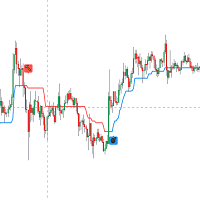
7. Adds Adaptive Supertrend
The Supertrend band width changes based on ML conviction. High conviction tightens the trailing stop. Low conviction or chop widens it.
How It Works
Machine Learning Feature Engine
Most RSI indicators analyze a single value. The ML RSI transforms RSI into a complete momentum fingerprint — eight independent characteristics describing how momentum behaves beneath the surface:
· RSI Value — Current RSI level
· RSI Slope — Rate of change
· RSI Acceleration — Change of the change
· Distance From Neutral — Distance from the 50 midpoint
· RSI Percentile Rank — Where current RSI sits vs. recent history
· RSI Volatility — Standard deviation of RSI
· Fast vs Slow RSI Spread — Short-term vs. long-term RSI gap
· RSI Regime — Smoothed directional trend of RSI
Together these create a much richer representation than a single RSI reading. Instead of asking 'Where is RSI?' the model asks 'What type of momentum behavior is currently occurring?'
Historical Analog Memory
The indicator continuously builds a memory bank of historical market behavior. Every confirmed bar is stored with its RSI fingerprint and the future outcome that followed. Over time the model accumulates hundreds or thousands of real market examples it can reference.
AI Classification Engine
The indicator searches for historical situations that closely resemble the current market across all eight RSI features simultaneously. Similarity is measured using a weighted Lorentzian distance function. Unlike traditional Euclidean distance, logarithmic compression reduces the influence of extreme outliers and prevents a single feature from dominating the comparison. The objective is not to find identical charts — it is to find historical momentum environments that behaved similarly.
Historical Analog Voting
After locating the closest historical matches, the system allows them to vote on the current market direction. Closer analogs receive greater influence. The weighted votes produce:
· Directional Bias
· Analog Agreement
· Classification Strength
· Similarity Quality
· Market Conviction
Rather than predicting the future directly, the model asks: 'How did the most similar momentum environments behave when they occurred previously?'
Adaptive Feature Optimizer
Markets constantly change. Features that are highly predictive in one regime may become less useful in another. The model continuously evaluates which RSI characteristics best separate bullish outcomes from bearish outcomes using Fisher Discriminant Analysis. Features that consistently separate winning from losing conditions receive larger weights; those that lose predictive power receive less influence over time.
Rank & Confidence Engine
Every setup receives two independent evaluations.
Rank measures setup quality:
· Historical agreement, analog quality, trend alignment
· Volatility conditions, regime structure
· Momentum consistency, market stability
Confidence measures model conviction:
· Historical consensus, analog clustering
· Directional consistency, signal persistence
· Structural confirmation
Signals are only generated once both quality and confidence thresholds have been satisfied.
ML Supertrend System
Unlike traditional Supertrends relying on a fixed ATR multiplier, the ML Supertrend dynamically adjusts sensitivity based on classification strength:
· High conviction — bands tighten, trend changes become faster, stops become more responsive
· Low conviction — bands widen, noise tolerance increases, whipsaws are reduced
How To Use
Reading The ML RSI
The ML RSI ranges from 0 to 100.
· Above 50 — bullish momentum conditions dominate
· Below 50 — bearish momentum conditions dominate
· Above 70 — strong bullish pressure
· Below 30 — strong bearish pressure
Reading The Signals
Long and Short signals appear only when the model detects a meaningful shift in market conditions and that shift passes both quality and confidence requirements.
· Long signal — classification engine identified a bullish environment supported by historical analog agreement, trend structure, and market conditions.
· Short signal — classification engine identified a bearish environment supported by historical analog agreement, trend structure, and market conditions.
Using The ML Supertrend
· Supertrend flips bullish — model considers the market in an uptrend regime
· Supertrend flips bearish — model considers the market in a downtrend regime
Use the ML Supertrend as both a trend filter and a dynamic trailing stop.
Settings