Point Break Indicator
- Göstergeler
- Sürüm: 1.0
- Etkinleştirmeler: 5

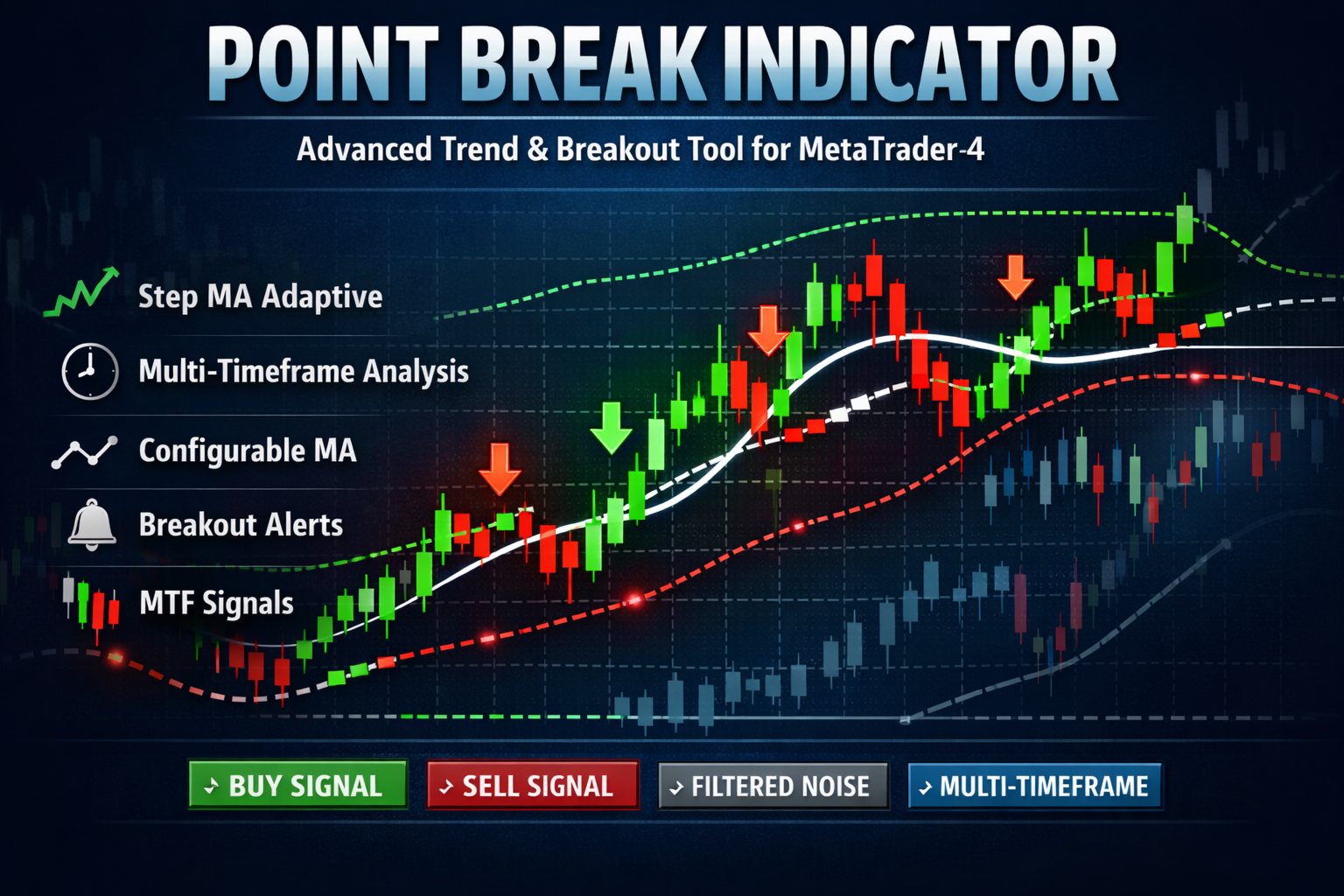
The Point Break Indicator is an advanced tool designed to identify trend changes, breakouts, and dynamic price levels through a combination of:
-
OMA Adaptive Average
-
Step Moving Average
-
Volatility filter
-
Multi‑Timeframe analysis
The indicator blends advanced smoothing techniques with volatility‑based breakout logic, allowing it to filter market noise and highlight more reliable signals.
✔ Main Features
Step Moving Average (StepMA)
At the core of the indicator is a Step Moving Average, a moving average that does not follow every small price movement but shifts only when price exceeds specific dynamic thresholds.
These thresholds are calculated using:
-
volatility (ATR)
-
sensitivity
-
step size
This allows the indicator to:
-
reduce noise
-
identify real trends
-
generate cleaner reversal signals
When price crosses the upper or lower band, the indicator changes direction and generates a signal.
✔ OMA Adaptive Average (smoothing engine)
The indicator uses an OMA (Optimized Moving Average) based on a modified Tilson T3 algorithm with 6 progressive smoothing levels.
This produces a moving average that is:
-
very smooth
-
low‑lag
-
adaptive to volatility
⚙ OMA Parameters
OmaLength
extern int OmaLength = 25;
Defines the period of the adaptive OMA.
Low values:
-
faster average
-
more frequent signals
-
more sensitive to noise
High values:
-
slower average
-
cleaner trends
-
fewer false signals
Typical value: 20–40
OmaSpeed
extern double OmaSpeed = 2.5;
Controls the reaction speed of the average.
| value | behavior |
|---|---|
| low | slower average |
| medium | balanced |
| high | more reactive |
Recommended values: 1.5 – 3
OmaAdaptive
extern bool OmaAdaptive = true;
Enables dynamic adaptive mode.
When active, the average period is not fixed but changes based on the ratio between:
-
trend signal (real movement)
-
noise (market noise)
If the market is:
-
Strong trend → faster average
-
Sideways market → slower average
This greatly improves signal quality.
⚙ StepMA Parameters
Sensitivity
extern double Sensitivity = 0.5;
Controls how easily the StepMA changes direction.
Low values:
-
more signals
-
more reactive
High values:
-
fewer signals
-
more stable trends
StepSize
extern double StepSize = 50;
Defines the minimum movement required to change trend.
The actual size is calculated using ATR, making it adaptive to market volatility.
High values:
-
fewer signals
-
stronger trends
Low values:
-
more reversals
⚙ Price Parameters
HighLow
extern bool HighLow = false;
Determines which price is used in the calculation.
-
false → uses Close
-
true → uses High/Low
When enabled, the indicator becomes:
-
more sensitive to intrabar breakouts.
⚙ Noise Filter
Filter
extern double Filter = 0
Activates a statistical filter based on the standard deviation of price changes.
Used to:
-
eliminate micro‑movements
-
reduce false signals
If the price change is below the calculated threshold, the price is considered unchanged.
FilterPeriod
extern double FilterPeriod = 0
Number of bars used to calculate the standard deviation.
If set to 0:
-
OmaLength is used automatically.
⚙ Dynamic Bands
UpPips / DnPips
These parameters create bands above and below the StepMA line.
They are useful for:
-
breakout levels
-
dynamic trailing stops
-
support/resistance zones
⚙ Multi‑Timeframe (MTF)
The indicator can read signals from higher timeframes.
This enables:
-
signal confirmation
-
multi‑timeframe analysis
✔ Benefits for the Trader
-
Reduced market noise
-
Clearer reversal signals
-
Automatic adaptation to volatility
-
Multi‑timeframe confirmation
-
High customization
Suitable for:
-
scalping
-
intraday
-
swing trading
The Point Break Indicator transforms the chart into a powerful decision‑making tool, offering immediate visual signals and reliable multi‑timeframe analysis. Perfect for professional traders and enthusiasts who want to operate with precision and confidence.