Qif Pro Market Regime Engine
- Indicadores
-
Dario Cadeddu
 Quantitative Trading Systems Developer focused on risk management, market regime analysis and structured trading workflows for MetaTrader 5.
 - Versão: 1.0
- Ativações: 5
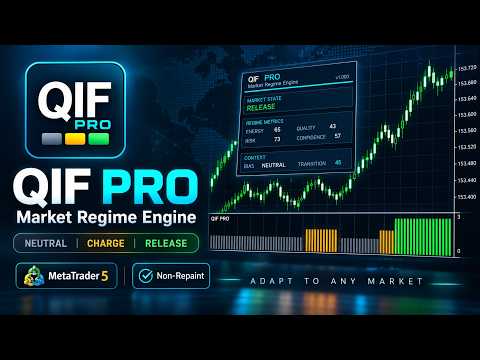
QIF PRO is a market regime and transition indicator for MetaTrader 5, built to help traders understand what kind of market phase is developing.
Most indicators focus mainly on direction. QIF PRO takes a different approach: it looks at the condition of the market itself and classifies it into three states:
NEUTRAL — CHARGE — RELEASE
It also tracks several internal measures such as Energy, Quality, Risk, Confidence, Structure, Transition and Directional Bias.
The goal is not to tell you when to buy or sell. The goal is to give you a clearer view of the environment in which your strategy is operating.
The three market states
NEUTRAL
No active QIF transition is currently detected.
This does not mean the market is flat or inactive. Price can still trend or move quickly while QIF remains NEUTRAL.
CHARGE
CHARGE represents a phase of organized compression or latent tension.
The market is building structure, but a qualified expansion has not yet been confirmed.
It is best understood as a preparation phase rather than an entry signal.
RELEASE
RELEASE represents an active expansion phase that meets the internal QIF conditions.
The important point is that RELEASE does not tell you whether price should move up or down.
Direction is handled separately through the Directional Bias.
Two ways to reach RELEASE
QIF PRO can enter RELEASE in two different ways.
The standard sequence is:
NEUTRAL → CHARGE → RELEASE
In this case, the market first builds a CHARGE phase and then moves into a qualified expansion.
The second path is:
NEUTRAL → RELEASE
This is called Direct Release.
It is designed for strong, well-structured expansions that begin without a clear CHARGE phase beforehand. The conditions for Direct Release are intentionally stricter.
Both types are displayed to the user simply as RELEASE.
Market metrics
QIF PRO uses several adaptive measures to describe the current market condition.
Energy
Shows the relative intensity of market activity and expansion.
Quality
Measures how clean and coherent the current market structure is.
Risk
Measures relative noise, disorder and instability in the market condition.
This is not account risk or monetary risk.
Confidence
Shows how strongly the internal QIF measures agree with each other.
It is not a probability of profit.
Transition
Measures the strength of the current change or acceleration in market conditions.
Structure
Measures how coherent the recent directional structure is.
Structure is also available through the public EA buffers.
Directional Bias
Shows the directional context of the recent structured move.
Bias is kept separate from the market state on purpose.
A RELEASE can therefore appear with a bullish, bearish or neutral Bias.
Adaptive normalization
Most QIF metrics are normalized against the recent history of the instrument.
So, for example, an Energy reading of 80 does not mean there is an 80% chance of a large move.
It simply means current Energy is high compared with the recent reference window used by the indicator.
This adaptive approach helps QIF PRO work across markets with very different price scales and volatility characteristics.
Designed for different markets
QIF PRO is not built around a single currency pair.
The same core logic can be used on:
- Forex
- Gold
- Indices
- Commodities
- other MetaTrader 5 instruments with enough historical data
The mathematical core was internally validated using the same default configuration on:
EURUSD, GBPUSD, USDJPY, USDCAD and XAUUSD on H1
across two different broker feeds.
Each dataset contained 5,000 closed bars, for a total of 50,000 H1 bars.
This validation was used to check the consistency of the market-state engine across different instruments and broker feeds.
It was not a profitability backtest.
Closed-bar operation
QIF PRO works with closed bars.
The current forming candle is not used as the final published market state.
This helps reduce intrabar instability and makes the indicator more suitable for systematic use and Expert Advisor integration.
The state machine also uses confirmation bars, minimum holding periods, abort conditions and cooldown logic to avoid excessive state changes.
If MetaTrader later updates or backfills historical data, QIF PRO may recalculate the affected history. This is different from changing a signal while a candle is still forming.
CPU-efficient design
QIF PRO uses an incremental calculation model.
During normal operation, it avoids recalculating the entire history on every tick.
A full recalculation is only performed when needed, for example after initialization or a change in market history.
This makes it suitable for multi-chart use and automated strategies.
Operating modes
QIF PRO includes four operating modes:
AUTO
Recommended for most users.
BALANCED
Uses the baseline balanced configuration.
FAST
Uses shorter windows and faster confirmation for a more responsive behavior.
ROBUST
Uses longer windows and more conservative confirmation.
For most users, AUTO is the best place to start.
Expert Advisor integration
QIF PRO can be accessed through iCustom / CopyBuffer and exposes public data buffers for automated strategies.
Buffer 2 — State
0 = NEUTRAL
1 = CHARGE
2 = RELEASE
Buffer 3 — Risk
0–100
Buffer 4 — Energy
0–100
Buffer 5 — Quality
0–100
Buffer 6 — Confidence
0–100
Buffer 7 — Structure
0–100
Buffer 8 — Transition Strength
0–100
Buffer 9 — Directional Bias
-100 to +100
For EA use, the recommended reading is the latest closed bar, using shift 1.
This allows QIF PRO to be used as a market-regime or context filter inside an automated strategy.
How QIF PRO can be used
QIF PRO can be useful with different trading styles.
A breakout trader may use CHARGE as a preparation phase and RELEASE as confirmation that expansion has actually started.
A trend-following strategy may use RELEASE together with its own directional rules.
A mean-reversion strategy may decide to reduce exposure during strong expansion phases.
A discretionary trader can use the panel to quickly understand whether the market is neutral, building pressure or already expanding.
The important point is that QIF PRO is designed to work alongside your trading logic, not replace it.
Main inputs
Mode
AUTO / FAST / BALANCED / ROBUST
Use Tick Volume
Enables the limited relative tick-volume contribution used by the activity engine.
Show Panel
Shows or hides the QIF information panel.
Max Bars
Sets the maximum number of historical bars processed and displayed.
Structure Lookback
Reference window used for market-structure analysis.
Activity Short Lookback
Short-term activity window.
Activity Long Lookback
Long-term activity reference.
Volume Lookback
Reference window for relative tick-volume analysis.
Normalization Window
Rolling reference window used by the adaptive normalization engine.
Advanced inputs also control confirmation, minimum state duration, cooldown, CHARGE abort logic, RELEASE conditions and Direct Release conditions.
The default settings are the recommended starting point.
Important
QIF PRO is a market-state and transition indicator.
It is not a complete trading system and it does not place trades.
RELEASE does not mean BUY.
CHARGE does not guarantee that a breakout will occur.
Directional Bias is not a standalone trading signal.
Confidence is not a probability of profit.
Risk is not account or monetary risk.
QIF PRO is designed to add context to an existing trading method, together with proper risk management and independent entry and exit rules.