 MetaTrader 5
 Experts
 지표
지표
 스크립트
스크립트
 라이브러리
라이브러리
 보관함
보관함
당사 팬 페이지에 가입하십시오

Gold Session Boxes: Sydney, Tokyo, London, New York and the overlap - MetaTrader 5용 지표

What I build:
- 조회수:
- 1772
- 평가:
- 게시됨:
- 업데이트됨:
-
 이 코드를 기반으로 한 로봇이나 지표가 필요하신가요? 프리랜스로 주문하세요
프리랜스로 이동
이 코드를 기반으로 한 로봇이나 지표가 필요하신가요? 프리랜스로 주문하세요
프리랜스로 이동


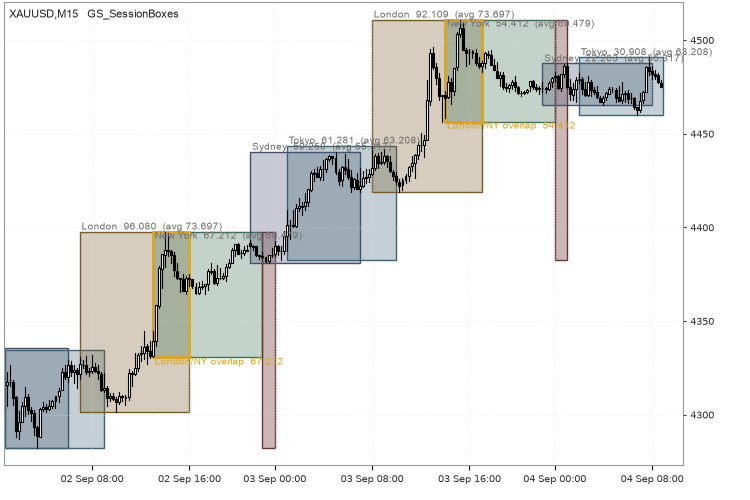
Gold moves in sessions. Most of the XAUUSD daily range is made between 13:00 and 16:00 GMT, when London and New York are both open, while the Sydney and Tokyo hours usually drift inside a narrow band and the rollover hour at 22:00 GMT carries the widest spread of the day. This indicator puts those facts on the chart so you can see at a glance which session you are trading, how far it has already moved, and how that compares with the average.
What it draws
- One high/low box per session and per day: Sydney, Tokyo, London and New York, each in its own colour, filled or outline only.
- The London/New York overlap as a thicker outlined box drawn on top of the session fills.
- The daily rollover hour shaded across the day's high and low, as a reminder to avoid opening trades into the spread widening.
- A label on every box with the session range in price units (gold, indices) or points (FX pairs) and the average range of the last N completed sessions, for example London 92.109 (avg 73.697).
Time zones
All session times are entered in GMT, which is how session tables are normally published. The indicator reads the difference between the broker's server clock and GMT with TimeTradeServer() - TimeGMT() , rounds it to the nearest 15 minutes and applies it to every window, so the boxes stay correct across the spring and autumn daylight-saving changes without editing the inputs. The offset is refreshed on every new bar.
Inputs
- Sessions: show/hide and start/end hour (GMT, 0-23) for Sydney (21-6), Tokyo (0-9), London (7-16) and New York (13-22). A session that ends on the next day, such as Sydney, is handled automatically.
- Overlap and rollover: overlap window (13-16 by default) and the rollover hour (22).
- Appearance: number of days to draw (10), fill boxes, show labels, number of sessions used for the average range (10), colours, label font size.
- Alerts: optional pop-up, push notification or sound when a session opens; each session alerts once.
How to use it
- Attach it to M1-H1 charts. On timeframes above H1 a session is shorter than one bar and the indicator draws nothing.
- Trend-following: trade only inside the London box and the overlap, where the range is being made; treat Tokyo box breakouts with caution because the Asian range is often re-entered when London opens.
- Range comparison: when the current London range is already above its average, the remaining move is statistically smaller; a small Tokyo box before London often precedes a wide London session.
- Rollover: the shaded hour is where most stop-outs on tight stops happen. Widen or avoid.
Implementation notes
- No indicator buffers, indicator_plots 0 : everything is chart objects with the prefix GSSB_ , removed in OnDeinit .
- Ranges are taken with CopyHigh / CopyLow between the window times, so they are exact regardless of the chart timeframe.
- Objects are redrawn once per new bar, not on every tick, and the object count is bounded by days × sessions.
- All objects are hidden from the object list and drawn in the background so they never block clicks on the chart.
Built for XAUUSD, but it works on any symbol. The screenshot shows XAUUSD M15 with the default settings on a black-on-white chart.
MT5 Memory Meter Panel
A lightweight memory meter dashboard that reveals current MT5 memory usage and key resource statistics directly on the chart.
 AI Prompt Writer - Simple AI Assistant Customization
Customize your MetaTrader 5 AI Assistant with selectable language, personality, menu and behavior using a simple prompt file.
Completed Bar Trend Regime Dashboard MT5
An MT5 dashboard that classifies completed-bar trend regimes using EMA structure, ADX/DI, higher-timeframe confirmation, ATR, breakout position and spread context.
Pending Order Inspector MT5
Read-only panel that checks a BUY STOP or SELL STOP against the symbol contract before you send it: price tick grid, volume minimum/step/maximum, stop distances and order permissions. It never sends, changes or suggests anything.