Elliott Wave Engine
- Indicatori
- Versione: 1.2
- Aggiornato: 10 luglio 2026
- Attivazioni: 5

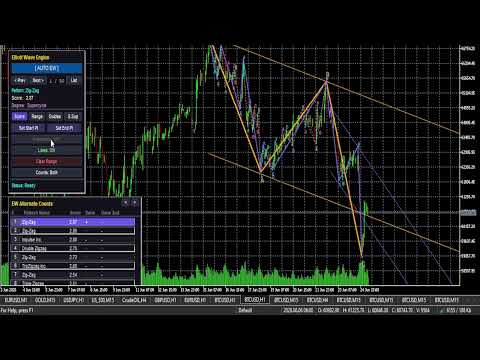
The Auto Elliott Engine is a tool designed for MetaTrader 5 that automates the identification, decomposition, and projection of price structures based on the Elliott Wave Theory.
Powered by a pattern-recognition engine, this indicator processes price action to identify market configurations, translating data into structured scenarios.
Key Features-
Multi-Degree Recognition: Analyzes price action across multiple fractal levels. From higher degrees, such as Supercycle or Cycle, down to minor structures.
-
Identifies several Pattern formations:
- Impulses
- Contractive/Expanding Diagonals
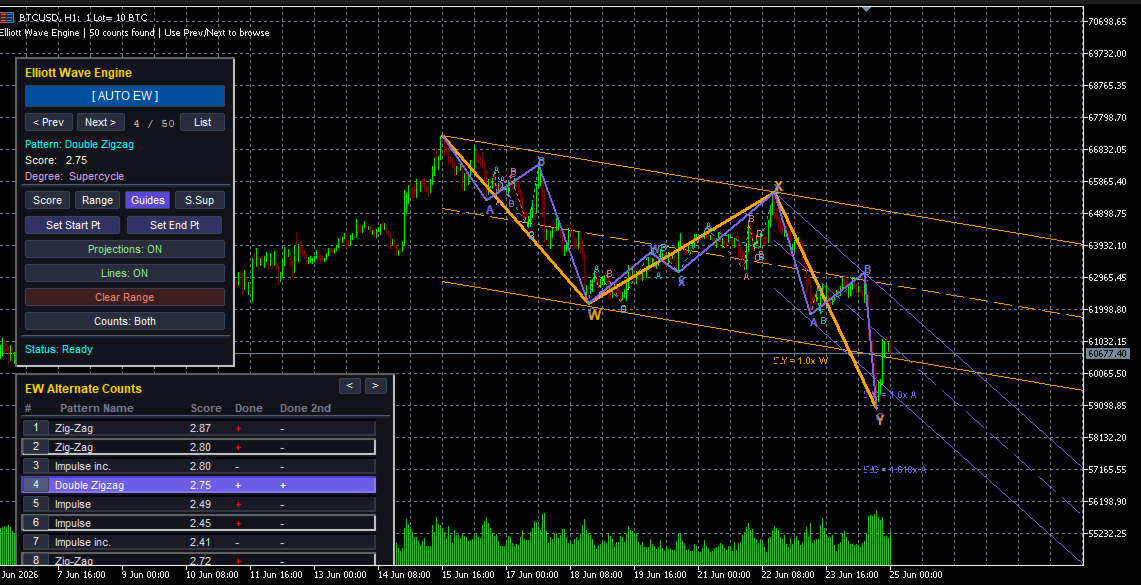
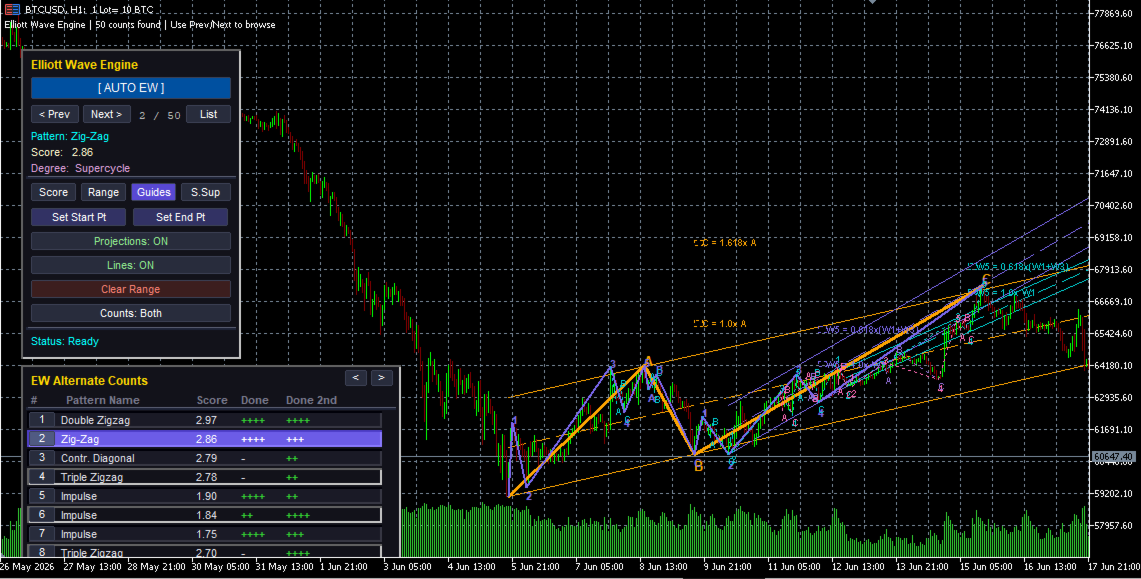
- Simple and doble or triple Zig-Zags
- Regular/Expanded Flats
- Triangles
- WXY/WXYXZ Combinations.
-
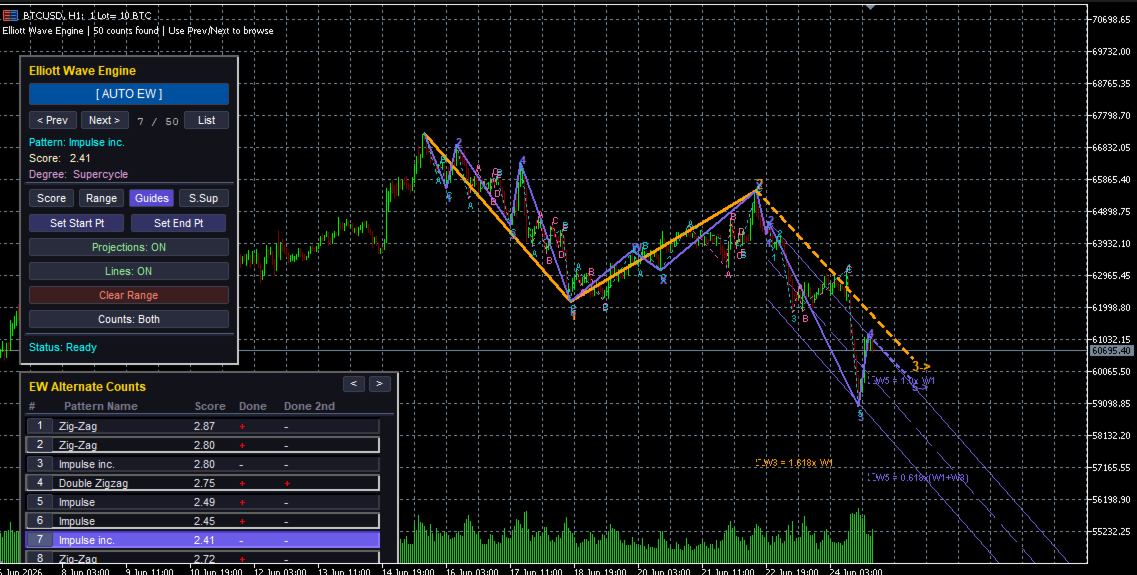
Fibonacci Projections: The system projects retracement and extension zones on the chart based on the active wave. The interface allows for toggling between visualizing key areas of the last wave or a mapping of all calculated ranges.
-
Scoring System: Each suggested count undergoes a qualification process. If a structure shows anomalies or exceeds the margins of classic Elliott behavior, such as excessive retracements or unusual proportions, the engine assigns penalties to prioritize others counts that adhere to classic wave theory.
- Appears right below the main panel, stacked vertically. - Aligns cleanly on left edges for left corners and right edges for right corners. - Automatically shifts the main panel upwards in bottom-corner configurations to ensure both panels fit on screen. - Lists up to 8 counts per page with index buttons, pattern names, scores, and completion checks (`+`, `++`, etc.). - Features mouse-wheel scrolling. - Click-to-Select: Clicking on any alternate count row instantly updates the chart drawing to showcase that specific pattern.
Ideal For
Technical market analysts and price-action specialists who seek to assist their wave counting and automate the mapping of price expansions and contractions.
Important Note: This indicator does not take into account all Elliott Wave guidelines; for example, it does not include "The Right Look".
How to Use-
Start the Analysis: Click the "Start" button to select the starting point of the wave count. This should be an extreme point from which the count originates.
-
Historical Range: We recommend selecting a range of 100 to 200 historical bars. Calculating the wave structure is resource-intensive; while you can experiment with a larger historical range, please be aware that processing times will increase. If you require analysis over a larger historical range, we recommend switching to higher timeframes.
-
Run the Count: Click the "Auto EW" button to execute the count within your selected range.
-
Manage Projections: You can toggle the visual projections by clicking the "Projections: ON / Projections: OFF" button.
-
Navigation: Use the "< Prev" and "Next >" buttons on the interface to view alternative wave counts.
- Score: Based on the overall point rating.
- Range: Based on the price range covered.
- Guides: Based on guidelines.
- S. Sup: Based exclusively on the score of the higher-degree pattern.
The Vertical label spacing multiplier has been set to 1 by default. However, if you notice that labels overlap on the same vertex, we recommend increasing this value to 2 or 3 to resolve the issue (for example, in assets like BTC).
By default, the indicator is configured to perform a count automatically as soon as it is loaded onto the chart. But It works best when the user selects the range they want the indicator to process and then clicks "Auto EW".
Strategy Tester:
The interactive panel is now supported in the Strategy Tester. It performs almost identically to real-time Live Charts (only minor differences are expected due to the nature of the testing engine).
- Auto-analyze on load = true (by default)
- Analyze on new bar close = true (by default)