True Momentum LPD
- Indicatori
- Versione: 1.0

MT5 Version:
Pre Note: The indicator uses the Open price value for calculations.
This indicator represents a genuine momentum oscillator according to the true definition of "Momentum", and as realised by the techniques of digital filters. Scholarly papers on the subject by the current developer can be found here and here, but in this description we shall borrow only the minimum of conceptual and mathematical framework needed. In the process, we expose some long-held myths about indicators supposedly measuring price momentum, and in particular the one called the "Momentum Oscillator", which is included among the standard MT indicators.
In my earlier free indicators (MT4: DFT of Price and Q n D Frequency Response) , one can get an introduction to frequency analysis to obtain the recognition that many technical indicators have the form of linear digital filters.
An ideal price momentum oscillator has the magnitude frequency response shown in the second screenshot. The response is linear up to a cutoff frequency beyond which all higher frequencies are filtered out to eliminate the noise. The bigger the cutoff frequency the faster the response (maximum 0.5) .The initial linear region is necessary for the filter to act as a differentiator, which is the embodiment of the concept of momentum. A filter with such a frequency response is called a Low Pass Differentiator (LPD), and is subject to much research in the field of digital signal processing (DSP) . Actual filters meeting this criterion must necessarily have a large filter order resulting in a huge signal lag. So in practice, the goal is to only approximate this delta shaped frequency response.
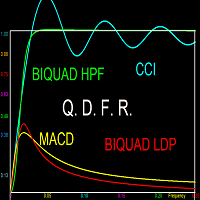
The third screenshot shows the frequency response of the "Momentum Oscillator" on the of MT4 terminal. It looks very different from the LPD response just explained. Metaquotes Corp would do well dropping it from its platform! Careful investigation of the oscillator shows many inconsistencies between price movements and indicator movements (and I am not talking about divergences).
The fourth screenshot shows a comparison of the frequency response of the MACD and the Biquad LPD. Both have the necessary features to be recognised as momentum oscillators (and also the Awsome Oscillator) . But the Biquad LPD is better. It is more linear in the linear region and quenches more high frequency noise. The lag is also lower than the MACD in the important frequency range (screenshot five). The high noise suppression of the LPD allows the implementation of the true acceleration having a parabolic frequency response as shown in screen shot 6. Compare to screenshot five with the inappropriate form of the MT4 platform Acceleration oscillator calculated from the Awesome oscillator.
FINALLY, about the indicator function, appearance and usage: the indicator calculates and plots the Biquad LPD for the selected inputs. Green histogram lines are go long signal, and Red regions go short. The indicator can be called via "iCustom" to import the first buffer signal which is +10 for long and -10 for short and 0 otherwise. The signal is always on, but it can be monitored (if desired) by the input options. There are three modes for signalling which are subject for optimisation.
Check out (MT4: this indicator) to see the performance of the Biquad LPD momentum indicator.
More Observations on "Momentum Oscillator":
Unfortunately, there are numerous misconceptions in this field, and many times claims are made without proof, or even a proper understanding. We will concentrate here on claims dealing with momentum, they are:
1- The conventional indicator "Momentum Oscillator", being the difference (or ratio) between the the current price and the price p- periods has already been falsified in my preprint here . Momentum is not calculated as the difference in price.
2. Although the MACD possesses some of the required features to fit the description of a momentum oscillator (see my pre-print), this is by accident - not by design. It is not in general true that momentum can be defined as the difference between a fast moving average and a slow moving average.
3. The claim that momentum oscillators are leading indicators needs clarification. The terms "leading" or "lagging" have very specific meanings in the mathematics of oscillations, and in physics. The output of a digital filter always lags the input, as necessitated by the principle of causality. So what is really meant by the MACD, for example, being a leading indicator? Momentum is a quantity related to motion and its direction.As a momentum oscillator, the most important information it can provide is the direction of price. A positive MACD ought to indicate increasing price, while negative means decreasing price. Since price changing direction is one of the most important factor in trading decisions, then the zero-crossing of the MACD line, which supposedly means price changing direction, ought to be the the most important piece of information from this indicator. But if you pay attention to all zero crossings of the MACD (use long periods to minimise volatility effects), you will find that they are always delayed relative to the the price reversal visible on the price chart. They never lead. But the claim of technical analysts is that the VALUE REVERSAL of the oscillator happens before the reversal of price. This could happen, but without certainty. When we consider the reversal of a proper momentum oscillator, we are investigating the acceleration (or deceleration) of price. It is true that acceleration determines the price motion after an interval in time, at the assumption the acceleration is constant or not changing very much - but this is seldom the case. Anyway, the momentum oscillator should be of high quality and very low noise to discern acceleration. But the main MACD line crossing the 9 period signal line is not high quality.
3. A true momentum oscillator does not represent the price itself, rather, it represents the change in the price. So trying to read into the price trend from the momentum oscillator is wrong in principle. The reason that there is remnant info of the trend (like tops or bottoms) has to do with the the "leakage" of the filter. All this info should have been removed by the momentum oscillator. Consider the filter having the near perfect frequency response shown in screenshot 8 (next to last), this filter was designed by Matlab's Filter Design App in the Signal Processing utility. The oscillator given by this filter is shown in screenshot 9 (last), Only smooth curving lines are visible, there is no information about trend. But notice how much lagging this oscillator is relative to the price itself. It has a perfect momentum oscillator shape, but it is useless because of the large lag. Those who try to read the trend from a momentum oscillator are milking the sickly cow. (This does not apply to my Biquad High Pass Filter , whose purpose is to accentuate divergences and small/medium range trends, or to the RSI for example, because the RSI is not a momentum oscillator as erroneously considered, but is a high pass filter detrender).
4. Because trend-following is meaningless for a momentum oscillator, and because all tops and bottoms should disappear in a good oscillator, then it follows that following divergences is not a good practice. Again, here one is trying to read from undiscarded refuse.
5. Does the slope of a moving average indicate momentum ? Yes ! But the moving average (or low pass filter) must satisfy the crucial condition of having flat pass-bands in its magnitude frequency response. For example, none of the standard averages SMA, EMA or LWMA have flat passbands. If you have the time, please install and play with my Quick n Dirty Frequency Response indicator.
The take from this discussion is this: Only zero crossings and oscillator value reversals have a well established meaning. If the momentum oscillator is of high quality (i.e. linear frequency rise, low noise, and low lag.), then it becomes an effective tool for trading.
Final Note: I have spent a considerable amount of time and effort searching for the ultimate linear momentum LPD oscillator. Versions do exist,for example LPD's designed by the Filter Design App of Matlab (differentiator design), are exquisite . See the last screenshot. But they have a very long lag. The ones designed by the equiripple method allow (with a little trickery) to get properly normalised minimum phase filters. But these are still laggy compared with the Biquad (which, like the MACD and others, is a fast IIR filter). Even doing tricks like using interpolation techniques have disadvantages, they improve the lag in some frequency ranges but introduce more noise in others. There is always a trade-off between the different oscillators: if they are better in one area, they are worse in another area. For this reason, one should pick a a momentum oscillator, and get to know its strength and weaknesses. This is the only way to be successful. The Biquad introduced here is not bad at all. But I provide some of my other "high tech" momentum oscillators (MT4: here) .