ScoreEdge Apex
- Experts
-
Noel Anjao Alube
 Dedicated to developing smart, data-driven trading solutions with a strong focus on performance, risk management, and innovation. Committed to transforming trading ideas into automated strategies.
 - Version: 1.0
- Activations: 5
ScoreEdge Apex — Regime-Adaptive Confluence Trading Engine for XAUUSD & Multi-Asset Markets
There are thousands of Expert Advisors on this marketplace that promise 90% win rates and guaranteed monthly returns. ScoreEdge Apex is not one of them. It was built on a simple, unglamorous premise: most EAs fail live traders not because their entry logic is bad, but because they apply the same entry logic to every market condition. A breakout strategy forced onto a dead Asian session bleeds the account in noise. A mean-reversion strategy forced onto a strong NFP trend day gets run over. ScoreEdge Apex's entire architecture exists to solve that one problem — know what kind of market you're in before deciding how (or whether) to trade it.
Below is a complete breakdown of every system inside the EA, so you know exactly what you're buying before you buy it.
1. The Regime Detection Layer — Reading the Market Before Acting
Every new bar, ScoreEdge Apex runs a Market Regime Classifier that analyzes:
- ADX (Average Directional Index) — measures whether the market is trending or directionless
- Bollinger Band Width — measures whether volatility is expanding or contracting
- ATR (Average True Range) behavior — measures the current volatility regime relative to recent history
- Candle-size spike detection — flags abnormal bars (larger than 4x average ATR) as likely stop-hunt or news-spike manipulation
Based on this analysis, the EA classifies the market into one of four states: Trend, Range, Volatility Expansion, or Stand-Down. Only the logic appropriate to the detected regime is allowed to activate. This single design choice is what prevents the EA from "fighting" the tape — it will not try to trend-follow in a dead, choppy range, and it will not try to fade strength in a genuine breakout. When the market shows signs of manipulation (an abnormal spike candle), the EA does the professional thing: it stands down and waits for the noise to clear rather than getting run over.
2. The Confluence Scoring System — Transparent, Not a Black Box
This is the heart of the EA, and it's built to be fully explainable — every trade decision can be traced back to a visible, weighted score out of 100:
| Component | Weight |
|---|---|
| Higher-timeframe (H4/D1) trend alignment | 20 |
| Market structure confirmation (BOS/CHoCH) | 15 |
| Order block / supply-demand zone reaction | 15 |
| Liquidity sweep detection | 10 |
| Fair value gap presence | 10 |
| RSI/MACD momentum confirmation | 10 |
| Session timing quality | 10 |
| Volume/tick confirmation | 5 |
| Spread condition check | 5 |
Execution thresholds are hard-coded into the logic: scores of 75+ trigger a full-size position, 60–74 trigger a half-size position, and anything below 60 is skipped entirely. Counter-trend setups — trades against the higher-timeframe bias — are held to a stricter 85+ threshold, because trading against the dominant trend needs a much higher bar of evidence. There is no neural network, no "AI black box" making unexplainable decisions here — every component of the score is visible, loggable, and tunable by you.
3. Institutional-Style Risk & Trade Management
Position sizing is calculated dynamically from your account equity, your configured base risk percentage, the confluence score of the specific trade (higher-scoring trades can size up slightly, within your caps), and recent performance (losing streaks automatically reduce size). Stops are never arbitrary pip counts — they're calculated from ATR and then widened further if needed to clear the nearest real structural swing point, so you're not getting stopped out by routine market noise sitting a few pips too close to price.
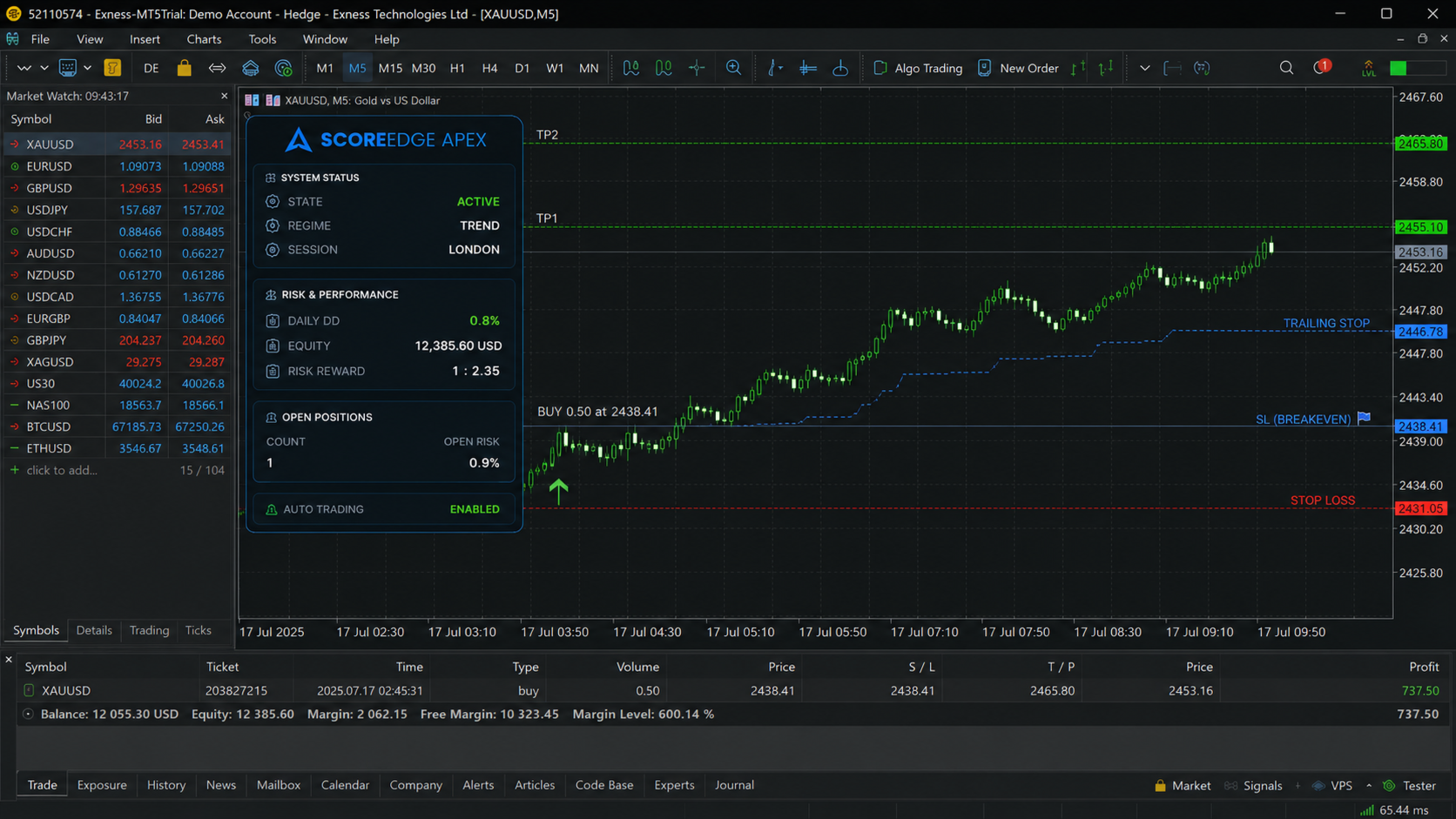
Winning trades are managed with a scaled-exit system:
- First target reached → partial position closed, stop-loss moved to breakeven automatically
- Extended target reached → a second partial closed
- Remaining runner → managed with a smart trailing stop that adapts to ATR and structure, letting genuine trends run further than a fixed take-profit ever would
4. Capital Preservation Is Hard-Coded, Not Optional
This is the section serious traders care about most, and it's built into the core logic rather than left as an easily-ignored setting:
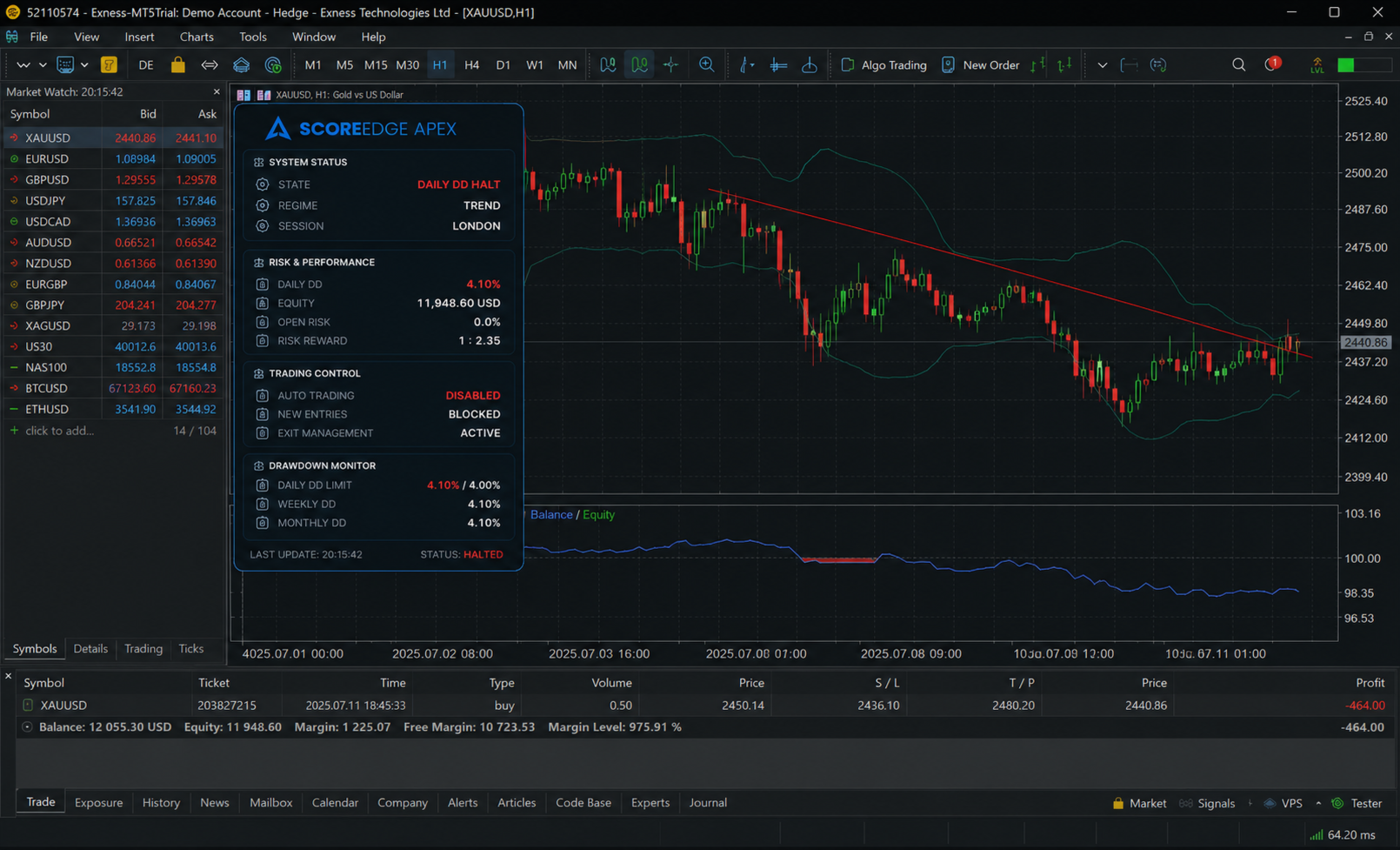
- Daily drawdown circuit breaker — trading halts automatically for the remainder of the day once the configured daily loss limit is hit
- Weekly drawdown response — risk is automatically cut in the following week if weekly losses exceed the configured limit
- Monthly recovery mode — the EA drops to minimal risk sizing if monthly drawdown breaches your ceiling, prioritizing capital preservation over chasing losses back
- Consecutive loss cooling-off — after a defined run of consecutive losing trades, the EA pauses new entries for a full trading day
- Exposure caps — hard limits on how many USD-correlated positions and how many metals (gold/silver) positions can be open at once, plus a total open-risk ceiling across the whole account so you're never accidentally over-leveraged across multiple symbols simultaneously
None of these are cosmetic settings you have to remember to configure correctly — they are structural guardrails built to protect the account even if you never touch a single input.
5. Multi-Asset Opportunity Scanner
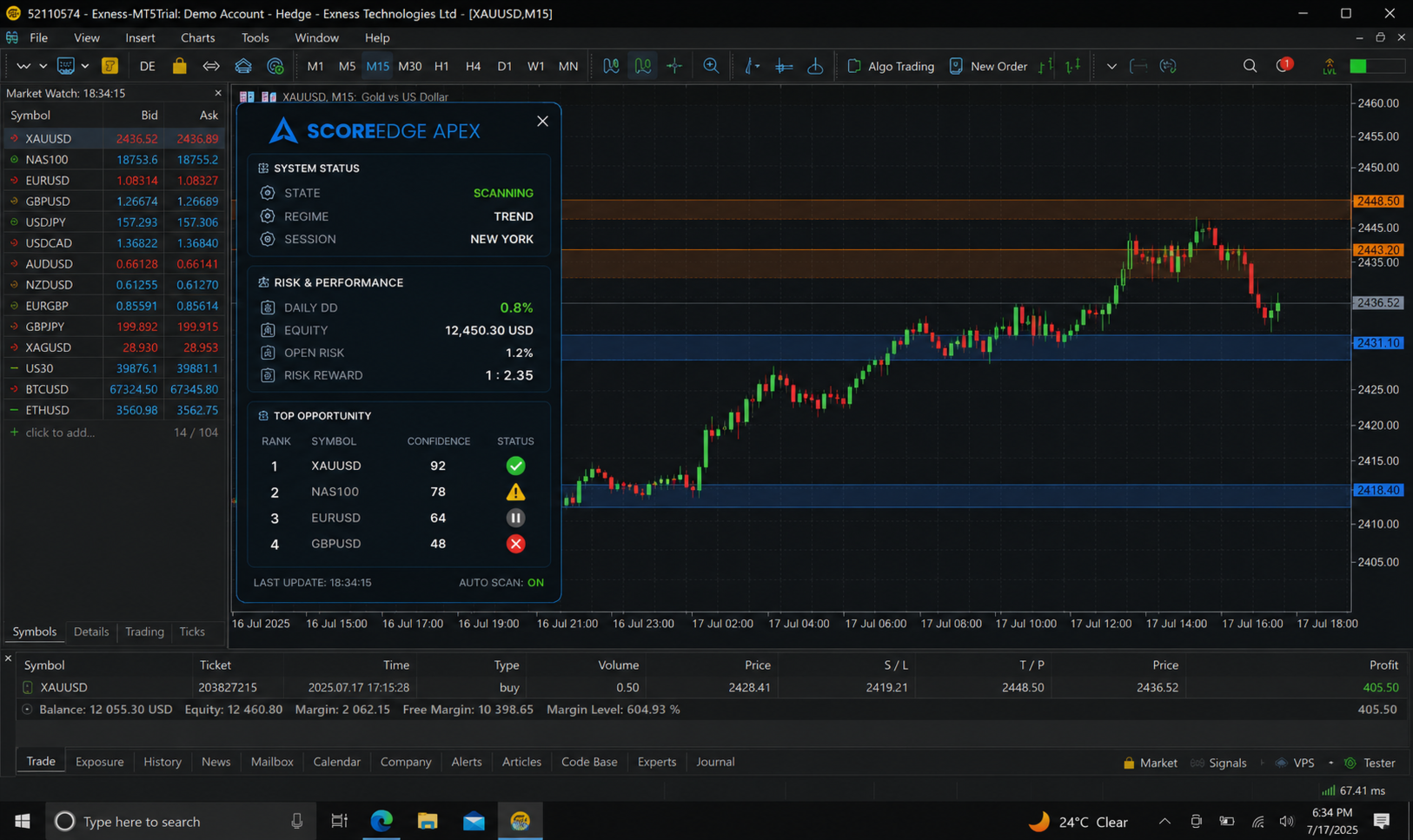
While XAUUSD (Gold) is the EA's primary specialization, ScoreEdge Apex can optionally scan a full configurable watchlist simultaneously — XAUUSD, XAGUSD, EURUSD, GBPUSD, USDJPY, AUDUSD, BTCUSD, and more. Every symbol on the watchlist is scored using the exact same confluence engine in real time, ranked, and only the single highest-ranking opportunity is acted on. This means you're never sitting there missing a clean setup on a correlated pair just because you were only watching one chart.
6. Session & Spread Intelligence
Trading activity respects real market-session behavior rather than treating every hour of the day the same:
- Asian session — reduced activity, smaller size
- London session — standard trading activity
- London/New York overlap — highest-quality liquidity window, standard-to-elevated activity
- New York close — reduced activity as liquidity thins
- Dead zone (low-liquidity overnight hours) — full stand-down, no new trades
Spread and slippage guards reject signals outright when execution conditions aren't clean, so a temporary broker-side spread spike can't force the EA into a bad fill.
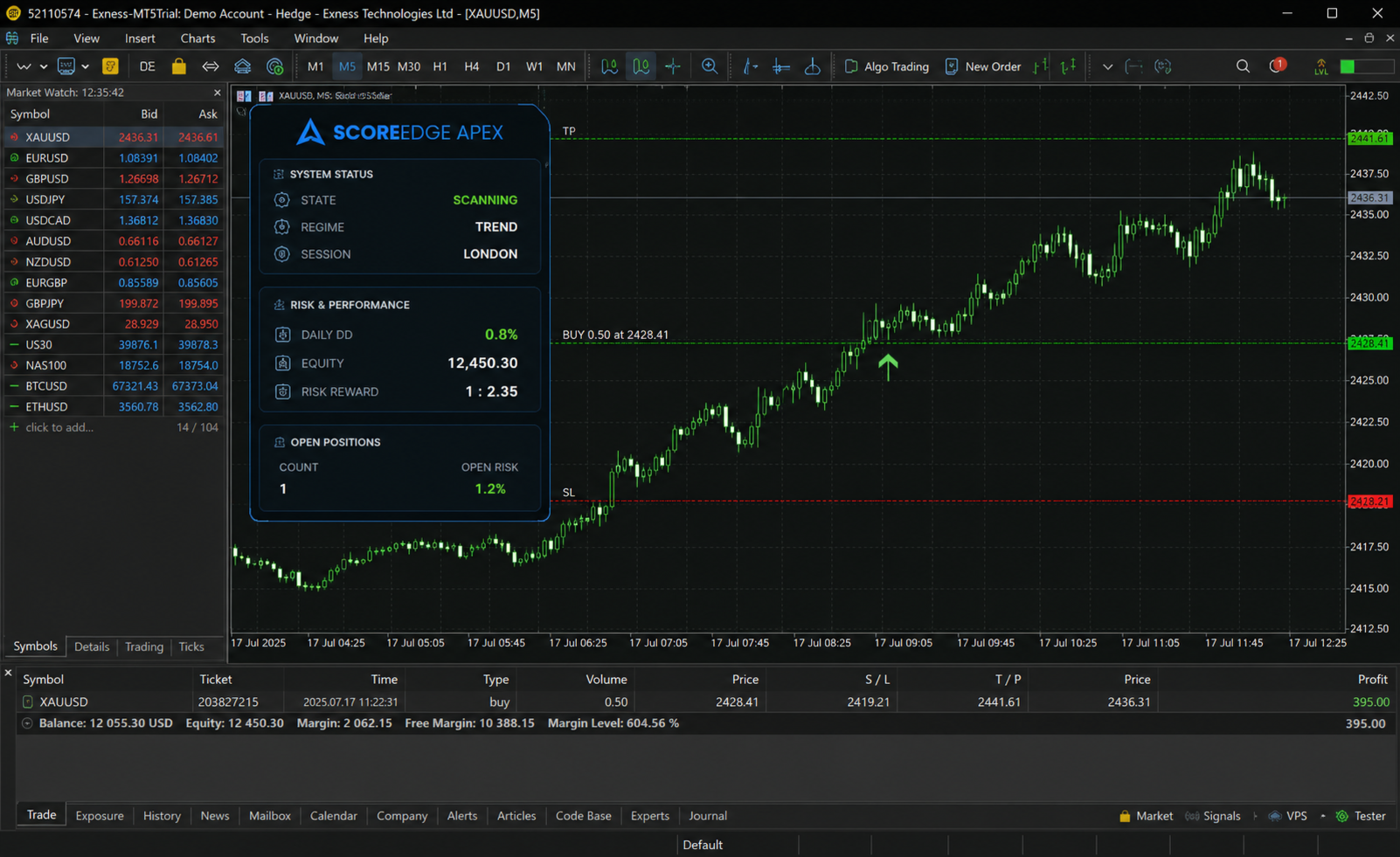
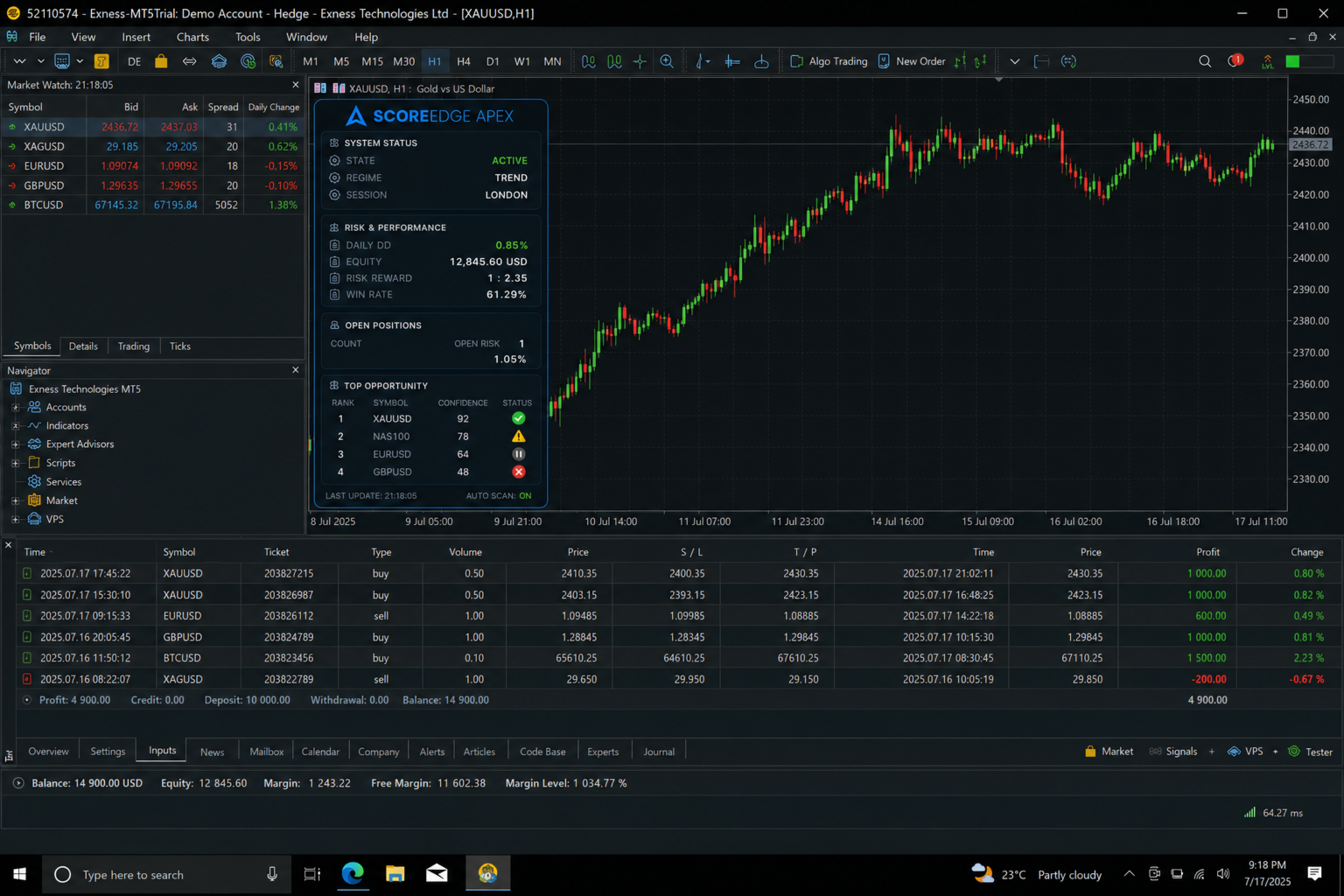
7. The Professional Command-Center Dashboard
Everything above is surfaced on a clean, professional on-chart panel so you never have to dig through terminal tabs to understand your account's state at a glance:
- System Status — current operating state, detected regime, active session
- Risk & Performance — live daily drawdown, account equity, consecutive loss count
- Open Positions — position count and real-time aggregate open risk percentage
- Top Opportunity — the highest-ranked symbol across your watchlist right now, with its live confluence score
Color-coded status indicators mean you can tell your account's health from across the room — green when scanning normally, yellow when caution flags are active, red when a drawdown or loss-streak halt has engaged.
8. What This EA Deliberately Does NOT Do
Just as important as what's included is what's explicitly excluded by design, because these are the mechanisms that blow up accounts and get EAs banned from prop firms:
- No martingale lot doubling
- No grid systems without stops
- No "no stop-loss hedge recovery" logic
- No revenge re-entry after a stop-out
- No fixed lot scaling divorced from account size
- No guaranteed-profit claims of any kind
If a system claims 90%+ win rates or 50% monthly returns, it's almost always one of the mechanisms above hiding underneath. ScoreEdge Apex was built specifically to avoid all of them.
9. Who This Is Built For
This EA is for traders who already understand that long-term profitability comes from discipline, risk control, and a repeatable process — not from marketing promises. If you want a systematic, fully explainable, risk-first approach to trading XAUUSD and its correlated markets, with every decision traceable to a visible score rather than an unexplainable black box, this is built for you.
10. Recommended Deployment
- Forward-test on a demo account for a minimum of 30 days before committing live capital
- Start live trading with conservative risk settings (0.25%–0.5% per trade) for the first two weeks
- Scale risk upward only after your own live results confirm stability over a meaningful sample of trades
- A VPS with low latency to your broker is recommended for consistent scanning cadence, though not required
- Compatible with any broker offering standard MT5 execution; works on standard, ECN, and raw-spread account types