VI Comparison
- Indicateurs
- Version: 1.1
- Mise à jour: 21 août 2025
- Activations: 5

Screens realtime- https://t.me/+rEuJQo8zHLllMzgy Signals.Metals.etc
This tool is designed to detect anomalies in market trading activity. It analyzes price movements and volumes to identify moments of unusually strong buying or selling pressure. Such periods are often followed by a cooling phase or consolidation, providing traders with valuable reference points for decision-making.
The indicator requires no complex setup and is suitable for both experienced traders and beginners.
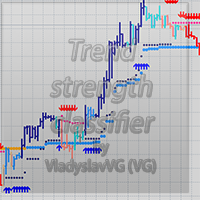
Screenshots of the 5m XAUUSD indicator, it also works on other assets, but for me it makes no sense to scalp several pairs, one with accurate signals is enough for profit.
The lower indicator (red and blue lines) is our VI Comparison, but it is better to use it in tandem with VI Calculator (the indicator above, 4 lines of different colors)
Pros:
⚡ Quickly identify discrepancies between volumes and price direction.
🛠 Flexible adjustment of the period and smoothing method (EMA, SMA, etc.).
🔍 Ability to select the type of volume (tick or real).
📉 Clear signals for analyzing the strength of movement.
Custom calculation takes into account the adapted formula and can better filter noise.
A smoother and more informative line for medium-term and short-term trading.
Ability to test different smoothing methods directly in the indicator.
How to use
Install the indicator in a separate chart window.
Compare the behavior of the blue line (original) and the red line (custom version).
When the indices diverge, look for possible reversal points or trend confirmation.
Combine with other indicators and support/resistance levels to increase accuracy.
Works on any assets: forex, cryptocurrencies, metals, stocks, indices.
Input parameters
Period — index calculation period.
MaMethod — smoothing method (EMA, SMA, etc.).
VolumeType — volume type (tick or real).
VI Comparison is a reliable assistant for a trader who wants to better understand the relationship between volumes and price movements, find reversals and confirm trends.