EUR/USD key levels for the bulls from JP Morgan(based on forexlive article)
JP Morgan publish the next technical analysis for EURUSD, and for now
- about the key levels for the bullish trend to be continuing in
intra-day and day trading:
"For the bulls to really gain more
traction and in order to free the way for a much broader recovery
towards 1.1699 and 1.1811 (int. 38.2 % on highest scales), it would take
additional breaks above 1.1288 (int. 76.4 % on higher scale) and
ultimately above 1.1383 (daily trend)."
"Particularly below 1.1288, the market remains in the danger zone."
As we see from intra-day H1 chart - the EUR/USD is traded between Fibo
resistance at 1.1160 and 23.6% Fibo support at 1.1145 for possible
breakout of the price movement of the key resistance levels. Thus,
forecast made by JP Morgan may be the rrue in this case.
EUR/USD, USD/JPY, EUR/GBP, AUD/USD - Intraday by SEB(based on efxnews article)
Skandinaviska Enskilda Banken (SEB) made some intra-day analysis for few
pairs whch may be used for the next week for example. Those pairs are
the following: EUR/USD, USD/JPY, EUR/GBP and AUD/USD. This is
very short technical analysis for good s/r levels and for the direction
to be followed:
EUR/USD: "The failed move below
1.1126 (and the created downside spike) keeps the short term wave
pattern unclear. As long as 1.1190 remains unbroken there’s still a
possibility that an upward correction ended the other day but if making
way above the resistance new highs should be penciled in."
USD/JPY: "With the
pair still below the mid body resistance downside risks are increasing.
If also today manages to stay below 124.68 then downside risks will be
even further enhanced going into next week. A move below 124.07 will
likely lead to a loss of the 123.79 key support."
EUR/GBP: "The ongoing
correction has still room to move a bit further north. The primary
target for the move is 0.7176 with a possible extension towards the
trend line at 0.7200. Once there look for offers to be returning."
AUD/USD: "After the latest
rejection from the 2001 trend line the pair fell down but only to a
marginally new low. Price action with no follow through selling together
with a bullish divergence hints of an overly oversold market and
therefore also an increasing reaction risk. Shorts should be very
cautious should we break above 0.7440 (if such a move takes place today
it will also create a bullish key week reversal)."
Japan GDP data, Inflation in the UK, the US and Canada, FOMC Meeting
Minutes, US Unemployment Claims and Philly Fed Manufacturing Index.
These are our market movers for this week. Join us as we explore the
highlights on Forex calendar.
U.S. data released last week raises hopes for a Fed rate hike by the end
of the third quarter. Retail sales rebounded in July amid a rise in
purchases of automobiles and other goods, suggesting growth rate is
positive in the second and third quarters. Retail sales edged up 0.6%,
in line with market forecast, while core sales, excluding automobiles
gained 0.4%. The robust release added to a strong employment data,
suggesting the US economy is on solid footing. Will this trend continue?
Japan GDP data: Sunday, 23:50.
Japan’s economy recovered from the brief tax-induced recession in 2014,
with GDP growth of 0.6% in the first quarter, exceeding market forecasts
of 0.4% expansion rate. On a yearly base, GDP grew 2.4%, way above the
1.6% rise expected by analysts. Domestic consumption edged up 4.3% and
wage growth increased, indicating a positive momentum. Exports increased
10% due to the weaker yen, but inflation continues to fail, despite the
massive money-printing program aimed to lift inflation. Economists
estimate a 0.5% contraction in the second quarter.
UK Inflation data:
Tuesday, 8:30. UK Inflation index inflation fell to 0% in June, from
0.1% in the prior month due to a decline in clothing and food prices as
well as air fares. Bank of England governor Mark Carney expects
inflation to remain low in the coming months, but anticipates a pick-up
by the end of this year. However, rising wages expected to increase
consumption, leading to stronger inflation pressure. UK CPI is expected
to remain flat this time.
US Building Permits: Tuesday,
12:30. The number of building permits issued in June edged up 7.4% to a
1.34 million-unit rate, the highest level since July 2007. Builders’
confidence also reached a 9-1/2-year high in July, indicating the
housing market is expected to expand further in the coming months.
Economists forecast that the housing market will compensate for the
struggling manufacturing sector. The number of permits is expected to
reach 1.21million in July.
US Inflation data:
Wednesday, 12:30. U.S. consumer prices increased 0.3% in June, rising
for the fifth consecutive time after a rebound in gasoline prices as
well as a range of other goods indicating inflation is back in track.
The recent positive economic data such as the growth trend in the
housing market raises the odds for a rate hike in the near future.
June’s gain was preceded by a 0.4% in May. Both CPI and Core CPI are
expected to gain 0.2% this time.
US FOMC Meeting Minutes:
Wednesday, 18:00. In their previous meeting, Federal Reserve officials
started preparing for a rate raise later this year, amid promising
economic data. John C. Williams, president of the Federal Reserve Bank
of San Francisco said he wants to make sure the economy progresses in
line with the Fed’s expectations before voting to raise rates. Even
those supporting the tightening measures, preferred to delay the rate
hike until September.
Japan rate decision:
Thursday. Aug 7 The Bank of Japan kept its accommodative monetary
policy, aiming toward 2% inflation without additional monetary easing.
However, economists believe the 2% deadline may be changed, depending on
future oil price moves. The weak yen is positive for exports and
companies but is bad for households and small firms via rising import
costs. Household sentiment picked up and Consumer spending remained
string after emerging from a temporary hit from bad weather.
US Unemployment Claims:
Thursday, 12:30. The number of Americans filing initial claims for
unemployment benefits increased unexpectedly by 5,000 last week,
reaching 274,000. However, the general trend remains positive,
indicating the US labor market continues to strengthen. Analysts
expected claims to reach 272,000, but the number of new claims continue
to stay below the 300,000 threshold and the four-week moving average of
claims fell 1,750 to 266,250, the lowest since April 2000. The number if
new claims are expected to reach 272,000 this week.
US Philly Fed Manufacturing Index:
Thursday, 14:00. Philadelphia’s manufacturing gauge for the region
plunged in June to 5.7 from 15.2 in June. The reading was worse than the
12.5 points estimated earlier but still indication expansion. The
strong dollar and softer global demand lowered the number of orders for
manufactured goods. Economists expect a meaningful rebound in the next
few months. New orders reached 7.1, from 15.2 and employment remained
flat. Philadelphia’s manufacturing index is expected to reach 7.2 in
July.
Weekly Outlook for USD, EUR, JPY, GBP, AUD by Morgan Stanley(based on efxnews article)
Morgan Stanley is continuing to make a weekly forecast for the
currency pairs making on technical analsysi, fundamental analysis and
for some Morgan Stanley's expectation about what they want for us to do for example sorry. As we see - the expectation for EUR is bearish and for AUD is bearish too (USD is for bullish condition).
USD: "We believe USD strength will be focused against EM and commodity
currencies going forwards, with AxJ particularly underperforming. This
is largely a result of the CNY move, but also reflects growth
differentials and structurally lower commodity prices. However, we would
expect the path against other G10 currencies to be driven more by data
into September, as the market watches the Fed closely."
EUR: "We believe EUR could benefit from the latest developments in China. CNY
moves could spill over into general asset market volatility. This would
support currencies with current account surpluses that have been used
to fund risky holdings, as investors unwind their risky positions. EUR
is such a currency. In addition, many investors have hedged their
European equity holdings, and as these positions are unwound, this will
lead to buying back of hedges, supporting EUR."
JPY: "We believe JPY is likely to face conflicting forces following the
developments in China. On the one hand, this increases deflationary
risks for Japan, as a weaker CNY could lead to disinflationary pressure
in Japan. It also challenges Japanese competitiveness, given the impact
on the REER. On the other hand, uncertainty on CNY is likely to
de-stabilize risk appetite, leading to repatriation and supporting JPY.
Overall, we expect the latter effect to win out in impact, but recognize
the risks."
GBP: "The dovish inflation report and risk appetite getting hit has provided
some headwinds for GBP. However with China developments still playing on
markets’ minds and the Fed coming back into play, we believe GBPUSD is
going to be driven more by the USD side of the pair. The BoE is still
one of the central banks heading towards a hike next year so GBP should
gain some relative strength. Here we like to buy against the more
vulnerable commodity currencies (CAD, NOK and AUD)."
AUD: "We believe AUD is likely to be an underperformer following the
developments in China this week, though stabilization in the near term
could provide some relief for the currency. However, given China’s close
trade relations with China, any CNY weakness will lead to de facto AUD
REER appreciation, which may be countered by AUDUSD weakness in order to
maintain competitiveness."
Goldman Sachs - Elliot Wave technical analysis on the daily EUR/USD(based on forexlive article)
Goldman Sachs made Elliot Wave technical analysis on the daily EUR/USD and those are the following comments (below their chart):
"Has finally sustained a break above its 55-dma and the July '14 downtrend".
"Both
of these levels have been very relevant to recent price action. The
55-dma in particular held the entire decline from the May '13 high to
early-Apr. '15. It should now act as important support at 1.1095."
"The
next big pivot to focus on is 1.1168; an ABC from the Jul. 20 th low. A
close above will open potential for a 1.618 extension target to 1.1366.
This also happens to be close to the previous two highs from May/June
(1.1438-68) and a 0.618 extension from March (1.1432)."
"Overall, seems the next two big levels are 1.1168 and then 1.1366-1.1468."
If we look at the other patterns so we can see just two situations around: short-term (forming bearish patterns) and long-term (forming bullish patterns).
Short-term scenario
This is forming bearish gartley for H12 timeframe:
This is the forming bearish retracement pattern for H8 timeframe:
Long-tern situation with bullish
Forming bullish butterfly pattern and forming bullish 3-Drives pattern for MN1:
Thus,
we can confirm for EURUSD to be in bearish market condition in
short-term situation up to 2015 year-end for example, and in bullish
condition in long-term in 2016.
BNP Paribas for USD - 'We expect to be a choppy second half of August'(based on efxnews article)
BNP Paribas are forecasting the strong USD but with the secondary ranging market condition - just because of China
news on Fed expectations:
"The underlying effective Fed funds rate has also been drifting higher
over the past two weeks, reaching 15bp and suggesting some of the move
in rates market pricing could reflect expectations for a move within the
target range rather than a hike in the target."
"The minutes to the Fed’s July meeting on Wednesday will be
closely watched for more insight into Committee thinking on the timing
of hikes, while a speech from San Francisco Fed President John
Williams on Thursday from a conference in Indonesia may give some
insight into how Fed thinking has been affected by CNY developments."
"We remain patiently bullish on the USD through what we expect to be a choppy second half of August."
As we see from the chart - Dollar Index Future (DXY) is located above
100-SMA/200-SMA for bullish condition and, seems, this bullish condition
will be continuing in August as well. But the choppy market was started
in the end of April this year and there is no any indication that this
choppy condition will be finished by the beginning of September. Thus,
we can confirm the forecast made by BNP Paribas.
5 reasons to believe gold prices could recover to $1,200 at year-end - HSBC(based on cnbc article)
The bank made a forecast for the price of gold at year-end and
estimated that it will be increase as much as 10 percent higher than
current levels. The bank set out five reasons in a report on Friday for the experts to believe
gold prices could recover to $1,200 per ounce at the year-end.
1. Fed tightening is already priced into gold "With
a shift in the Federal Reserve's policy
having been anticipated in the financial markets since as early as 2013,
some of the declines based on a rate rise have already occurred." Thus,
the reaction of the gold may not be negative one in any case.
2. Actual Fed hikes could see gold prices rise "This pattern has important ramifications for gold. History shows
that gold prices…generally rise, though sometimes with a lag, after the
first rate hike."
3. There's scope for a short-covering rally Short positions on the Comex touched the peak on July 7 while long
positions are at their highest since December 2009.
4. Low prices will, ultimately, spur demand "In important gold consuming nations, such as China, India,
Indonesia, and Vietnam, as well as other EMs, consumers may have fewer
tools at their disposal with which to protect savings and household
wealth against rising prices or low or negative real interest rates."
5. Central bank buying will remain supportive "The PBoC is an important central bank with
significant influence. The mere fact that they have accumulated gold may
lead other EM central banks to examine purchasing bullion. Also many central banks hold quite low levels of
gold reserves in relation to their forex holdings, leaving room for
further accumulation."
"The EURUSD closed last week by keeping the 100 hour MA (blue line in the
chart below) as a support level. Today in the Asia-Pacific session, the
price dipped below that moving average level, and has stayed below (at
least on a closing basis) since that time. The weaker than expected
Empire manufacturing has push the price back above the moving average,
but last hours closing price could still not close above it. So there is
some reluctance to have a momentum shift to the upside. The current
100 hour moving average comes in at 1.11147."
John and Merlin break down the week’s biggest news
headlines from the currency devaluation from China, to the sale of coal
mines by Goldman Sachs. They also take a look at the decision by the EU
to bail out Greece once again. How long will it last? Finally,
commodities continue to be crushed providing potential buying
opportunities for those ok with more Risk!
FOMC Meeting Minutes expectations by Barclays and September Fed hike(based on efxnews article)
Barclays made a forecast for high impacted fundamental news events
which will be on Wednesday at 19:00 GMT. The bank is telling that
Federal Open Market Committee is already made a decision concerning a September
Fed hike. Besides, Barclays is expecting the USD dollar to gain strength because "fears around China and weak commodity prices should keep pushing
investors out of risky assets":
"We do not expect a material change and we anticipate that the document
will echo the latest comments from different FOMC members. We think
they will want to keep options open and will probably signal the data
dependency of their decisions ahead. We believe that the FOMC
has already made up their mind about their next move, absent any market
disruptive events in the months ahead. Our base case remains a September
Fed hike."
"Furthermore, we argued that the actual path of the normalization process will be more important for FX markets. The pace at which the Fed could tighten monetary conditions should depend heavily on price measures."
"We expect the USD to be supported in the next weeks mainly due to external factors.
Fears around China and weak commodity prices should keep pushing
investors out of risky assets, benefiting the USD under different
scenarios."
The next FOMC Meeting Minutes will be in Oct 8, 2015 so we should really expect something important one for this release on on Wednesday at 19:00 GMT concerning September Fed hike.
EUR/USD key levels for the bulls from JP Morgan (based on forexlive article)
JP Morgan publish the next technical analysis for EURUSD, and for now - about the key levels for the bullish trend to be continuing in intra-day and day trading:
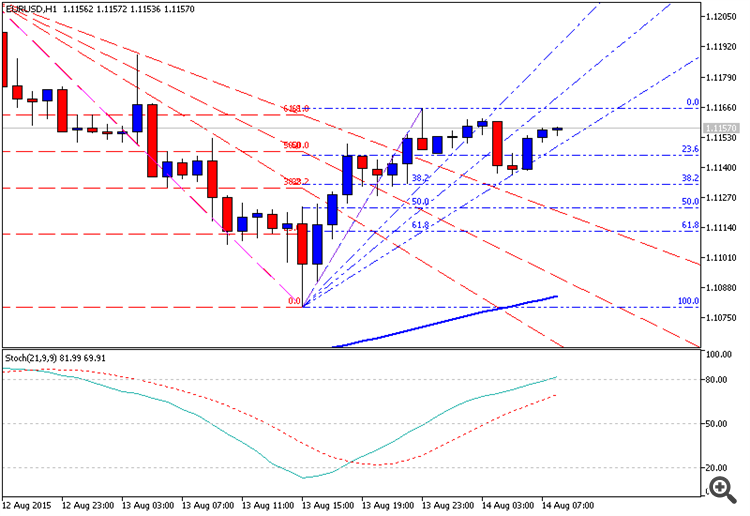
As we see from intra-day H1 chart - the EUR/USD is traded between Fibo resistance at 1.1160 and 23.6% Fibo support at 1.1145 for possible breakout of the price movement of the key resistance levels. Thus, forecast made by JP Morgan may be the rrue in this case.EUR/USD, USD/JPY, EUR/GBP, AUD/USD - Intraday by SEB (based on efxnews article)
Skandinaviska Enskilda Banken (SEB) made some intra-day analysis for few pairs whch may be used for the next week for example. Those pairs are the following: EUR/USD, USD/JPY, EUR/GBP and AUD/USD. This is very short technical analysis for good s/r levels and for the direction to be followed:
EUR/USD: "The failed move below 1.1126 (and the created downside spike) keeps the short term wave pattern unclear. As long as 1.1190 remains unbroken there’s still a possibility that an upward correction ended the other day but if making way above the resistance new highs should be penciled in."
USD/JPY: "With the pair still below the mid body resistance downside risks are increasing. If also today manages to stay below 124.68 then downside risks will be even further enhanced going into next week. A move below 124.07 will likely lead to a loss of the 123.79 key support."
EUR/GBP: "The ongoing correction has still room to move a bit further north. The primary target for the move is 0.7176 with a possible extension towards the trend line at 0.7200. Once there look for offers to be returning."
AUD/USD: "After the latest rejection from the 2001 trend line the pair fell down but only to a marginally new low. Price action with no follow through selling together with a bullish divergence hints of an overly oversold market and therefore also an increasing reaction risk. Shorts should be very cautious should we break above 0.7440 (if such a move takes place today it will also create a bullish key week reversal)."
Forex Weekly Outlook August 17-21 (based on forexcrunch article)
Japan GDP data, Inflation in the UK, the US and Canada, FOMC Meeting Minutes, US Unemployment Claims and Philly Fed Manufacturing Index. These are our market movers for this week. Join us as we explore the highlights on Forex calendar.
U.S. data released last week raises hopes for a Fed rate hike by the end of the third quarter. Retail sales rebounded in July amid a rise in purchases of automobiles and other goods, suggesting growth rate is positive in the second and third quarters. Retail sales edged up 0.6%, in line with market forecast, while core sales, excluding automobiles gained 0.4%. The robust release added to a strong employment data, suggesting the US economy is on solid footing. Will this trend continue?
Weekly Outlook for USD, EUR, JPY, GBP, AUD by Morgan Stanley (based on efxnews article)
Morgan Stanley is continuing to make a weekly forecast for the currency pairs making on technical analsysi, fundamental analysis and for some Morgan Stanley's expectation about what they want for us to do for example sorry.
As we see - the expectation for EUR is bearish and for AUD is bearish too (USD is for bullish condition).
USD: "We believe USD strength will be focused against EM and commodity currencies going forwards, with AxJ particularly underperforming. This is largely a result of the CNY move, but also reflects growth differentials and structurally lower commodity prices. However, we would expect the path against other G10 currencies to be driven more by data into September, as the market watches the Fed closely."
EUR: "We believe EUR could benefit from the latest developments in China. CNY moves could spill over into general asset market volatility. This would support currencies with current account surpluses that have been used to fund risky holdings, as investors unwind their risky positions. EUR is such a currency. In addition, many investors have hedged their European equity holdings, and as these positions are unwound, this will lead to buying back of hedges, supporting EUR."
JPY: "We believe JPY is likely to face conflicting forces following the developments in China. On the one hand, this increases deflationary risks for Japan, as a weaker CNY could lead to disinflationary pressure in Japan. It also challenges Japanese competitiveness, given the impact on the REER. On the other hand, uncertainty on CNY is likely to de-stabilize risk appetite, leading to repatriation and supporting JPY. Overall, we expect the latter effect to win out in impact, but recognize the risks."
GBP: "The dovish inflation report and risk appetite getting hit has provided some headwinds for GBP. However with China developments still playing on markets’ minds and the Fed coming back into play, we believe GBPUSD is going to be driven more by the USD side of the pair. The BoE is still one of the central banks heading towards a hike next year so GBP should gain some relative strength. Here we like to buy against the more vulnerable commodity currencies (CAD, NOK and AUD)."
AUD: "We believe AUD is likely to be an underperformer following the developments in China this week, though stabilization in the near term could provide some relief for the currency. However, given China’s close trade relations with China, any CNY weakness will lead to de facto AUD REER appreciation, which may be countered by AUDUSD weakness in order to maintain competitiveness."
Goldman Sachs - Elliot Wave technical analysis on the daily EUR/USD (based on forexlive article)
Goldman Sachs made Elliot Wave technical analysis on the daily EUR/USD and those are the following comments (below their chart):
If we look at the other patterns so we can see just two situations around: short-term (forming bearish patterns) and long-term (forming bullish patterns).
Short-term scenario
This is forming bearish gartley for H12 timeframe:
This is the forming bearish retracement pattern for H8 timeframe:
Long-tern situation with bullish
Forming bullish butterfly pattern and forming bullish 3-Drives pattern for MN1:
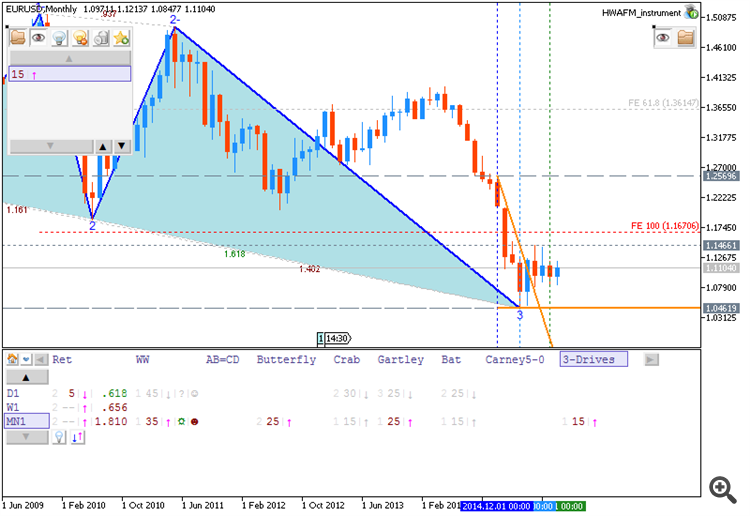
Thus, we can confirm for EURUSD to be in bearish market condition in short-term situation up to 2015 year-end for example, and in bullish condition in long-term in 2016.BNP Paribas for USD - 'We expect to be a choppy second half of August' (based on efxnews article)
BNP Paribas are forecasting the strong USD but with the secondary ranging market condition - just because of China news on Fed expectations:
As we see from the chart - Dollar Index Future (DXY) is located above 100-SMA/200-SMA for bullish condition and, seems, this bullish condition will be continuing in August as well. But the choppy market was started in the end of April this year and there is no any indication that this choppy condition will be finished by the beginning of September. Thus, we can confirm the forecast made by BNP Paribas.
5 reasons to believe gold prices could recover to $1,200 at year-end - HSBC (based on cnbc article)
The bank made a forecast for the price of gold at year-end and estimated that it will be increase as much as 10 percent higher than current levels. The bank set out five reasons in a report on Friday for the experts to believe gold prices could recover to $1,200 per ounce at the year-end.
1. Fed tightening is already priced into gold
"With a shift in the Federal Reserve's policy having been anticipated in the financial markets since as early as 2013, some of the declines based on a rate rise have already occurred." Thus, the reaction of the gold may not be negative one in any case.
2. Actual Fed hikes could see gold prices rise
"This pattern has important ramifications for gold. History shows that gold prices…generally rise, though sometimes with a lag, after the first rate hike."
3. There's scope for a short-covering rally
Short positions on the Comex touched the peak on July 7 while long positions are at their highest since December 2009.
4. Low prices will, ultimately, spur demand
"In important gold consuming nations, such as China, India, Indonesia, and Vietnam, as well as other EMs, consumers may have fewer tools at their disposal with which to protect savings and household wealth against rising prices or low or negative real interest rates."
5. Central bank buying will remain supportive
"The PBoC is an important central bank with significant influence. The mere fact that they have accumulated gold may lead other EM central banks to examine purchasing bullion. Also many central banks hold quite low levels of gold reserves in relation to their forex holdings, leaving room for further accumulation."
Friday held the MA. Today more below. (based on forexlive article)
"The EURUSD closed last week by keeping the 100 hour MA (blue line in the chart below) as a support level. Today in the Asia-Pacific session, the price dipped below that moving average level, and has stayed below (at least on a closing basis) since that time. The weaker than expected Empire manufacturing has push the price back above the moving average, but last hours closing price could still not close above it. So there is some reluctance to have a momentum shift to the upside. The current 100 hour moving average comes in at 1.11147."
Weekend Edition with John O'Donnel (based on fxstreet article)
John and Merlin break down the week’s biggest news headlines from the currency devaluation from China, to the sale of coal mines by Goldman Sachs. They also take a look at the decision by the EU to bail out Greece once again. How long will it last? Finally, commodities continue to be crushed providing potential buying opportunities for those ok with more Risk!
FOMC Meeting Minutes expectations by Barclays and September Fed hike (based on efxnews article)
Barclays made a forecast for high impacted fundamental news events which will be on Wednesday at 19:00 GMT. The bank is telling that Federal Open Market Committee is already made a decision concerning a September Fed hike. Besides, Barclays is expecting the USD dollar to gain strength because "fears around China and weak commodity prices should keep pushing investors out of risky assets":
-
"We do not expect a material change and we anticipate that the document
will echo the latest comments from different FOMC members. We think
they will want to keep options open and will probably signal the data
dependency of their decisions ahead. We believe that the FOMC
has already made up their mind about their next move, absent any market
disruptive events in the months ahead. Our base case remains a September
Fed hike."
-
"Furthermore, we argued that the actual path of the normalization process will be more important for FX markets. The pace at which the Fed could tighten monetary conditions should depend heavily on price measures."
-
"We expect the USD to be supported in the next weeks mainly due to external factors.
Fears around China and weak commodity prices should keep pushing
investors out of risky assets, benefiting the USD under different
scenarios."
The next FOMC Meeting Minutes will be in Oct 8, 2015 so we should really expect something important one for this release on on Wednesday at 19:00 GMT concerning September Fed hike.