A grid Expert Advisor places or manages orders at a sequence of price levels. Spacing may be fixed or depend on a rule such as recent volatility. The arrangement of entries defines the grid; it does not tell you whether volume increases, whether a stop exists or whether the strategy has an edge.
Before considering one, write down how open inventory builds and how the complete basket exits at a loss. An attractive sequence of closed winners cannot answer those questions. This guide uses hypothetical arithmetic to make the exposure visible, not to recommend a trading configuration.
1. Follow the positions through an adverse move
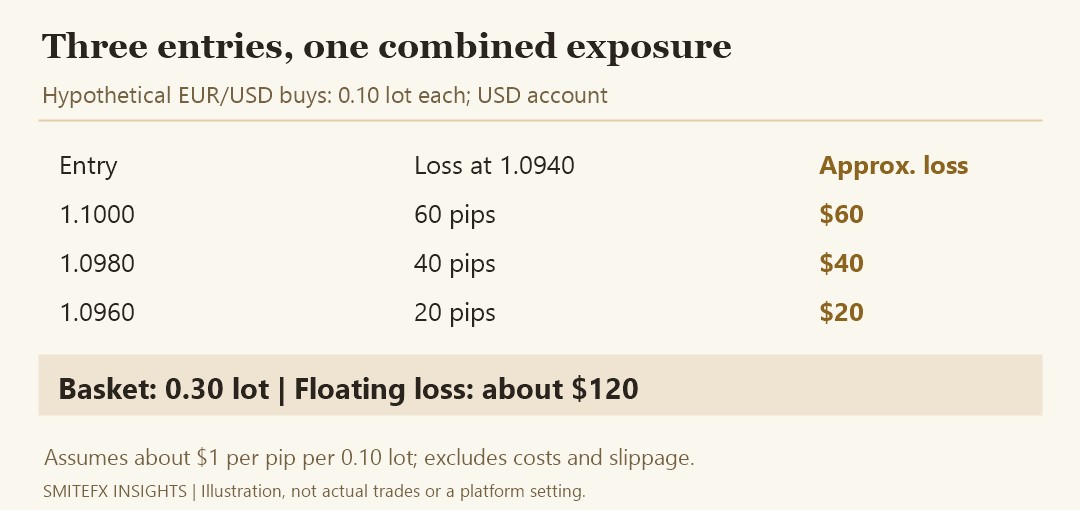
Imagine an averaging grid that buys EUR/USD at 1.1000, 1.0980 and 1.0960. Each entry is 0.10 lot. If price falls to 1.0940, the positions are approximately 60, 40 and 20 pips underwater. Assuming a USD account and about USD 1 per pip for each 0.10-lot position, the combined floating loss is about USD 120 before costs.
The exposure is now 0.30 lot. Another 20-pip decline adds about USD 60 of loss on the existing basket. If a fourth position opens, subsequent price movement affects four positions. A limit derived only from the first order misses that changing sensitivity.
2. Separate entry spacing from volume escalation
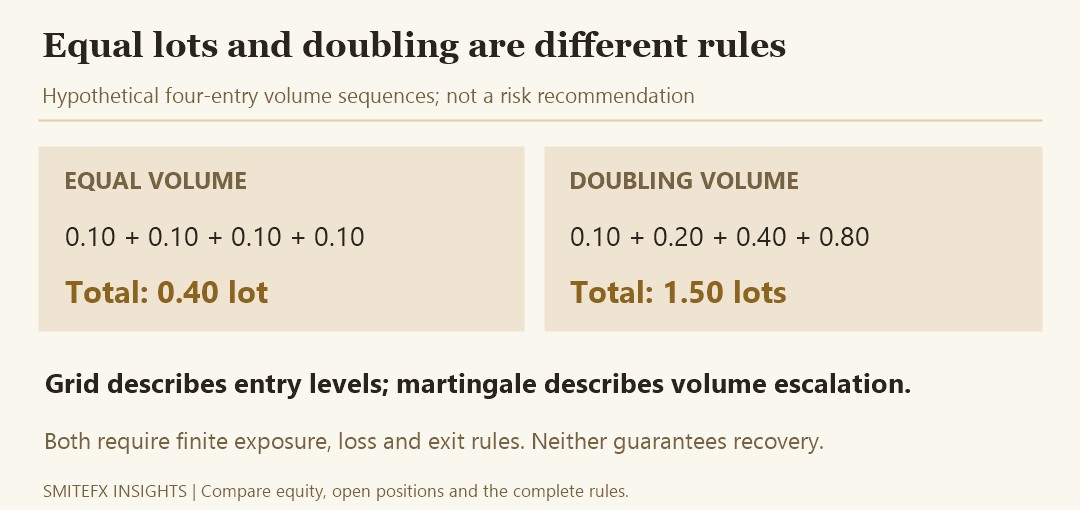
A grid does not automatically mean martingale. Equal-volume entries and increasing-volume recovery rules produce different exposure. Four equal 0.10-lot entries total 0.40 lot. A doubling sequence of 0.10, 0.20, 0.40 and 0.80 totals 1.50 lots.
Both arrangements need finite limits. Ask for maximum levels, total volume, instrument exposure and the loss rule for the whole basket. A fixed-size grid can still accumulate a substantial loss if additions continue long enough. A doubling system can reach its financing constraints much faster.
3. Read equity alongside the balance curve
Repeated reversals can allow a grid to close small winners while another basket remains underwater. Suppose several GBP 20 gains are booked while GBP 600 of floating loss remains open. The closed-trade history looks reassuring, but account equity reflects the outstanding exposure.
Inspect the largest floating loss, the number of simultaneous positions and every basket left open at the reporting cutoff. Mark remaining positions to market in a test. Ending a backtest before an unresolved basket closes does not make its economic loss disappear. Our drawdown guide explains why equity and balance answer different questions.
4. Make the exit specification as clear as the entry
Does the basket exit on money profit, price distance, time, equity or a fixed stop? Are financing and commissions included in the target? A nominal breakeven price can still leave a net loss. Establish what happens after a price gap skips several intended levels.
Margin is a financing constraint, not a maximum loss budget. Broker stop-out may liquidate positions before the reversal the strategy expects. Increasing the deposit is not automatically a solution: if the EA sizes proportionally to balance, more capital may leave percentage risk largely unchanged.
5. Test operation when the ideal sequence breaks
Restart the terminal with a basket open. Check whether the EA reconstructs positions, preserves limits and recognises orders from another chart instance. Otherwise, an operational mistake can multiply exposure beyond the intended model.
Test rejected orders, partial fills where supported, wider spreads and delayed execution. The MQL5 order-property reference distinguishes order types, states and filling policies. A calculation assuming every level fills at its exact intended price can misrepresent average entry and exit.
Test the transition from a quiet range into a persistent trend. A filter based on past volatility is another rule to evaluate, not a guarantee that the next regime will be suitable. Keep development results separate from later forward observations.
6. Check the actual account contract
A strategy label does not establish whether a particular broker or evaluation account permits it. Permission to use EAs does not necessarily cover every recovery implementation, copying arrangement or execution method. Read the exact account's current written restrictions and ask for clarification when the rules are ambiguous.
Contractual permission and economic suitability are separate. An allowed strategy may still expose your account to losses you cannot afford. A finite daily loss allowance is incompatible with assuming that an eventual reversal is certain.
7. Compare a different inventory model
A single-entry strategy with an explicit stop has a different inventory profile from an averaging basket. For a concrete documentation reference, the Fortune MT5 listing describes its single-entry gold breakout approach. Read the current product specification and test the exact version; that description does not establish future profitability.
Apply the same evidence checklist to Fortune, Fortress and Frontier rather than inferring a strategy's controls from the SmiteFX name. Compare equity history, costs, trade count and open exposure. Copying a strategy also does not remove its inventory risk: the copying service can reproduce that exposure in a follower account.
A practical review worksheet
For each filled level, record volume, entry, average basket price and loss at a further adverse price. Add the next proposed order before deciding whether the basket remains within its limits. Repeat with wider costs and an adverse move beyond the development sample.
Then record maximum level count, total exposure, basket loss limit, margin assumptions, exit method and restart behaviour. If those details are unavailable, a smooth chart is insufficient evidence. Defer allocation until the mechanism is clear. Use the pre-live EA evaluation checklist to connect this exposure review to broader due diligence.
Source and risk note: Adapted from SmiteFX Insights, first published 26 November 2026. The source article's original reference cutoff is 31 October 2026; the Fortune product description was checked 29 November 2026. All numerical examples and diagrams are hypothetical, exclude stated costs and are not actual results or prescribed settings. No universal prop-firm ban or proprietary grid controls are claimed. Leveraged trading can lose money; past results do not guarantee future returns. This is education, not personalised investment advice.