Why Autonomous AI Agents Trigger Liquidity Cascades: Lessons from the ECB's Working Paper No. 3225

What happens to market liquidity when autonomous AI agents stop acting in isolation and start reacting to each other's order flow?
A newly revised working paper from the European Central Bank (ECB)—"Ex machina: financial stability in the age of AI" (ECB Working Paper Series No. 3225, November 2026) by Kartik Anand, Sophia Kazinnik, Agnese Leonello, and Ettore Panetti—examines how two dominant AI architectures behave in a strategic liquidity-run setting with multiple equilibria.
🔬 Core Findings from ECB Working Paper No. 3225
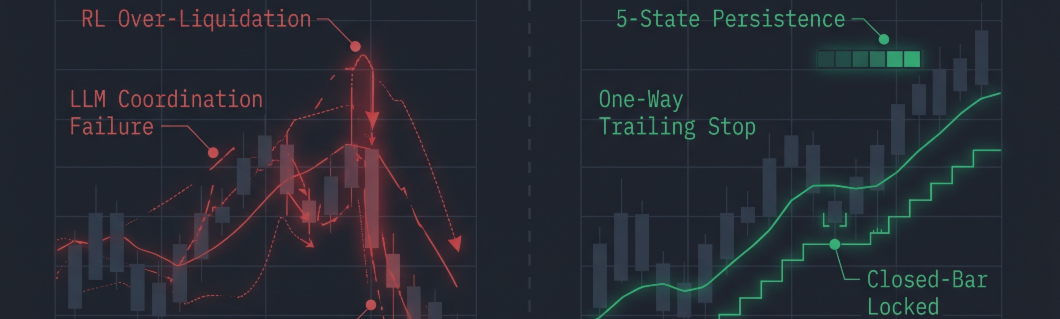
- Reinforcement Learning (Q-Learning) Over-Liquidates: Due to a formal learning bias, RL algorithms systematically redeem and exit positions excessively—capable of pushing markets into suboptimal, non-Nash panic outcomes.
- Large Language Models (LLMs) Fail to Coordinate: By inspecting their chain-of-thought reasoning, the authors show that LLM agents form diverging beliefs about what other participants will do, creating unpredictable fragility and sudden cascades.
- Architecture Shapes Fragility: The same dynamics govern bank runs, currency attacks, and sudden intraday liquidity vacuums—meaning automated agent design alone can destabilize price action without any change in underlying fundamentals.
Survival Beats Prediction When Liquidity Snaps
No chart indicator can predict the exact minute a cluster of RL models or LLM-driven desks triggers a liquidity cascade. Treating indicators as crystal balls is how accounts get caught on the wrong side of violent structural breaks.
On a live MetaTrader chart, the practical defense is strictly defensive and structural: classify whether buying or selling pressure is actually holding its state bar-to-bar, and anchor trade exits to a one-way trailing stop that ratchets with structure and never moves backward when volatility expands.
Closed-Bar Tools for State Classification & Structural Trailing
Both tools below run strictly on finalized closed bars with zero repainting:
📐 TREND PERSISTENCE
- ▸ Trend Survival States (MT5) · 🆓 — Measures buying and selling pressure with adaptive volatility bands and classifies the market into five objective states (strong bull, weak bull, neutral, weak bear, strong bear)
🔍 REGIME AND STRUCTURE
- ▸ Structure Flow and Trailing Stop (MT5) · $99 · MT4 Version ($99) — Combines an adaptive directional flow line, five one-way trailing stop methods that never retreat, and a condition panel reporting measurement agreement
👉 Explore all 18 non-repainting measurement tools on my MQL5 profile: mql5.com/en/users/naamo (@naamo)
🛡️ When automated liquidity cascades hit, you don't need a louder forecast—you need objective state tracking and a trailing stop that refuses to step backward.
📚 References & Further Reading:
- Anand, K., Kazinnik, S., Leonello, A., & Panetti, E. (2026). Ex machina: financial stability in the age of AI (European Central Bank Working Paper Series No. 3225, revised Nov 2026): ECB Official PDF


