
Why Fafnir's Talon waits 2 USD before the level, the research behind version 4.0

Version 4.0 of Fafnir replaced one of its gold modules. The old Talon broke the 72 hour high or low of gold and entered right at the level. It did well in the first half of 2026, then faded, and from September it was flat or slightly negative. Before deciding what to do with it I measured why, and the answer changed the module completely.
This post shows the three measurements behind the new Talon, the test that it is not an accident of the exit, and where it stops working.
HOW IT WAS MEASURED
- Gold ticks with bid and ask from the broker of the live signal, January to November 2026.
- A replay of the module on those ticks, with 100 ms between the signal and the fill, the real spread and a commission of 0.06 USD per 0.01 lot. Checked against the EA in the MetaTrader 5 Strategy Tester, it gives the same trades on 1,394 of 1,413.
- Results are in USD per trade at 0.01 lot. On gold that is one ounce, so 1 USD of price is 1 USD of profit.
- A level is an H1 swing high or low that is the extreme of the hours on both sides of it and has not been broken since.
- The exit is the same in every test. Stop 2 USD, target 15 USD, and once a trade is 1 USD up it closes when it gives back half of its best gain.
- Rules were chosen on January to June. July to November was kept aside and used only to check them.
1. OLDER LEVELS PAY MORE
The old Talon traded any 72 hour extreme that had held for 30 minutes. In the Strategy Tester in 2026, 39 % of its trades were on extremes less than two hours old. That is usually the last candle of a move that is still running, not a level. Those trades earned 0.26 to 0.32 USD each, while the same module on extremes older than 24 hours earned 1.64.
So I ran the same order and exit on swings of different length.
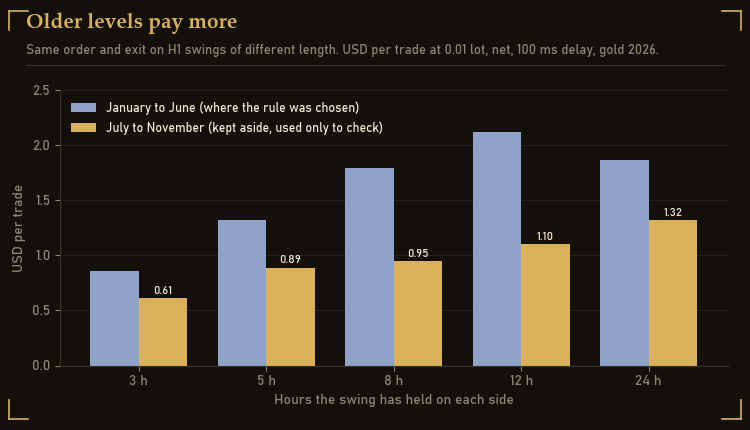
USD per trade on H1 swings that held 3, 5, 8, 12 and 24 hours on each side. Blue is the half of the year where the rule was chosen, gold the half kept aside.
Every length is positive in both halves. In the half kept aside the result grows with the age of the swing, from 0.61 USD per trade on 3 hour swings to 1.32 on 24 hour swings. The new Talon uses four lengths at once, 5, 8, 12 and 24 hours.
2. THE ORDER BELONGS JUST BEFORE THE LEVEL
The second measurement keeps everything fixed and moves only the order. Zero is an order at the level itself. A positive distance places the order before the level, so it fills while price is still approaching. A negative distance waits for a confirmed break.
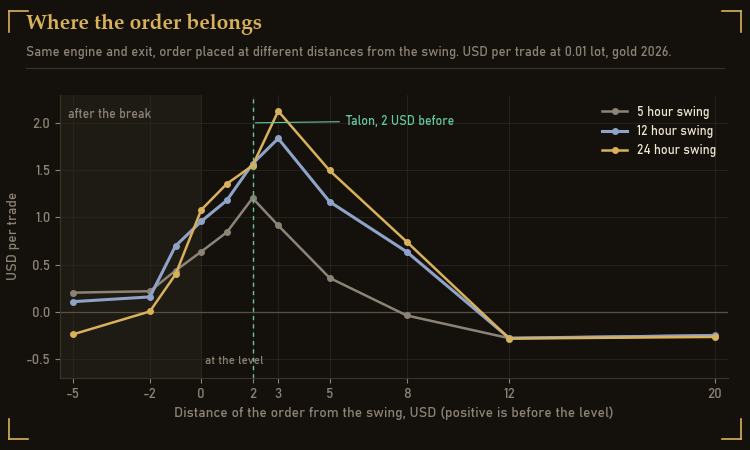
USD per trade by distance of the order from the swing, for 5, 12 and 24 hour swings. The shaded area is entry after the break.
Three things stand out. The best place is 2 to 3 USD before the swing, on every length. An order at the level earns clearly less, and waiting for a confirmed break earns little. And 12 or 20 USD before the swing the same engine loses money.
The last point is the important one. If the profit came only from catching a burst of momentum with a good exit, an order 12 USD from the swing would do as well as one 2 USD from it, because the exit is identical. It loses instead, so the swing itself carries the edge.
My reading is that price which comes within a few dollars of a level that has held for many hours tends to reach it. An order just before the level takes that last stretch, while an order at the level pays the spread and slippage of the busiest moment. That part is an interpretation. The curve is the measurement.
The gap widened in the second half of the year. With the same exit, from July to November a 12 hour swing gave 0.33 USD per trade at the level and 1.10 two dollars before it. A 24 hour swing gave 0.60 and 1.32.
3. WHEN SEVERAL LENGTHS AGREE
Sometimes one swing is the extreme of 5, 8, 12 and 24 hours at the same time, and those moves are better. A trade on a level that only one length saw earned 0.87 USD on average. When two lengths agreed it earned 1.92, and with three 2.33.
That is why every length places its own order. When they agree, more orders rest on the same level and the size grows where the edge is larger. With very active gold, a 14 day average range of 90 USD or more, the 8, 12 and 24 hour lengths add a second order 3 USD before the level, the other distance the curve above favours on longer swings.
The live account saw this on 25 November. One low held on all four lengths, seven orders filled on the break and all seven closed at their target within half a minute. The trade by trade comparison of that week with the Strategy Tester is here. The other side of it is that the seven orders lose together, each at its 2 USD stop, when such a level holds.
4. NOT AN ACCIDENT OF THE EXIT
A rule found on one year of data can be luck. To test that I shuffled the order of the minutes inside each month. That keeps the volatility of every month but destroys the levels and what price does around them. Then I ran the four lengths on 40 shuffled histories.
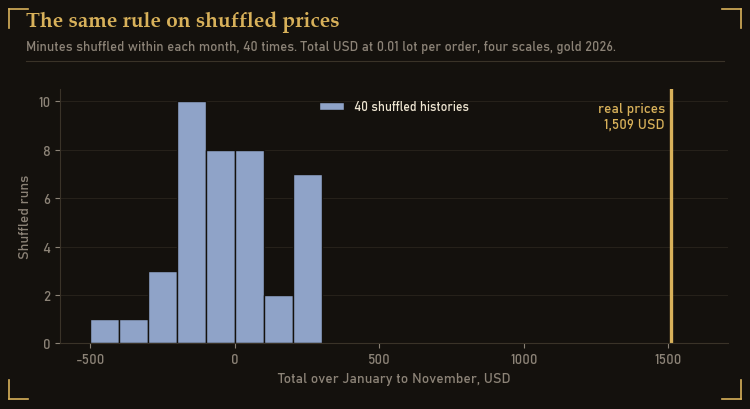
Total of the four lengths from January to November 2026, at 0.01 lot per order. Blue are the 40 shuffled histories, gold is the real one.
On real prices the four lengths made 1,508 USD over 1,156 trades. The shuffled histories averaged minus 18 USD and the best of them made 295. None came close.
5. WHERE IT STOPS WORKING
- It needs active gold. With a second source of gold ticks, July 2024 to November 2026, an earlier build with three of the four lengths lost 0.14 USD per trade while the 14 day range was below 60 USD, earned 0.30 between 60 and 70, and 1.05 above 70. So Talon rests while the range is below 70 USD.
- Even with a wide range, 2025 was weaker than 2026 in that second source, about 0.50 USD per trade.
- It needs fast fills. The tests use 100 ms. Talon carries a brake that pauses it if its last 100 breakouts slipped more than 0.88 USD on average.
- One year of ticks from one broker is the main evidence. The second source agrees on 2026, and the live account is only a few weeks old.
Fafnir on the Market https://www.mql5.com/en/market/product/207569
Live signal https://www.mql5.com/en/signals/2399375
User guide https://www.mql5.com/en/blogs/post/780187
Risk notice. Trading leveraged products carries a high risk of loss. Tests on past data and a short live record do not guarantee future results. Test any EA on a demo account first.


