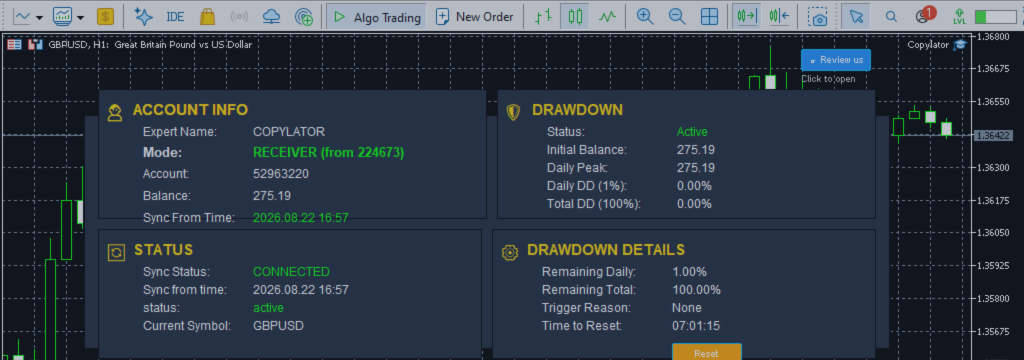
Copying a Sender Who Trades Manually: What Changes — COPYLATOR – MT5 Trade Copier

Product link:
https://www.mql5.com/en/ market/product/191385
Many discussions about trade copying assume that the Sender is running an Expert Advisor. The strategy follows programmed conditions, entries are generated by defined rules, and exits are managed according to the logic built into the system.
But not every Sender uses an EA. Many are human traders who open, modify, and close positions manually. A trade copier can copy their trading activity, but the behavior behind those trades can be very different.
Manual trading introduces discretion, irregular timing, changing position sizes, and decisions that may depend on market conditions or the trader's judgment at a particular moment.
Understanding these differences is important before connecting a Receiver account to a manually operated Sender.
1. The Signal Arrival Pattern
An automated strategy generates trades when its programmed conditions are met. Depending on its design, it may trade frequently, occasionally, or only during specific sessions.
A manual trader operates differently. The timing of trades depends on when the trader observes an opportunity and decides to act.
They may open several positions during an active market session and then remain inactive for several days. They may trade during unusual hours, avoid certain sessions, or temporarily stop trading because of personal circumstances.
The copier does not need to understand why a trade was opened. It processes the trading activity according to its configuration.
For the Receiver, however, this irregularity matters. A month with forty trades does not guarantee that the next month will produce a similar number. Historical trade frequency is useful information, but it should not be treated as a fixed schedule.
2. Discretionary Exits
An EA generally closes positions according to programmed conditions, such as a stop-loss, take-profit, trailing-stop rule, or another exit condition.
A manual trader can make discretionary decisions at any time.
They may close a profitable position before reaching its original target, reduce exposure because market conditions have changed, or exit a losing position before the stop-loss is reached.
They may also close only part of a position and leave the remainder open.
When the copier supports and correctly processes these trading actions, the Receiver's account can reflect the Sender's decisions. This means the Receiver is not simply following an entry strategy. The Receiver is also following the Sender's exit judgment.
That judgment may be valuable, but it is not necessarily consistent. A Receiver should examine how the Sender manages exits, rather than evaluating performance only by entry accuracy or reported profitability.
3. Frequent Stop-Loss and Take-Profit Modifications
Manual traders sometimes modify stop-loss and take-profit levels frequently. They may move a stop to reduce risk, adjust a target, or respond to a change in market structure.
An automated strategy may also modify stops frequently, but its modifications are usually generated by programmed conditions. With a manual trader, the timing and frequency depend on the trader's decisions.
A copier that supports real-time SL/TP synchronization can transfer supported changes from the Sender to the Receiver. COPYLATOR includes real-time SL/TP synchronization for this purpose.
However, synchronization does not mean that every modification is guaranteed to produce an identical result on every account.
Differences in broker execution conditions, minimum stop distances, price availability, symbol specifications, terminal connectivity, and other trading constraints can affect whether a modification is accepted and how it is executed.
For this reason, frequent modifications deserve attention during testing. The Receiver should verify that stop-loss and take-profit changes are being reflected as expected and investigate any recurring differences.
4. The Hesitation Gap: When a Trade Is Opened and Quickly Closed
A manual trader may open a position and then change their mind shortly afterward.
For example, they may enter a trade, notice a new piece of information, reconsider the setup, and close the position within a short period.
If the copier processes both the opening and closing actions, the Receiver may also open and then close a position that existed for only a short time.
This can create a cost difference between the two accounts.
The Receiver may incur spread, commission, and possibly other trading costs even when the Sender's original trade was open for only a brief period. Actual results depend on the instruments, brokers, execution prices, and account conditions involved.
When such quick reversals happen repeatedly, their accumulated costs can become meaningful.
This is one reason to examine more than the Sender's gross trading performance. A Receiver should also consider how frequently the Sender opens and closes positions within very short intervals.
5. Trading Around News Events
Manual traders may respond directly to economic news, central-bank announcements, unexpected headlines, or sudden market movements.
Some deliberately trade during major news events. Others avoid those periods entirely. The important point is that the decision depends on the individual trader.
News-related trading can create additional execution challenges:
- Spreads may widen temporarily.
- Prices may move rapidly between available quotes.
- Slippage may increase.
- Orders may be filled at prices different from those expected.
- Broker execution conditions may change during volatile periods.
A Receiver copying a manual trader who frequently trades around news should understand these conditions before choosing the setup.
The Sender's execution price is not a guarantee that the Receiver will obtain the same price. Even when the copier transfers an order promptly, differences in broker conditions and market liquidity can produce different results.
6. Inconsistent Position Sizes
One of the most important characteristics to examine in a manually operated account is position-size consistency.
An automated strategy may calculate volume using a defined formula. A manual trader may use a consistent risk model, but may also change position size according to perceived opportunity, volatility, account conditions, or personal judgment.
For example, a Sender might open a 0.50-lot position on one trade and a 0.10-lot position on the next.
If the Receiver uses a 1:10 balance-ratio relationship, the approximate copied volumes would be:
- Sender: 0.50 lots → Receiver: 0.05 lots.
- Sender: 0.10 lots → Receiver: 0.01 lots.
The Receiver therefore inherits the variation in the Sender's position sizes.
This may be appropriate if the Sender follows a deliberate risk model. It may be problematic if the volume changes are driven by inconsistent judgment or attempts to recover previous losses.
Copying a manually operated account means copying its position-sizing behavior as well as its entries and exits.
7. Multi-Day Positions and the Human Attention Factor
A manual trader may open a position and leave it running for several days.
They may be monitoring the market regularly, or they may temporarily be unavailable because of travel, work, or other personal commitments.
The Receiver's copied position can remain open during the same period, subject to the copier's configuration and any subsequent actions received from the Sender.
During a multi-day holding period, several factors become important:
- Overnight and weekend swap charges.
- Changes in market volatility.
- Potential gaps when markets reopen.
- Whether the original stop-loss and take-profit levels remain appropriate.
- The availability of the Sender's and Receiver's trading terminals.
The Receiver should not assume that a long holding period is automatically part of a carefully managed strategy. It is worth understanding how the Sender monitors open positions and what happens when market conditions change while a trade remains active.
8. Manual Intervention and Unplanned Trades
A manual trader can intervene in a position at any time. They may close a position manually, change its stop-loss, partially close it, or open a new trade that was not part of a previously documented trading plan.
From the copier's perspective, supported trading actions are processed according to the configured copying rules. The copier does not know whether a particular action came from careful analysis, an emotional reaction, or an impulsive decision.
This distinction is important for the Receiver.
A copied trade does not automatically become a well-planned trade simply because it came from an established Sender account. The Receiver is still exposed to the Sender's decision-making process, including its strengths and weaknesses.
Before copying a manual trader, it is useful to understand whether the Sender follows a documented strategy or frequently makes discretionary changes that are difficult to evaluate.
9. The Advantages of a Manual Sender
Manual trading also has potential advantages. It would be incomplete to focus only on its variability.
A skilled human trader may recognize unusual market conditions, interpret context, and adapt when a situation falls outside the assumptions of a fixed strategy.
They may decide not to enter a trade even when a technical condition appears, reduce exposure before a major announcement, or close a position because new information has changed the original outlook.
An EA can also be designed to respond to changing conditions, but it can only act according to the logic and information available to it.
A capable manual trader may therefore offer judgment and flexibility that a particular automated strategy does not provide.
However, discretion is not automatically an advantage. Its value depends on the trader's skill, discipline, consistency, and ability to manage risk.
The Receiver should evaluate the quality of the decisions, not simply assume that human judgment is superior to automation.
10. Configuring a Copier for a Manual Sender
Copying a manually operated account requires particular attention to position sizing and risk controls.
Several COPYLATOR features can help the Receiver manage the copying arrangement:
Maximum Lot Cap
A maximum lot cap limits the volume of an individual copied position according to the configured setting. It can help prevent an unexpectedly large Sender position from producing an equally large Receiver position.
It does not, however, guarantee a maximum account loss or control the combined risk of multiple simultaneous positions.
Flexible Lot Management
COPYLATOR supports different lot-sizing approaches, including fixed volume, multiplier-based sizing, and balance-ratio scaling.
The appropriate method depends on the Receiver's account size, risk tolerance, and expectations about the Sender's position-sizing behavior.
Drawdown Protection
Drawdown protection can help the Receiver enforce configured account-level limits. Depending on the settings, the system can block further copying and can also close positions and delete pending orders when the configured protection conditions are reached.
It is important to remember that drawdown protection is not a guarantee against losses exceeding a configured threshold. Market gaps, slippage, execution delays, and other conditions can affect the final outcome.
Real-Time SL/TP Synchronization
When the Sender modifies supported stop-loss or take-profit levels, COPYLATOR can synchronize those changes with the corresponding Receiver positions.
This is particularly relevant when copying a manual trader who actively manages open positions. The Receiver should still test synchronization under the actual broker and account conditions before relying on it.
11. What Should You Measure Before Choosing a Manual Sender?
Average monthly profit and total trade count are not enough to evaluate a manually operated account.
A more useful review includes several behavioral measurements:
- Trade frequency: How many positions does the Sender normally open, and how much does this number vary?
- Holding-time distribution: How long do positions typically remain open? What are the shortest and longest holding periods?
- Position-size distribution: Does the Sender use similar volumes, or do position sizes vary significantly?
- Modification frequency: How often are stop-loss and take-profit levels changed?
- Early exits: How often does the Sender close positions shortly after opening them?
- News exposure: Does the Sender regularly trade during major economic announcements?
- Drawdown behavior: How does the Sender respond after a series of losing trades?
These measurements help distinguish a disciplined manual trader from one whose behavior changes significantly from week to week.
Consistency does not guarantee future profitability, but it makes the copying arrangement easier to understand, test, and manage.
12. Test the Actual Copying Behavior
Before connecting a Receiver account to a manually operated Sender with meaningful capital, it is sensible to test the complete process.
A useful demo test should include more than opening a single position. It should examine different types of activity:
- Open a market position manually.
- Modify its stop-loss and take-profit levels.
- Partially close the position.
- Close the remaining volume.
- Open and close another position within a short interval.
- Test different Sender position sizes.
- Observe how the Receiver handles multiple simultaneous positions.
Check the copied volumes, modifications, closing behavior, and execution differences. Use separate demo accounts or another controlled test arrangement when comparing manual and copied execution, so that duplicate orders do not interfere with the results.
The purpose is to understand how the copier behaves under realistic manual trading activity, not merely to confirm that one trade can be copied successfully.
13. Summary: You Are Copying a Trader's Decisions
Copying a manual Sender is different from copying a fully automated strategy because the trading behavior may depend on human judgment, attention, and changing decisions.
- Trade timing may be irregular.
- Exits may be discretionary rather than rule-based.
- Stop-loss and take-profit levels may be modified frequently.
- Positions may be opened and closed within short periods.
- Position sizes may vary significantly.
- News reactions and personal availability may influence trading activity.
A trade copier can transfer supported trading actions, but it cannot evaluate the quality of the Sender's decisions or guarantee identical execution across accounts.
COPYLATOR provides flexible lot management, real-time SL/TP synchronization, Partial Close support, multi-sender and multi-receiver functionality, and drawdown protection to help manage different copying arrangements.
The most important decision, however, comes before configuration: understand the person whose trading activity you intend to copy.
A skilled manual trader may offer valuable judgment and adaptability. But that judgment comes with variability, and the Receiver should be prepared to manage both.
Product link:
https://www.mql5.com/en/ market/product/191385