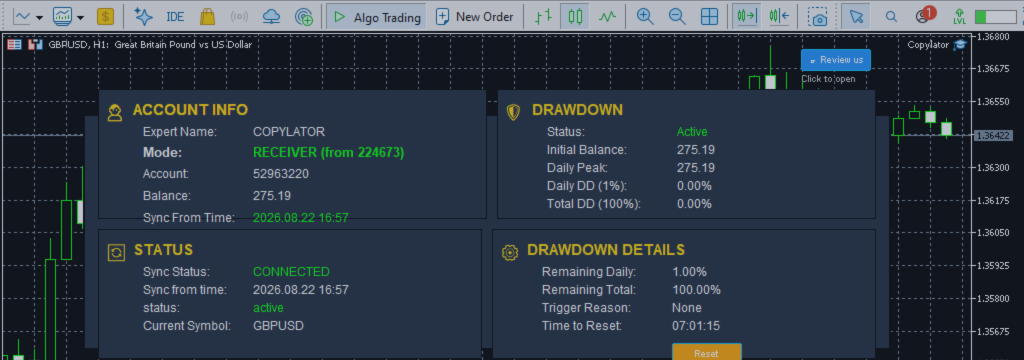
When the Sender Deposits Money: How Balance-Ratio Scaling Silently Resizes Everything — COPYLATOR – MT5 Trade Copier

Product link:
https://www.mql5.com/en/ market/product/191385
A trader configures balance-ratio scaling, tests it on a demo account, and confirms that a 1.00-lot trade on the Sender becomes a 0.10-lot trade on the Receiver. The ratio is 1:10, the calculation is correct, and the setup works as expected for months.
Then the Sender deposits additional money into the account.
The next copied trade is smaller. The Receiver's position sizes have changed, even though nobody modified the Receiver's lot-sizing settings.
This is not necessarily a software error. It is a possible consequence of balance-ratio scaling: the calculation depends on account balances, and those balances can change independently of the Receiver's configuration.
1. What Balance-Ratio Scaling Actually Calculates
In a typical balance-ratio model, the Receiver's trade volume is calculated using the relationship between the two account balances:
Receiver Lot Size = Sender Lot Size × (Receiver Balance ÷ Sender Balance)
For example:
- Sender balance: $10,000
- Receiver balance: $1,000
- Sender trade volume: 1.00 lot
- Calculated Receiver volume: 0.10 lot
The important detail is that this ratio is based on account balances, not necessarily on the values that existed when the configuration was first created.
If the balance values used by the copier change, the calculated volume can change on subsequent trades. The exact update and calculation behavior depends on the copier's implementation and settings.
2. The Deposit Direction: Position Sizes Become Smaller
Imagine that the Sender initially has $10,000 and the Receiver has $1,000.
The calculation is:
$1,000 ÷ $10,000 = 0.10
A 1.00-lot Sender trade therefore produces a calculated Receiver volume of 0.10 lots.
Now the Sender deposits another $10,000. The Sender's balance becomes $20,000, while the Receiver's balance remains unchanged.
The new calculation is:
$1,000 ÷ $20,000 = 0.05
The same 1.00-lot Sender trade now produces a calculated Receiver volume of 0.05 lots.
The Receiver's position size has been reduced by 50%, without any change to the Receiver's own lot-sizing configuration.
This may be exactly what the balance-ratio method is designed to do: maintain a proportional relationship between the two account balances. But it may not be what the Receiver expected when choosing the original settings.
3. The Withdrawal Direction: Position Sizes Become Larger
Now consider the opposite situation.
The Sender starts with $10,000 and the Receiver has $1,000. The calculated volume for a 1.00-lot Sender trade is 0.10 lots.
The Sender then withdraws $5,000. The Sender's balance falls to $5,000.
The new calculation becomes:
$1,000 ÷ $5,000 = 0.20
The Receiver's calculated volume has doubled, from 0.10 to 0.20 lots.
This is the more dangerous direction from a risk-management perspective. The Receiver is now taking larger positions without having deliberately increased the lot size.
If the market moves against the position, the financial impact can be substantially greater than it was under the original sizing relationship.
4. Why the Sender May Not Realize the Impact
A Sender managing a personal trading account may deposit or withdraw money for entirely ordinary reasons:
- Adding capital to the account.
- Withdrawing profits.
- Moving funds between accounts.
- Changing the amount of capital allocated to trading.
- Meeting a margin requirement or adjusting available funds.
These decisions are normally made for the Sender's own financial reasons. The Sender may not know which Receivers use balance-ratio scaling or how a balance change affects their calculated trade volumes.
The result is an important information gap: a change made on one account can influence the position sizing of connected accounts, even though the people operating those accounts may not have been involved in the decision.
5. The Compounding Effect Across Multiple Receivers
The impact can become more significant when one Sender is connected to several Receivers.
If multiple Receivers use balance-ratio scaling against the same Sender, a change in the Sender's balance can affect the calculated volume for all of them.
For example, when the Sender's balance doubles, the calculated volume for each Receiver with an unchanged balance is halved, assuming the same balance-ratio formula and no other sizing constraints.
If the Sender later withdraws capital, the calculated volumes can increase again.
This creates coordinated changes across a group of accounts. Each Receiver may have a different balance, multiplier, or maximum lot cap, but the same Sender balance change can influence all of their calculations.
For anyone operating a multi-receiver setup, monitoring the Sender's balance is therefore part of monitoring the overall position-sizing arrangement.
6. The Drawdown Protection Consequence
Consider a Receiver with a 15% total drawdown threshold and an original position size of 0.10 lots.
After a Sender withdrawal, the calculated Receiver volume increases to 0.20 lots.
For the same instrument, direction, and approximate price movement, a position twice as large will generally produce approximately twice the monetary profit or loss, before considering differences in execution costs and other trading conditions.
The Receiver's drawdown threshold has not necessarily changed. However, the larger position can consume the available drawdown allowance much faster.
This distinction matters:
- The drawdown setting may still be configured correctly according to its original parameters.
- The position-sizing relationship may have changed because the Sender's balance changed.
- The Receiver may therefore reach the configured drawdown threshold after a smaller adverse market movement than originally expected.
Drawdown protection can help respond when its configured conditions are reached, but it does not guarantee that the Receiver's exposure will remain unchanged when the Sender's balance changes. Execution conditions, slippage, and gaps can also affect the final result.
7. Maximum Lot Cap: A Useful but Limited Defense
A maximum lot cap can limit the impact of an increase in calculated volume.
Suppose the Receiver's calculated volume rises to 0.20 lots, but the maximum lot cap is set to 0.15 lots.
The resulting volume is limited to 0.15 lots, assuming the copier's configured sizing rules apply the cap to that calculation.
This reduces the immediate impact of the balance change. However, it does not preserve the original balance ratio. The Receiver is now trading below the volume that the uncapped calculation would produce.
A maximum lot cap should therefore be understood as a position-size boundary, not as a complete risk-management solution.
It also does not control cumulative exposure by itself. Several simultaneous positions, correlated instruments, and changing market conditions can still create substantial account risk.
8. Fixed Lot Sizing: Avoiding Dependence on the Sender's Balance
A Receiver using fixed lot sizing does not derive its trade volume from the Sender's balance.
If the configured fixed volume is 0.10 lots, a deposit or withdrawal on the Sender's account does not, by itself, change that configured volume.
This makes fixed lot sizing a useful alternative when the Receiver wants more direct control over position size.
However, fixed lot sizing has its own limitation: it does not automatically adapt to changes in the Receiver's balance.
If the Receiver's account grows, the same fixed volume represents a smaller proportion of the account. If the Receiver's balance falls, that same volume represents a larger proportion of the account.
In other words, fixed lot sizing avoids dependence on the Sender's balance, but it does not eliminate every possible change in relative account risk.
9. Monitoring the Sender's Balance and Calculated Volume
A practical monitoring process can help Receivers identify unexpected changes before they become a larger risk-management problem.
Consider recording the following information at regular intervals:
- The Sender's current balance.
- The Receiver's current balance.
- The configured lot-sizing method and multiplier, if applicable.
- The maximum lot cap.
- The calculated Receiver volume for a standard Sender trade, such as 1.00 lot.
Comparing these values makes it easier to identify changes in the balance ratio.
For example, if the Sender's balance increases by 10% while the Receiver's balance remains unchanged, the calculated volume becomes approximately 9.09% smaller.
If the Sender's balance decreases by 10%, the calculated volume becomes approximately 11.11% larger.
This inverse relationship is important. A 10% balance change does not produce an exactly equal percentage change in the opposite direction because the calculation uses a ratio.
A Receiver can establish a review threshold, such as a 10% change in the Sender's balance, and check the lot-sizing configuration whenever that threshold is reached.
10. Why Balance-Change Notifications Would Be Useful
A balance change is not necessarily a configuration change. However, when balance-ratio scaling is used, it can have a direct effect on future trade volumes.
For that reason, a notification system that identifies significant changes in the Sender's balance could be useful to Receivers.
Such a notification would not need to change the lot size automatically. Its purpose would simply be to alert the Receiver that the inputs used in the sizing calculation have changed.
Until a Receiver has access to a suitable notification or monitoring mechanism, regular manual checks provide a straightforward way to identify changes.
The key principle is simple: a change in the Sender's balance should trigger a review of the Receiver's expected position size, especially when the change increases exposure.
11. The Question to Ask Before Choosing a Sender
Before choosing a Sender for a balance-ratio setup, the Receiver can ask a simple question:
Do you regularly deposit or withdraw money from this trading account?
The answer can help the Receiver understand how stable the balance ratio is likely to be.
A Sender who frequently withdraws profits or adds capital may have a balance that changes regularly. A Receiver using balance-ratio scaling should account for that possibility when choosing lot-sizing parameters and setting a maximum lot cap.
A Sender who generally keeps trading capital unchanged may offer a more stable balance reference, although trading profits and losses can still change the account balance over time.
This is not a reason to avoid a particular Sender. It is a reason to understand how the Sender's account activity interacts with the Receiver's position-sizing method.
12. Summary: The Balance Ratio Can Change Without a Settings Change
Balance-ratio scaling calculates trade volume using the relationship between the Sender's and Receiver's balances.
- When the Sender deposits money, the calculated Receiver volume generally decreases if the Receiver's balance remains unchanged.
- When the Sender withdraws money, the calculated Receiver volume generally increases if the Receiver's balance remains unchanged.
- These changes can affect multiple Receivers connected to the same Sender.
- A larger calculated volume can increase the Receiver's monetary exposure and make its drawdown allowance easier to reach.
- A maximum lot cap can limit position size, but it does not preserve the original balance ratio or eliminate account-level risk.
- Fixed lot sizing avoids direct dependence on the Sender's balance, but it does not automatically adapt to changes in the Receiver's own balance.
- Regular monitoring helps identify changes before they produce unexpected position sizes.
The central lesson is that balance-ratio scaling is not a permanently fixed lot-size agreement. It is a calculation based on account balances, and those balances can change.
A Receiver who chooses this method should monitor not only the copier's settings, but also the account values that influence the calculation. Otherwise, a normal deposit or withdrawal by the Sender can change the Receiver's exposure without anyone deliberately changing the Receiver's configuration.
Product link:
https://www.mql5.com/en/ market/product/191385