Why Every Trader Needs a Good Copier, Not Just a Cheap One — COPYLATOR – MT5 Trade Copier

Product link:
https://www.mql5.com/en/ market/product/191385
There is a moment in every trader's development when the main question changes. It stops being "Which strategy should I follow?" and becomes "How can I manage multiple accounts without spending all my time repeating the same operations?"
That moment arrives for different reasons. A trader opens a second account with another broker. Someone wants to test a strategy on a demo account while running it on a live account. Another trader manages a family member's account alongside their own. A prop firm trader wants to operate a challenge account while maintaining a separate personal account.
In each situation, manual execution becomes increasingly difficult to manage. A trade copier is no longer simply a convenience. It becomes part of the trading infrastructure.
And when a copier becomes infrastructure, its reliability matters far more than its purchase price alone.
The Problem with Manual Execution at Scale
Consider a trader operating two accounts with the same strategy. Every new position must be opened twice. Stop-loss changes must be repeated. Partial closes must be applied to both accounts. Finally, both positions must be closed correctly.
With three, four, or five accounts, the number of repeated operations grows quickly. The trader must also remember that each account may have different balances, lot sizes, broker conditions, and execution characteristics.
The challenge is not limited to opening trades. It includes every subsequent action throughout the position's lifecycle:
- Opening positions in the correct direction.
- Applying the intended lot size.
- Setting stop-loss and take-profit levels.
- Modifying existing orders and positions.
- Handling partial closes correctly.
- Closing the corresponding positions when the original trade is closed.
Every additional manual operation creates another opportunity for a mistake. A missed modification, an incorrect volume, or a delayed closing action can cause two accounts that were supposed to follow the same strategy to produce different results.
Manual execution may be manageable with one account and a low trading frequency. As the number of accounts and operations increases, however, the process becomes harder to control consistently.
Why the Cheapest Copier Is Not Always the Best Value
Price is an important consideration when choosing software, but the purchase price alone does not tell you how reliable a copier will be.
A low-cost copier may work perfectly well for a particular trader's requirements. The problem appears when buyers compare products based only on price or the ability to copy a basic market order.
A copier needs to handle more than the initial opening of a trade. It must also deal with the events that follow, including position modifications, partial closes, closing instructions, symbol differences, and account-level risk conditions.
Consider some situations that a trader should test before relying on a copier:
- A symbol is named differently by the sender's and receiver's brokers.
- A broker rejects an order because of its execution or filling requirements.
- A partial close is not handled as expected because of minimum volume or volume-step restrictions.
- A stop-loss or take-profit modification is not successfully applied.
- The receiver has different trading conditions from the sender.
- A drawdown threshold is reached, but the trader has not configured the intended response.
These situations do not necessarily mean that a particular low-cost product is defective. They illustrate why a copier should be evaluated under realistic conditions rather than judged by whether it successfully opens a few test trades.
The real cost of an unreliable setup may appear later through missed trades, incorrect position management, unexpected exposure, or the time required to investigate account differences.
The Four Functions That Determine Copier Quality
A copier's quality is not determined by the length of its feature list. It is determined by how reliably it handles four essential functions.
1. Detection
The copier must recognize trading activity on the sending account. This includes new positions and relevant changes to existing trades.
Reliable detection is the starting point. If an event is missed or recognized incorrectly, the receiver may not perform the intended action.
2. Execution
Once an instruction is detected, the receiver must attempt to execute the corresponding trade.
This involves more than copying the direction. The copier must account for volume settings, symbol mapping, available trading conditions, and the receiver broker's requirements.
Even a well-designed copier cannot guarantee identical execution prices across different accounts. Market movement, spreads, liquidity, broker processing, and slippage can all create differences.
3. Position Management
A trade does not end when the position is opened. The copier must also handle the subsequent management of the position.
Important operations include:
- Stop-loss and take-profit synchronization.
- Position modifications.
- Partial closes.
- Full closing of corresponding positions.
- Handling differences in broker volume requirements.
A copier that handles opening orders correctly but struggles with later modifications is incomplete for traders who actively manage their positions.
4. Risk Control
The fourth function is particularly important: what happens when the receiver account reaches a predefined drawdown threshold?
A copier should not be evaluated only by how it transfers profitable trades. It should also be evaluated by the risk-management options available to the receiver.
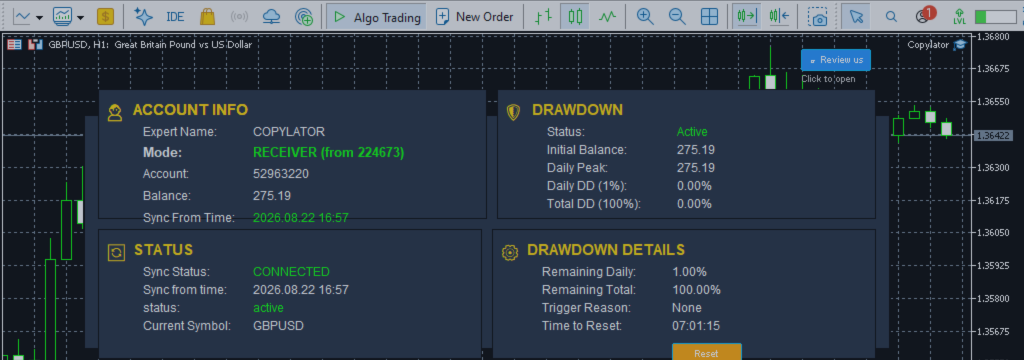
COPYLATOR includes drawdown protection that can block further copying when configured limits are reached. Depending on the selected settings, it can also close open positions and delete pending orders.
This gives the receiver an additional layer of account-level risk management. However, a configured drawdown threshold is not a guaranteed maximum realized loss. Slippage, gaps, execution delays, and other market conditions can cause the final result to exceed the threshold.
The Latency Question
Execution delay is another factor worth considering when comparing trade copiers.
There can be a difference between the moment a sender's trade is executed and the moment the corresponding receiver order reaches the broker. During that interval, the market may move.
For a strategy that targets relatively small price movements, even modest execution differences may have a noticeable effect. For a longer-term strategy, the same delay may be less significant.
Several factors influence the total delay:
- How the copier detects and communicates trading events.
- The computer and terminal performance.
- The network connection.
- The receiver broker's order-processing speed.
- Market liquidity and current volatility.
COPYLATOR uses the MetaTrader 5 Common Folder for local communication when the terminals operate in an appropriate shared environment on the same computer. This avoids requiring an external cloud server or API for that local communication arrangement.
However, it would be misleading to promise a fixed execution delay for every setup. The time between the sender's execution and the receiver's fill depends on the complete communication and execution path, not just the copier's internal processing.
The practical approach is to test the copier under the same computer, terminal, broker, and market conditions that will be used in actual trading.
Why Risk Control Matters More Than Copying Speed Alone
A trade copier can reproduce both profitable and losing trades. Copying accurately does not automatically make the underlying strategy safe.
The important question is whether the receiver has independent controls for limiting its exposure.
Without receiver-side risk controls, a trader may continue copying through a prolonged losing period simply because the sender is still trading.
With COPYLATOR's drawdown protection, the receiver can define daily and total drawdown limits. When a configured threshold is reached, copying can be blocked. The trader can also configure whether open positions should be closed and pending orders deleted.
The distinction between these responses matters:
- Blocking only: Further copying is stopped, but existing positions are not automatically closed by that setting alone.
- Closing enabled: The configured response includes closing open positions and deleting pending orders when the drawdown condition is triggered.
The trader should understand these settings before using the copier on a live account. Risk protection is most useful when its behavior is configured and tested in advance, not when the account is already under pressure.
The Sender Does Not Know the Receiver's Risk Profile
A signal provider or sender generally trades according to the requirements of their own account and strategy.
They may not know the receiver's account balance, leverage, broker conditions, risk tolerance, or external trading restrictions.
One sender's position size may be appropriate for a large account but unsuitable for a much smaller receiver. The same trade can therefore create very different levels of risk across accounts.
This is why the receiver's configuration is so important.
COPYLATOR provides several lot-sizing approaches, including fixed volume, multiplier-based sizing, balance-ratio sizing, and maximum lot limits. These options allow the receiver to configure copied volume according to its own account requirements.
But lot sizing must still be evaluated alongside stop-loss distance, simultaneous positions, instrument specifications, and total portfolio exposure. A maximum lot cap limits the size of an individual copied position; it does not automatically limit the account's total risk.
The Reality of Managing Multiple Accounts
A trader operating three accounts is not necessarily running one identical implementation of a strategy. Each account has its own broker, execution conditions, spreads, available symbols, and configuration.
A well-configured copier helps keep the accounts aligned with the intended trading activity. But identical results should not be expected.
Differences may arise from:
- Different bid and ask prices.
- Different spreads and commissions.
- Slippage and execution delays.
- Different minimum lot sizes and volume steps.
- Different symbol specifications.
- Different account balances and lot-sizing rules.
The goal is not to make every account produce exactly the same profit and loss. The goal is to reproduce the intended trading instructions as consistently as the account and broker conditions allow.
When accounts diverge, the trader should be able to investigate whether the difference came from execution, configuration, or the underlying strategy.
The Time Cost of Manual Trading
Manual execution consumes attention throughout the trading day.
A trader may spend only a few minutes opening a position, but then must repeat the same process on every additional account. The time adds up when stop modifications, partial closes, and exits are included.
For example, a trader who spends 40 minutes each working day repeating trading operations uses approximately 200 minutes over a five-day week. Across an average month, that is roughly 14 to 15 hours.
That time could instead be spent reviewing strategy performance, evaluating risk, researching market conditions, or improving the trading process.
A copier can reduce repetitive work, although it does not eliminate the need to monitor terminals, review account activity, and verify that the configuration continues to operate correctly.
The Error Cost
Manual repetition creates opportunities for mistakes that are difficult to avoid consistently.
Examples include:
- Entering the wrong lot size on one account.
- Forgetting to move a stop loss.
- Closing one position but leaving another open.
- Applying a partial close incorrectly.
- Opening a trade on the wrong symbol.
- Failing to notice that one account did not execute an instruction.
A trade copier reduces the need to repeat these operations manually. It does not eliminate every possible error, because software configuration, broker restrictions, terminal interruptions, and execution failures still matter.
The real advantage is reducing the number of manual actions required and making the copying process more systematic and easier to review.
What a Good Copier Actually Looks Like
A good copier is not necessarily the product with the most impressive marketing claims or the lowest price.
It is a product that handles the complete trade lifecycle reliably, offers practical configuration options, and gives the receiver meaningful control over copied exposure.
For a serious multi-account setup, important capabilities include:
- Reliable copying of market and pending orders.
- Stop-loss and take-profit synchronization.
- Partial-close handling.
- Flexible lot management.
- Symbol mapping and missing-symbol alerts.
- Support for different MT5 account modes, including hedging and netting.
- Multi-sender and multi-receiver configurations.
- Receiver-side drawdown protection.
COPYLATOR – MT5 Trade Copier brings these capabilities together in one MT5 trade-copying solution. Its purpose is to reduce repetitive execution work while giving traders configuration and risk-management options for their receiver accounts.
As with any trading tool, the appropriate configuration depends on the strategy, brokers, account types, and risk requirements. Testing the complete setup before relying on it with significant capital remains essential.
When You May Not Need a Copier
Not every trader needs a trade copier.
Someone operating one account, following one strategy, and executing a small number of trades manually may find that the manual process is sufficient.
A copier becomes more valuable when:
- A second or additional account is introduced.
- The same strategy must be executed across several receivers.
- Trading activity becomes too frequent for comfortable manual repetition.
- Positions require regular modifications or partial closes.
- The trader needs different lot-sizing rules for different accounts.
- Independent receiver-side drawdown protection is required.
The decision should be based on operational needs, not on the assumption that every trader must automate everything.
Summary
A trade copier becomes an important part of a trader's infrastructure when manual execution across multiple accounts becomes difficult to manage consistently.
The difference between a suitable copier and an unsuitable one is not simply its purchase price. It is how reliably it detects trading activity, executes receiver orders, manages positions throughout their lifecycle, and provides practical risk-control options.
Execution speed matters, but it should not be evaluated through unsupported latency promises. Risk controls matter, but they do not guarantee a maximum realized loss. Flexible lot sizing matters, but it must be configured according to the receiver's actual exposure.
A good copier reduces repetitive work, helps keep accounts aligned with the intended trading instructions, and gives the trader more control over the copying process.
Choose a copier based on what it can reliably do under your actual trading conditions, not simply on what it costs. In multi-account trading, the value of dependable infrastructure becomes clear over time.
Product link:
https://www.mql5.com/en/ market/product/191385