What a Forex Copier Actually Does: The Seven Core Functions — COPYLATOR – MT5 Trade Copier

Product link:
https://www.mql5.com/en/ market/product/191385
A trade copier is often described in one sentence: it copies trades from one account to another. That description is accurate, but it leaves out the processes that make copying possible.
Between a trading action on the sender account and the corresponding execution on the receiver account, several distinct functions must work together. These functions detect trading activity, communicate the information, interpret it, execute orders, maintain relationships between positions, and report system status.
Understanding these functions makes it easier to configure a copier, identify potential problems, and understand why a copied trade may differ from the original.
1. Detection: Knowing That Something Happened
The first function is detecting a change on the sender account.
When a position is opened, modified, or closed, the copier must identify that event so it can be communicated to the receiver. The exact detection mechanism depends on the copier's architecture. Some systems use periodic polling, while others can also use terminal event notifications.
In a polling-based design, the copier periodically checks the sender's trading state and compares it with previously observed information. The polling interval influences how quickly a change may be detected, although actual end-to-end copying time also depends on communication, receiver processing, and broker execution.
Typical events include:
- A new market position.
- A new pending order.
- A modification to an existing position.
- A modification to an existing pending order.
- A position closure or pending-order cancellation.
What can go wrong? If the sender-side detection process fails to recognize an event, that event may never reach the receiver. A terminal that appears connected does not, by itself, prove that every trading event is being detected and transmitted correctly.
2. Publication: Making the Event Available
After detecting an event, the sender side must make its information available to the receiver.
This is the publication function. The copier records the relevant trading information in a format that the receiver can access. Depending on the architecture, this may involve a local file, a shared storage location, or a remote communication service.
For a local MT5 copier using the Common Folder, the sender and receiver terminals can exchange information through files in that shared terminal environment. This arrangement does not inherently require an external cloud service or API for communication between terminals on the same computer.
A trading record may contain information such as:
- Symbol and trade direction.
- Order or position type.
- Volume.
- Entry price or pending-order price.
- Stop loss and take profit.
- Sender ticket or position identifier.
- Event information needed to process the change.
The record must contain enough information for the receiver to understand the event. The communication mechanism must also preserve the information needed to process changes in a consistent manner.
What can go wrong? If information is missing, outdated, or unavailable, the receiver may be unable to reproduce the intended action correctly. Communication and file-access problems can interrupt the copying process even when the sender's trading activity is normal.
3. Reception: Reading the Published Information
The third function takes place on the receiver side. The receiver must access the published information and identify which events need to be processed.
In a file-based system, the receiver periodically checks the shared communication location and reads available records. A reliable implementation needs a way to distinguish new events from events that have already been processed.
Depending on the copier's design, this may involve sequence numbers, event identifiers, ticket mappings, acknowledgements, or other tracking information.
This tracking is important because the receiver must avoid processing the same event repeatedly, while also handling terminal restarts and temporary communication interruptions appropriately.
What can go wrong? If event tracking becomes inconsistent, the receiver may miss an update, process information more than once, or fail to resume correctly after a restart. The exact symptoms depend on how the copier stores and recovers its processing state.
4. Interpretation: Deciding What to Do
Reception tells the receiver what happened on the sender. Interpretation determines what the receiver should do with that information.
This is where many of the copier's user-configurable options come into play. The receiver evaluates the incoming event against its settings and account conditions.
Depending on the product and configuration, interpretation may involve questions such as:
- Symbol mapping: Is the sender's symbol matched to the correct symbol on the receiver broker?
- Spread filter: Is the current spread within the permitted limit?
- Trading schedule: Is copying permitted at the current time and on the current day?
- Direction filter: Is the trade direction allowed?
- Drawdown protection: Is copying currently blocked because a drawdown limit has been reached?
- Lot sizing: What volume should the receiver use under the selected sizing method?
- Reverse mode: Should the receiver trade in the opposite direction?
- Stop loss and take profit: Should the receiver use the sender's levels or configured alternative values?
These decisions can change the receiver's result even when the sender's event is detected and communicated correctly.
What can go wrong? An unsuitable filter or sizing configuration can cause a trade to be skipped, opened at a different volume, mapped to an unintended symbol, or executed in the opposite direction.
5. Execution: Sending the Order to the Broker
Once the receiver has interpreted an event and determined that an action is permitted, it must submit the appropriate trading request to its broker.
This is the execution function. The receiver constructs an order request using the relevant symbol, volume, order type, price, stop loss, take profit, and other required parameters.
The broker and trading environment determine whether the request can be accepted and executed.
Possible execution outcomes include:
- The broker accepts and executes the requested order.
- The broker rejects the request because of invalid parameters or account restrictions.
- The requested volume or price cannot be executed as expected.
- The execution price differs from the sender's price because of market conditions and execution differences.
Common reasons for rejection include insufficient free margin, invalid volume, unsupported symbols, incorrect filling modes, and stop-loss or take-profit levels that do not satisfy broker requirements.
What can go wrong? A correctly detected and interpreted trade can still fail at execution. The receiver broker may have different symbol specifications, trading conditions, minimum volumes, stop distances, or available liquidity.
6. Mapping: Linking Sender and Receiver Positions
After a trade is copied, the copier needs to maintain the relationship between the sender's position or order and its corresponding receiver position or order.
This relationship is commonly called mapping.
Mapping is essential for subsequent management actions. When the sender modifies a stop loss, the copier needs to identify which receiver position corresponds to that sender position. When the sender closes a trade, the copier needs to identify the correct receiver position to close.
Without reliable mapping, the copier would have to rely on indirect matching criteria such as symbol, direction, volume, and opening time. Those criteria can become ambiguous when several similar positions are open simultaneously.
What can go wrong? If the relationship between sender and receiver records is lost or becomes inconsistent, later modifications or closures may not be applied to the intended receiver position. This can leave positions out of sync or require manual investigation.
7. Monitoring: Knowing Whether the System Is Working
The seventh function is monitoring. A copier should provide useful information about its operational state so the trader can identify problems instead of assuming that copying is working correctly.
Depending on the product, monitoring may include:
- Sender and receiver status.
- Communication or connection information.
- Recent synchronization activity.
- Drawdown protection status.
- Connected receiver information.
- Warnings, errors, and rejected trade requests.
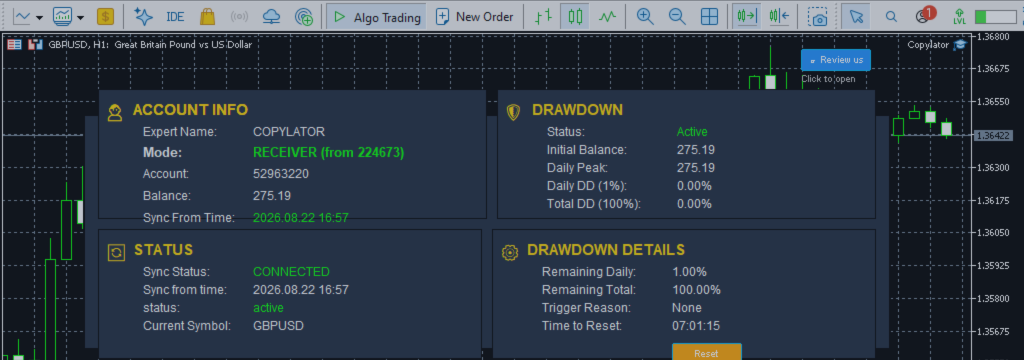
A dashboard is useful because it gives the trader a place to review the copier's state. However, monitoring information should not be confused with a guarantee that every broker request has been executed successfully. The broker's Journal, Experts log, and account history may also be needed when investigating a specific trade.
What can go wrong? Without useful monitoring, communication failures, rejected orders, and configuration problems may remain unnoticed until the trader sees an unexpected result on the account.
How the Seven Functions Work Together
The seven functions form a connected process:
- Detection: A trading event is identified on the sender.
- Publication: The event information is made available to the receiver.
- Reception: The receiver reads the available information.
- Interpretation: The receiver evaluates the event against its settings.
- Execution: The receiver submits the permitted trading action to its broker.
- Mapping: The relationship between the sender and receiver records is maintained.
- Monitoring: The system reports relevant operational information and potential problems.
These functions are interdependent. If an event is not detected, it cannot be published. If it is not published or received, the receiver cannot interpret it. If interpretation rejects the event, no corresponding order should be submitted. If execution fails, there may be no receiver position to manage.
Mapping then supports later actions such as modifications and closures, while monitoring helps the trader investigate the process.
This is why a missing trade on the receiver does not automatically mean that the copier has a single general failure. The problem may have occurred at several different stages.
Where Are These Functions Configured?
Not every function has a user-facing setting. Some are internal processes, while others depend on the trader's configuration or broker conditions.
- Detection and publication: These are primarily internal sender-side processes. Their behavior depends on the copier's communication architecture and operational state.
- Reception: This is primarily an internal receiver-side process responsible for reading and tracking incoming information.
- Interpretation: This is where many important user settings are applied, including lot sizing, symbol mapping, filters, reverse mode, drawdown protection, and SL/TP options.
- Execution: This depends on the receiver's trading environment, broker specifications, account conditions, and applicable copier settings.
- Mapping: This is generally handled internally by the copier and is essential for managing copied trades after their initial execution.
- Monitoring: This is presented through the copier's dashboard and available status or diagnostic information.
Understanding which function controls a particular behavior helps avoid changing unrelated settings when troubleshooting a problem.
A Practical Diagnostic Order
When a trade does not appear on the receiver, investigate the process in sequence rather than changing several settings at once.
- Check detection: Confirm that the sender terminal is running and that the trading event is recognized.
- Check publication: Confirm that the sender is successfully making event information available through the configured communication mechanism.
- Check reception: Confirm that the receiver is reading new information and processing it.
- Check interpretation: Review filters, symbol mapping, lot sizing, direction settings, and drawdown status.
- Check execution: Review the receiver's Experts and Journal logs for broker rejections or trading errors.
- Check mapping: Confirm that later modifications and closures affect the correct receiver positions.
- Check monitoring: Compare the dashboard and diagnostic information with the actual state of the trading account.
This sequence helps narrow down the source of the problem. For example, if the receiver has read an event but rejected it because of a spread filter, investigating broker execution settings is unlikely to solve the issue.
Which Function Has the Greatest Impact on the Trading Result?
All seven functions are necessary, but interpretation has a particularly direct influence on how the receiver account behaves.
Consider two traders using the same sender strategy. One uses fixed-lot sizing, while the other uses balance-ratio sizing. One allows copying during high-spread conditions, while the other applies a spread filter. One enables drawdown protection, while the other does not.
Even if detection, communication, and execution operate correctly, the receiver accounts can produce substantially different trading results because their interpretation settings differ.
This does not make the other functions less important. A sophisticated configuration cannot compensate for missing events, failed communication, rejected broker requests, or incorrect position mapping.
The practical lesson is that a copier should be evaluated as a complete process, not simply by whether it can open a position on a second account.
Summary
A Forex trade copier performs seven core functions: detection, publication, reception, interpretation, execution, mapping, and monitoring.
Detection identifies what happened on the sender. Publication makes the information available. Reception reads it on the receiver. Interpretation decides what action is appropriate. Execution submits the order to the broker. Mapping links the two accounts' trading records. Monitoring helps the trader verify the system's operational state.
Each function has a different responsibility, and problems at different stages can produce similar symptoms. Understanding the process makes troubleshooting more systematic and helps traders configure their receiver accounts more carefully.
A trade copier is not simply a tool that duplicates orders. It is a coordinated system that detects, communicates, interprets, executes, manages, and monitors trading activity.
Product link:
https://www.mql5.com/en/ market/product/191385