Margin, Leverage and Free Margin: How a Normal Trade Ends in a Stop Out

Most accounts are not blown by a bad strategy. They are blown by a position that was too big for the account. Margin, leverage and free margin are the numbers that show you this before it happens. Here is what each one means and how a normal-looking trade can end in a stop out.
The Key Terms
- Margin: a deposit the broker holds while a trade is open, not a fee. Margin = lots × contract size × price ÷ leverage.
- Leverage: how much larger the position is than the margin. At 1:100, $1 of margin controls $100.
- Equity: your balance plus the profit or loss of open trades.
- Free margin: equity minus used margin. It is your buffer, and it shrinks as open trades lose.
- Margin level: equity ÷ used margin × 100. A typical broker warns at 100% (margin call) and starts closing trades at 50% (stop out).
From Opening to Stop Out
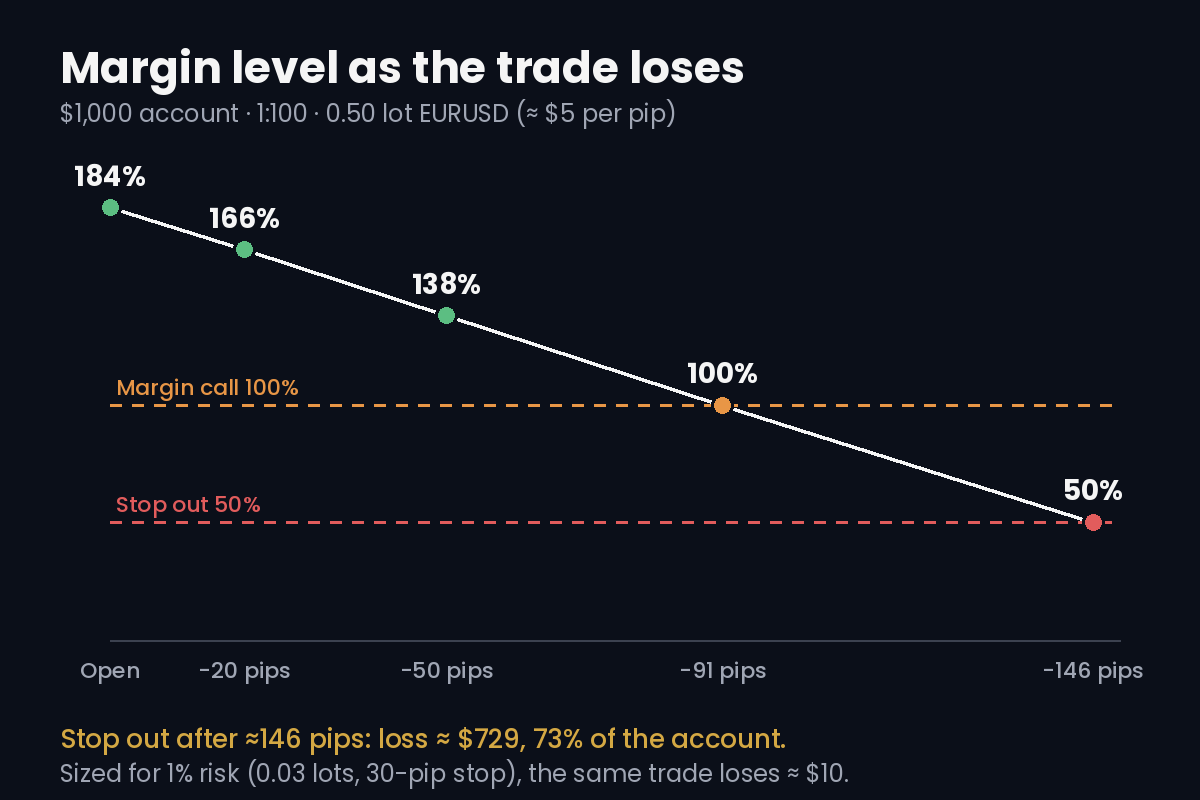
A $1,000 account at 1:100 opens 0.50 lots of EURUSD at 1.0850. That is about $5 per pip and $542.50 of used margin, so the margin level starts at 184%. Now price moves against the trade:
After about 91 pips the account reaches the margin call. After about 146 pips the broker closes the trade, with a loss of about $729, or 73% of the account. The same account risking 1% with a 30-pip stop would trade about 0.03 lots and lose about $10 if the stop is hit.
Leverage does not change your risk per pip. Lot size does. At 1:500 the same 0.50 lot still loses $5 per pip. Higher leverage only lets you open far bigger positions: over 4 lots on $1,000, where a 25-pip move can empty the account.
How to Keep Margin Under Control
- Size every trade by risk, not by the free margin you have.
- Use a stop loss on every trade and keep the margin level well above the margin call level.
- Remember that correlated positions use margin like several trades but lose like one large trade.
- Check the contract size in Market Watch › Specification, and your margin level in the Trade tab (Ctrl+T).
Margin and Multi-Level Robots
Expert Advisors that add positions use margin quickly. If every level doubles the lot, six levels need more than 60 times the margin of the first trade. Two things protect the account: how the levels are sized, and a hard drawdown limit that closes everything before the broker does.
Indiora keeps every US30 level the same size, so its exposure grows in a straight line, not exponentially. Aurion uses larger later levels on gold, which is why it needs 1:400 leverage, a small starting lot and a Max Drawdown % that you set before going live.
Trading on margin involves a high risk of loss. Margin call and stop out levels vary by broker and account type.