Spread, not strategy, often decides whether a scalper makes money. Most traders compare entry signals and win rates, but every trade pays one cost before it can earn a cent: the spread, plus commission and slippage.
Why scalpers feel it most
A swing trade aiming for 100 pips barely notices a 1-pip spread. A scalper aiming for 3 pips loses a third of its target to that same pip. And the lower the timeframe, the smaller the targets, so the spread takes an even bigger share.
The 30-second check
1. In Market Watch, note your broker's typical spread on the symbol during the session your EA trades. On a Raw account, add the commission converted to pips.
2. Open the EA's Strategy Tester report and find its average winning trade in pips.
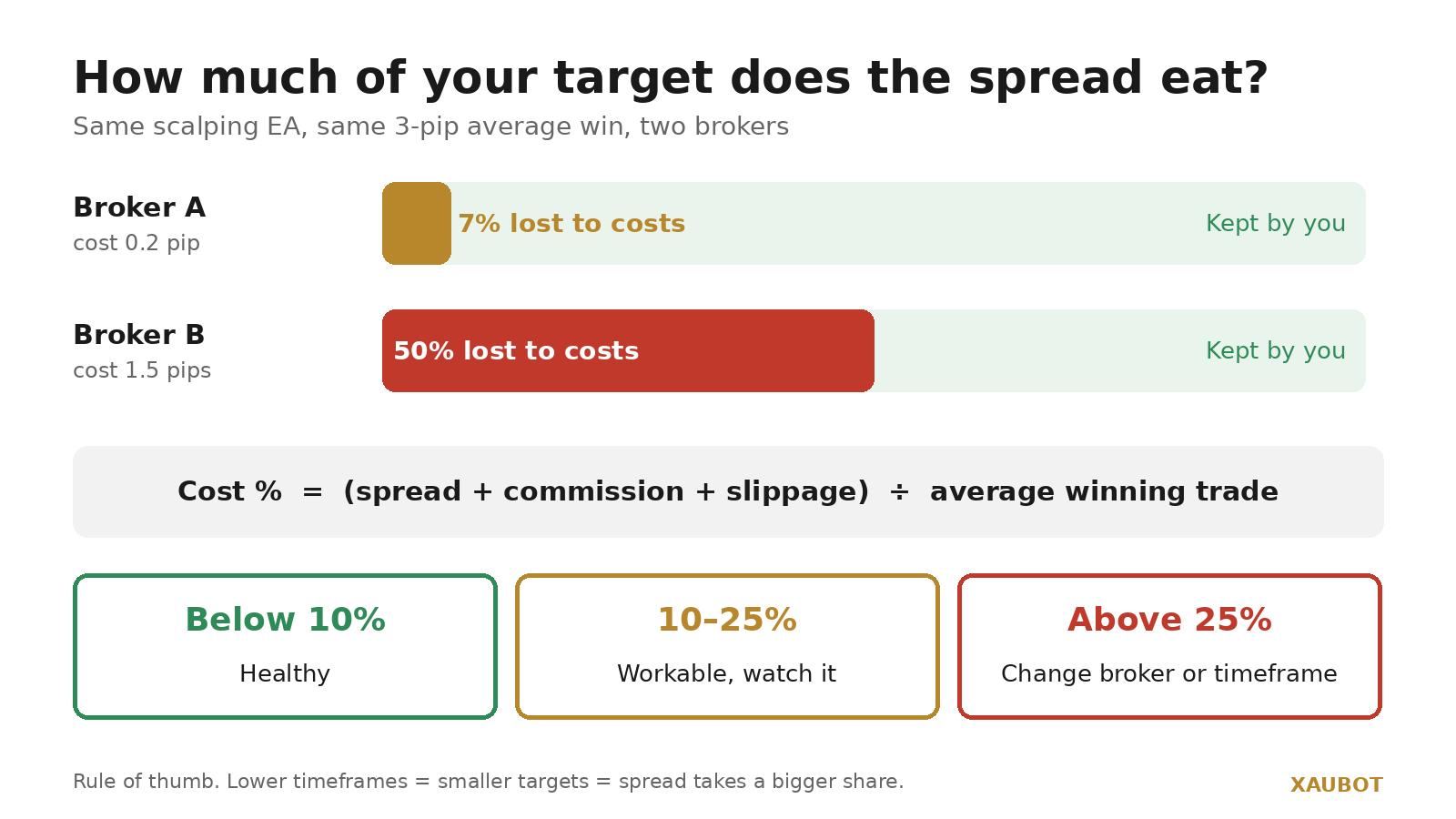
3. Divide your total cost by the average win.
Example: an EA's average win is 3 pips. At Broker A the total cost is 0.2 pip, so costs take about 7% of each win. At Broker B spread and slippage add up to 1.5 pips, so half of every winning trade is gone before it starts. Same EA, same signals, completely different result.
A simple rule of thumb
Below 10%, your costs are healthy. Between 10% and 25%, the EA can work, but watch it closely. Above 25%, switch to a Raw or ECN account, change broker, or use a higher timeframe.
Built-in spread protection
A good scalping EA refuses to trade when costs are too high. Vectron scalps US30 on M5 and skips entries when the spread is above 2.5 index points. Falcon FX scalps several Forex pairs from one chart and skips any pair whose spread is above its limit.
Whichever EA you use, test it on a demo account with your broker's real spread, not the lowest one possible.