VR Proton — Trading robot (Expert Advisor) for MetaTrader 4 and MetaTrader 5

VR Proton — Next-Generation Trading Robot
VR Proton is a trading robot (Expert Advisor) for MetaTrader 4 and MetaTrader 5, designed as a comprehensive system for automated management of trading series.
Instead of simply searching for an entry point, VR Proton combines several levels of trade management: trend-based entries, position additions when the price moves against the initial direction, automatic break-even protection, adaptive trailing stop, and series closure at a calculated level.
The main idea behind VR Proton is not to try to predict every next market movement, but to manage an already opened trading position according to how the price movement develops.
This approach makes it possible to view VR Proton not simply as another Expert Advisor, but as a technological system for managing the entire trading process.
Official trading robot page:
https://www.mql5.com/en/market/product/199125

More Than Just an Entry Signal — A Complete Trade Management System
A classic trading robot is often built around a simple logic: when a signal appears, open a position; when Take Profit is reached, close it.
VR Proton uses a more sophisticated model.
After the first position is opened, the algorithm continues to monitor the development of the trading series. Depending on price movement, the system can:
- open new trend positions;
- add positions during an adverse price movement;
- adjust the average price of the series;
- move profitable positions into a protected state;
- use adaptive trailing;
- calculate an exit level for part of the series;
- close the series based on its average price.
Thus, the robot works not only with an individual trade, but with the dynamics of the entire position series.
A Modern Approach to Trailing Stop
One of the key features of VR Proton is the use of several types of trailing stop.
In addition to a classic fixed-distance trailing stop, the system provides dynamic trailing as well as the more advanced Dynamic Extra mode.
With Dynamic Extra, the trailing distance changes depending on how far the price has already moved in the direction of the position. This is achieved using an adaptive exponent that changes between predefined minimum and maximum values.
The practical purpose of this approach is to avoid managing the position in exactly the same way at different stages of the price movement.
At the beginning of a movement, protection can be more compact, while as the trend develops, the algorithm can follow the position more freely.
This is particularly important for trending movements, where an overly early fixed Stop Loss can close a position during a normal retracement before the movement has had a chance to develop.
Trend Entries and Retracement Management
VR Proton uses two main scenarios for the development of a trading series.
The first is movement in the initial direction. In this case, the robot can continue building a trend-based series.
The second is a price movement against the open position. In this case, the algorithm can use a position-addition mechanism.
New positions are opened at a predefined distance from previous positions, while strategy parameters allow the trader to control the number of positions, the distance between additions, and changes in position volume.
At the same time, the distance between subsequent additions can change as the series develops. This makes it possible to avoid using exactly the same distance for every subsequent addition.
As a result, the system creates not simply a collection of independent trades, but a managed position structure with its own average price.
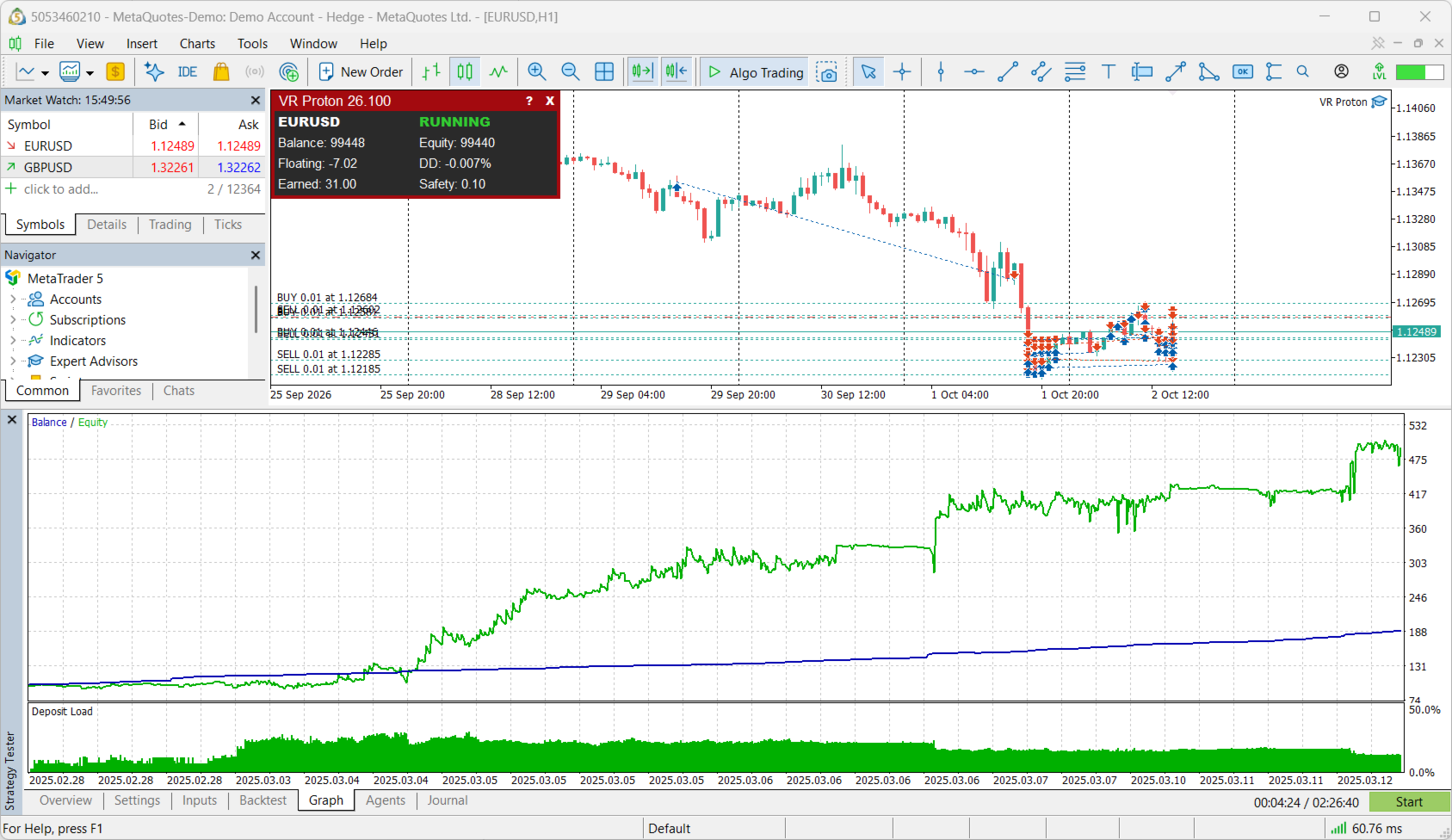
Managing the Series Instead of an Individual Trade
One of the most important concepts of VR Proton is working with the average price of the series.
When several positions are open, their overall result depends not only on the price of the latest entry, but also on the combined volume and price of all positions in the series.
VR Proton uses a weighted average price to calculate the target exit level.
This allows the algorithm to treat the series as a unified structure and calculate the exit based not solely on the most recently opened position.
Depending on the selected mode, the system can use different methods of selecting the outer positions of the series when forming the averaged exit level.
This mechanism is particularly important when working with multiple positions because it makes it possible to manage not an individual order, but the overall structure of the trading series.
Automatic Break-Even Protection
After the price has moved a predefined distance, VR Proton can move the position into a protected state.
This is not simply a matter of moving the Stop Loss to the opening price. The trader can specify an additional step that allows the protection level to be placed above the entry price for BUY positions or below the entry price for SELL positions.
As a result, a profitable position moves from its initial state into a mode where profit-protection mechanisms begin to operate.
This is an important stage of the VR Proton architecture because break-even protection and trailing are separate stages of position management.
Intelligent Exit Management
VR Proton is not limited to the classic Take Profit model for each individual position.
When managing a series, the algorithm can calculate an exit level based on the average price of selected positions and an additional profit value.
The system therefore takes into account:
- position entry prices;
- position volumes;
- the structure of the series;
- the selected averaged exit mode;
- an additional offset relative to the calculated average price.
This makes it possible to create a controlled exit point for part of the trading structure, rather than simply setting the same Take Profit for every trade.
Technology Built Around Price Movement
VR Proton does not attempt to build its strategy exclusively around predicting the next candle or finding the perfect reversal point.
The core idea is the sequential management of an already developing market situation.
The algorithm can be simplified into the following sequence:
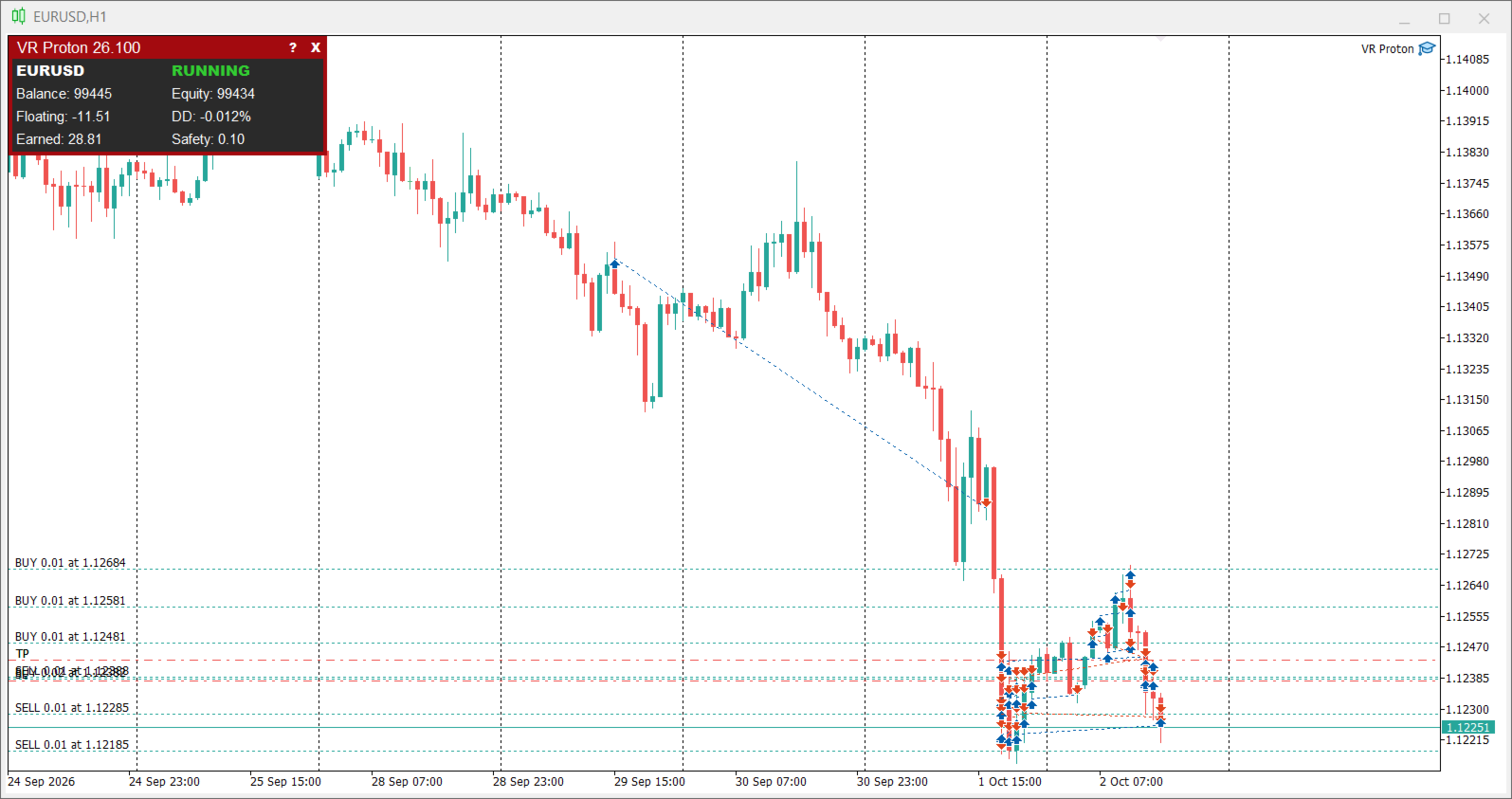
Entry → Movement Development → Retracement → Series Structure Adjustment → Recovery → Protection → Trailing → Exit.
If the price moves in the desired direction, the position can enter a protected state, after which the position-management mechanism begins to operate.
If the price temporarily moves against the initial direction, the strategy provides the possibility of adding a position at a more favorable price. At the same time, the average price of the entire series changes.
As the number of unprotected positions increases, the parameters controlling the distance between additions can change, while the volume of new positions can be calculated using a predefined multiplier.
Once the price movement recovers, the system can again move toward protecting the result and managing profitable positions.
This creates a technological sequence in which each stage has its own purpose:
- Entry — formation of the initial position;
- Development — continuation of the movement and formation of the series;
- Retracement — management of an adverse movement;
- Averaging — adjustment of the average price of the series;
- Recovery — managing the movement after a retracement;
- Protection — moving the position into the profit zone;
- Trailing — following the developing movement;
- Exit — fixing the result of the series.
It is this sequence of mechanisms that forms the core concept of VR Proton.
Flexible Algorithm Configuration
VR Proton provides a wide range of settings that allow the behavior of the strategy to be adjusted to a specific instrument, timeframe, and trading conditions.
Settings are available separately for BUY and SELL, allowing each trading direction to be configured independently.
Trading Direction
Determines whether the algorithm will operate with BUY or SELL positions.
Separate direction control makes it possible to use BUY only, SELL only, or both directions simultaneously.
This can be useful when testing different strategy configurations or when it is necessary to restrict trading to a single direction.
Initial Lot Size
Determines the initial trading volume.
This is one of the most sensitive strategy settings. Increasing the initial volume increases the financial impact of each position, but at the same time increases free-margin requirements and the potential load on the trading account.
Therefore, this parameter should be considered together with account size, trading instrument, and the maximum number of positions.
Break-Even Distance
Determines the distance the price must move in the profitable direction before the position-protection mechanism is activated.
A smaller value allows positions to enter a protected state earlier, but may result in protection being triggered more frequently during minor market fluctuations.
A larger value gives the position more room to develop, but protection will be activated later.
Break-Even Step
Determines the additional step used when setting the protection level relative to the opening price.
This means that break-even does not necessarily have to be set exactly at the entry price; it can be placed with a small margin in the profit zone.
Trend Position Count
Determines the parameters used to form the trend portion of the series.
Changing this value affects how actively the strategy can develop the initial movement and form a sequence of positions in the direction of the trend.
Adverse Move Distance
Determines the distance used when the price moves against the initial position.
This is one of the key parameters of the position-addition mechanism.
The smaller the distance, the faster new positions can appear. The larger the distance, the more room the price has before the next addition.
Therefore, this setting directly affects the density of the trading series.
Adverse Position Count
Determines the number of unprotected positions after which the logic used to calculate the distance between subsequent additions can change.
This makes it possible to create a more flexible series structure in which initial additions and subsequent additions can occur with different levels of intensity.
Volume Multiplier
Determines the volume multiplier for subsequent positions after the specified threshold has been reached.
For example, with a multiplier of 2.0, the next position may have twice the volume of the calculated base value.
This has a significant impact on the strategy's risk profile. The higher the multiplier, the faster the volume of the series can increase and the greater the potential margin load.
Therefore, this parameter requires particularly careful testing.
Average Exit Mode
Determines how positions are selected for calculating the averaged exit level.
The robot uses the structure of the series and the average price of selected positions to form the target level.
The selected mode affects which part of the series is used for the exit calculation and how the closing price is formed.
Average Exit Offset
Adds an additional offset relative to the calculated average price.
This allows the algorithm to calculate the exit not directly at the average price of the series, but with a predefined additional offset.
This parameter affects the price-recovery requirement and the potential target result when closing the selected part of the series.
Trailing Stop Type
Determines the type of trailing used by the algorithm.
VR Proton provides several approaches:
- classic fixed trailing;
- dynamic trailing;
- Dynamic Extra — adaptive mode;
- manual type provided in the settings structure.
Dynamic Extra deserves particular attention because its purpose is to change the behavior of position management as the price movement develops.
Trailing Base Size
Determines the base scale used to calculate the distance of the dynamic trailing.
Changing this value makes it possible to make the position management tighter or more flexible.
When configuring this parameter, it is important to consider the volatility of the instrument: a value that is too small may result in premature closure, while a value that is too large may give back a significant portion of accumulated profit.
Maximum Trailing Exponent
Determines the maximum exponent value used by the adaptive Dynamic Extra mode.
At the beginning of the movement, this parameter has a greater influence on the shape of the trailing-distance calculation.
Changing it can alter the behavior of the initial position management.
Minimum Trailing Exponent
Determines the minimum exponent value toward which the adaptive calculation moves as the price movement develops.
Thus, the combination of the minimum and maximum values defines the adaptation range of the trailing mechanism.
It is precisely the interaction between these two parameters that makes Dynamic Extra different from a conventional fixed trailing stop.
Fixed Trailing Distance
Determines the fixed distance used by the classic trailing mode.
In this mode, the logic is simpler: the Stop Loss follows the price at a predefined distance.
This option can be useful as a baseline mode for comparison with dynamic algorithms when testing the strategy.
Settings Do Not Work in Isolation
An important feature of VR Proton is that individual parameters cannot be considered completely independently of one another.
For example, changing Initial Lot Size affects the financial load, while changing Volume Multiplier determines how quickly the volume of the series can increase.
Adverse Move Distance affects the density of additions, while Adverse Position Count affects when the structure of those additions can change.
In turn, Break-Even Distance and Break-Even Step determine when a position enters a protected state, after which trailing can come into operation.
The parameters Maximum Trailing Exponent and Minimum Trailing Exponent then determine the adaptive behavior of the Dynamic Extra trailing mechanism.
Therefore, VR Proton should not be optimized based on a single parameter, but rather on a combination of parameters for a specific instrument, timeframe, and trading conditions.
Why VR Proton Belongs to the New Generation of Trading Robots
A modern trading robot is no longer necessarily a program that simply opens and closes trades based on a single signal.
A more advanced approach is to create systems capable of managing the entire lifecycle of a trading position.
This is the principle behind VR Proton.
The algorithm combines:
- trend-based entries;
- retracement management;
- series formation;
- average price adjustment;
- volume control;
- automatic break-even protection;
- adaptive position management;
- averaged exit calculation.
The result is a multi-level system in which each mechanism is responsible for a specific phase of the market movement.
A particularly important element is the modern approach to trailing: instead of using a single fixed distance, the robot can use a dynamic position-management model whose behavior changes as the movement develops.
What Is VR Proton Designed For?
VR Proton is intended for traders who are not satisfied with the standard “signal — entry — Take Profit” approach and want a more flexible tool for managing a trading series.
The robot may be of interest to traders who:
- use trend-based trading ideas;
- work with retracements and movement recovery;
- want to automate the management of position series;
- use break-even protection and trailing;
- want to test different approaches to dynamic position management;
- prefer to configure the algorithm's parameters themselves;
- test trading systems in MetaTrader 4 or MetaTrader 5.
At the same time, VR Proton should be regarded specifically as a tool for automating a trading strategy, not as a guarantee of profit.
How to Properly Test VR Proton
Before using the robot on a live account, comprehensive testing on a demo account and in the Strategy Tester is recommended.
It is particularly important to test the robot under conditions that are as close as possible to the intended real trading environment.
The following factors should be taken into account:
- trading instrument;
- timeframe;
- spread;
- commission;
- swap;
- account size;
- leverage;
- conditions provided by the specific broker;
- maximum load on available free margin.
During testing, it is also important to analyze not only profitability, but also maximum drawdown, the number of positions in a series, maximum position volume, series duration, and account load.
Particular attention should be paid to the averaging parameters and volume multiplier, as these can significantly change the risk profile of the strategy.
For a comprehensive evaluation, it is advisable to test different historical periods and compare several parameter sets.
Working with the Broker and Trading Conditions
The performance of a trading robot depends not only on the algorithm, but also on the conditions under which orders are executed.
Differences in spread, commission, execution speed, minimum volume, lot-step requirements, and available margin can significantly affect the behavior of the trading series.
Therefore, parameter settings that produce good results on one trading account may not demonstrate the same characteristics on another.
Before launching the robot on a live account, it is recommended to test VR Proton with the broker you intend to use.
About the Author of VR Proton
The author of VR Proton is a trader and programmer with more than 20 years of experience in financial markets and the development of software solutions for trading automation.
Over the years, numerous trading algorithms, Expert Advisors, and tools for MetaTrader 4 and MetaTrader 5 have been developed.
The development approach is practical: particular attention is paid to algorithm logic, code quality, configuration flexibility, and the ability to conduct comprehensive testing before use.
VR Proton is the result of practical trading-system development, with the primary focus not on an attractive entry signal, but on managing the entire sequence of trading events.
Demo versions and configuration sets are provided for the product, allowing users to study its operating principles and conduct their own testing.
The core development principle is not to promise the impossible, but to create tools whose logic can be studied, configured, and independently tested using historical data and a demo account.
VR Proton User Reviews
When choosing a trading robot, it is important to evaluate not only the strategy description and test results, but also the real experience of users who have already studied or used the product.
Reviews can provide additional insight into the robot's operation, configuration convenience, specific trading instruments, and overall user experience.
We recommend reviewing the feedback independently and considering the opinions of different users before deciding to purchase and launch the trading robot.
Read VR Proton reviews on MQL5 Market
The review page is located directly on MQL5 Market, allowing users to examine comments and ratings independently, without selective quotations or interpretations.
VR Proton — Technology for Managing Market Movement
The main idea behind VR Proton is not to find the perfect entry point.
The robot is built around a different principle — managing the development of a trading position after entry.
The price moves — the state of the series changes.
The position becomes profitable — protection is activated.
The movement continues — position management begins.
A retracement occurs — the algorithm can adjust the structure of the series.
The price recovers — the system can again protect the result and manage the exit.
This is why VR Proton can be viewed as a modern technological platform for trading strategy automation, where the entry is only the beginning of the process, while the main work of the algorithm continues throughout the entire lifecycle of the trading series.
VR Proton is not just a trading signal. It is a system for automated management of market movement, position series, result protection, and exits.
Official trading robot page: