MT5 Trade Copier: Drawdown Protection During High-Volatility Events – What Changes

Product link:
https://www.mql5.com/en/ market/product/191385
Drawdown protection is calibrated in calm markets. The trader sets a daily limit, a total limit, chooses Equity or Balance, and assumes the system will behave predictably. For weeks or months, it does. Then a high-volatility event arrives, and the protection behaves in ways the trader did not anticipate.
This is not a malfunction. It is the natural consequence of applying a percentage-based rule to a market that moves in ways percentages do not capture. Understanding how drawdown protection behaves under stress is what separates a trader who is protected from one who merely believes they are.
The Confirmation Window Becomes a Liability
Most drawdown systems include a short confirmation period before acting. This delay exists to prevent triggering on momentary spikes that recover within seconds. In normal conditions, it works as intended.
During a high-volatility event, the confirmation window becomes a liability. The account continues to lose while the copier waits to confirm the trigger. A 10% equity limit may become a 12% or 14% realized loss by the time the protection actually acts.
The effect is amplified when the event is a gap. If the market jumps from one price to another with no intermediate ticks, the confirmation period is effectively instantaneous—the threshold is crossed and the equity is already far beyond it. The protection triggers, but the loss already exceeds the limit.
There is no configuration that eliminates this. The only mitigation is to set limits with a larger buffer during periods when high-volatility events are expected, or to reduce position size ahead of known events.
Equity and Balance Diverge Sharply
In calm markets, Equity and Balance move together. Floating profit and loss is small relative to the account, and the two measures rarely differ by more than a fraction of a percent.
During a high-volatility event, the divergence becomes dramatic. Equity can drop several percent in seconds while Balance remains completely unchanged. If the protection is configured on Balance, it will not trigger at all—even as the account loses most of its value on paper.
This is why equity-based protection is generally preferred for accounts that need to survive volatile events. It reflects the actual risk exposure in real time, not the historical record of closed trades.
For traders using Balance-based protection, the practical implication is that high-volatility events are effectively unprotected. The protection will only respond once positions are closed, which may be far too late.
Slippage on Forced Closures
When drawdown protection triggers and closes positions, the closures happen at market price. In calm markets, this means a fraction of a pip of slippage. During a high-volatility event, the slippage can be substantial.
A position that is 20 pips in loss at the moment of the trigger may be closed at 35 pips in loss if the market is moving quickly. The realized loss exceeds the floating loss, and the account falls further below the limit than expected.
This slippage is unavoidable. It is the cost of closing positions in a fast market. The only way to reduce it is to close positions before the event arrives—which requires a decision made in advance, not during the crisis.
Traders who know a high-impact event is scheduled should consider reducing exposure beforehand. Closing half the position or tightening stops before the release reduces the amount of capital exposed to post-trigger slippage.
Multiple Triggers in Rapid Succession
In volatile markets, drawdown protection can trigger, clear, and re-trigger within minutes. The sequence is disorienting and can produce unintended behavior.
The pattern is usually:
- Equity drops below the threshold.
- The trigger is confirmed.
- Positions are closed.
- Equity stabilizes above the threshold because the losing positions are gone.
- The block clears.
- New trades open.
- Equity drops again.
- The trigger fires again.
Each cycle locks in a loss. The account is protected from any single catastrophic event, but it bleeds through repeated triggers. This is a known behavior of automated protection in fast markets, and it is not a bug—it is the protection doing exactly what it was configured to do.
The practical response is to disable new copying during periods when volatility is expected to remain elevated, rather than allowing the system to cycle through repeated triggers. A manual pause is often more effective than automated protection during these windows.
Pending Orders Fill Unexpectedly
Pending orders are particularly vulnerable during high-volatility events. A limit order resting near the market can be triggered by a sudden spike, filled at an unexpected price, and immediately turn into a losing position.
If the drawdown protection is configured to block new trades but not delete pending orders, these fills can occur after the block is active. The copier prevents new signals from being copied, but the pending order—placed before the trigger—still executes.
The result is a position that was never intended to exist, opened during a period when the account was supposed to be protected. This is one of the most common causes of unexpected losses following a drawdown trigger.
The solution is to enable pending order deletion as part of the drawdown response. This ensures that no order placed before the trigger can execute after it.
The Dashboard Becomes Unreliable
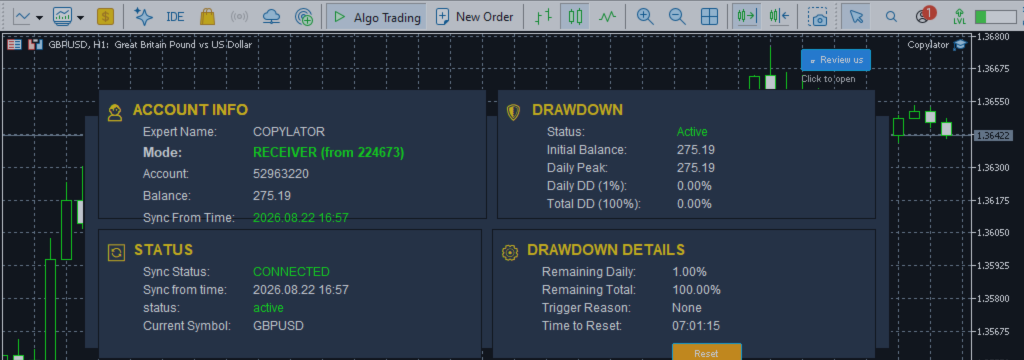
In calm markets, the drawdown dashboard updates smoothly and displays accurate information. During a volatile event, it can lag behind reality by several seconds.
The displayed drawdown percentage may be lower than the actual current drawdown. The trigger status may not update immediately. The countdown to the next reset may appear frozen.
This is not a failure of the dashboard—it is a consequence of the update interval. The dashboard refreshes periodically, not continuously. During fast markets, the gap between refreshes becomes visible.
Traders should not rely on the dashboard as the sole source of information during a volatile event. Broker-side equity readings are the ground truth. The dashboard is a convenience, not a substitute.
Configuration Adjustments for Volatile Periods
For traders who expect to face high-volatility events regularly, several configuration adjustments reduce the risk of unexpected behavior.
Increase the buffer between the intended limit and the configured limit. If the trader wants to cap losses at 10%, set the limit at 8% or 9% to account for confirmation delay and slippage.
Use equity-based protection. Balance-based protection does not reflect floating losses and will not respond during the event.
Enable both position closing and pending order deletion. Partial protection leaves gaps through which losses can still occur.
Reduce lot sizes during periods when events are expected. Smaller positions mean smaller absolute losses, which means smaller slippage in absolute terms.
Pause copying manually before scheduled events. No automated system responds as quickly as a decision made in advance.
What to Do After a High-Volatility Trigger
After the event passes and the account has stabilized, several actions are appropriate before resuming normal operation.
First, verify that all positions are closed. Occasionally, a closure may fail in fast markets, leaving an unintended position open. Close it manually if necessary.
Second, verify that pending orders are deleted. The same principle applies. A remaining pending order is a latent risk.
Third, review the actual realized loss against the intended limit. If the gap is large, adjust the buffer before the next event.
Fourth, wait for volatility to normalize before resetting. Resetting immediately after a trigger, while conditions are still unstable, invites a second trigger within minutes.
Fifth, document the event. Note the trigger time, the realized loss, the cause, and the configuration adjustments that would have improved the outcome. This record is invaluable for the next event.
Summary
Drawdown protection behaves differently during high-volatility events. The confirmation window becomes a liability. Equity and Balance diverge sharply. Slippage on forced closures amplifies the loss. Multiple triggers can occur in rapid succession. Pending orders can fill unexpectedly. The dashboard becomes unreliable.
None of these are failures. They are the natural interaction between a percentage-based rule and a market that does not respect percentages. The protection is still valuable—it prevents the worst-case outcome. But it is not perfect, and treating it as perfect leads to surprises.
The best protection during high-volatility events is a combination of automated safeguards and advance planning. Set conservative limits. Use equity-based measurement. Enable all protective actions. Reduce exposure before known events. Pause copying when conditions are extreme. Then review and adjust after the event passes.
Drawdown protection is a tool, not a guarantee. Understanding its limits is what makes it effective.
Product link:
https://www.mql5.com/en/ market/product/191385