MT5 Trade Copier: Equity vs. Balance-Based Drawdown – Which One Should You Choose?

Product link:
https://www.mql5.com/en/ market/product/191385
Drawdown protection has a setting that most traders skim past without thinking: the choice between Equity and Balance as the basis for calculation. It looks like a minor technical detail. In practice, it changes the entire behavior of the protection system—when it triggers, how often it triggers, and what it actually protects you from.
Two accounts with identical balances, identical strategies, and identical drawdown limits can behave completely differently depending on which basis is selected. Understanding the difference is not optional; it determines whether your protection helps or hinders.
What Balance-Based Drawdown Measures
Balance-based drawdown measures only realized losses. When a position is open and floating in loss, the balance does not change. The equity drops, but the balance remains untouched until the position is closed.
This means that balance-based protection ignores open drawdown entirely. An account can have five losing positions open, each down significantly, and the balance-based drawdown will still read zero. Only when those positions are closed does the loss register and the protection evaluate.
The practical effect is that balance-based protection is slow. It reacts to confirmed losses, not to developing ones. It will never trigger because of a temporary floating loss that later recovers.
What Equity-Based Drawdown Measures
Equity-based drawdown measures the account's current value, including all floating profit and loss. Every open position contributes to the calculation in real time.
This makes equity-based protection fast and sensitive. A position that is down 50 pips immediately reduces the equity, and the drawdown percentage rises accordingly. If the floating loss is large enough, the protection can trigger before any position is closed.
The trade-off is that equity-based protection reacts to temporary conditions. A position may be in floating loss during a normal pullback and recover shortly afterward. If the protection triggers during that pullback, the account is blocked even though no real loss occurred.
Why the Difference Matters in Practice
Consider a strategy that trades a basket of correlated positions. Five trades open simultaneously, each with a small stop loss. During the trade, the market moves against all five temporarily. The floating loss reaches 6% of equity before the market reverses and all five positions close in profit.
Under equity-based protection with a 5% limit, the copier blocks during the floating drawdown. The positions remain open and eventually close profitably, but the account is now blocked and cannot copy new trades until a reset.
Under balance-based protection with the same 5% limit, nothing happens. The balance is unchanged while the positions are open. When they close in profit, the balance actually increases. The protection never triggers.
Neither outcome is inherently correct. The question is which behavior matches the trader's intent.
When Equity-Based Protection Is the Right Choice
Equity-based protection is appropriate when the trader wants to cap the worst-case scenario at any moment, not just at the point of realization.
- Prop firm accounts, where the firm measures drawdown on equity and will fail the account based on floating losses, not just realized ones.
- Strategies with wide stops and long holding periods, where floating drawdown can become very large before any position closes.
- Traders who cannot tolerate the psychological pressure of watching equity fall without intervention.
- Accounts using high leverage, where a large floating loss can trigger a margin call before any position is closed.
For prop firm traders, equity-based protection is not a preference—it is a requirement. The firm's own rules are based on equity, and any internal protection that measures something different will fail to protect the account from the actual constraint.
When Balance-Based Protection Is the Right Choice
Balance-based protection is appropriate when the trader wants to protect against confirmed losses and is comfortable with temporary floating drawdown.
- Strategies that hold multiple positions simultaneously and often experience temporary floating drawdown before recovery.
- Long-term accounts where the trader has a high tolerance for unrealized losses and does not want the protection to interfere with normal operations.
- Accounts where the primary risk is a series of realized losses rather than a single large floating position.
- Traders who prefer a protection system that triggers rarely and only on confirmed damage.
Balance-based protection is less intrusive. It allows the strategy to operate with minimal interference and only acts when the account has actually lost money.
The Hybrid Approach
Some traders find that neither pure approach is ideal. A practical compromise is to use equity-based protection with a slightly higher limit than the equivalent balance-based setting.
If the trader would set a 5% balance-based limit, an equity-based limit of 6% or 7% gives the strategy room to experience normal floating drawdown without triggering, while still catching genuine adverse moves before they become realized.
This approach captures most of the speed of equity-based protection without the frequent false triggers that come from measuring temporary conditions.
Monitoring and the Daily Peak
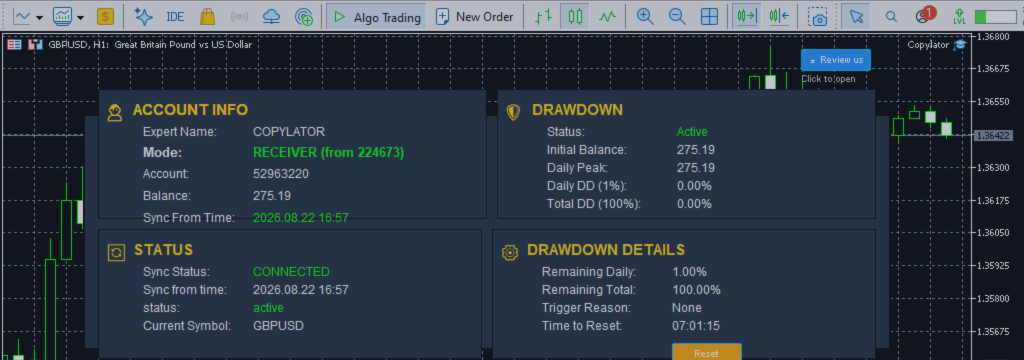
One aspect that surprises many traders is how the daily peak is tracked. In equity-based mode, the daily peak is the highest equity value reached during the day—not the highest balance. This means that an unrealized profit briefly pushing equity to a new high raises the peak, and any subsequent decline is measured from that elevated level.
A strategy that opens a profitable position, watches it reach its peak, and then retraces to break-even will show a drawdown from the peak even though the account has not lost anything overall. This is technically correct—the account did give back profit—but it can feel counterintuitive.
Balance-based tracking avoids this entirely because the peak is only updated when a position closes in profit.
How to Decide
The cleanest way to choose is to answer three questions.
First, what does your broker or prop firm measure? If they use equity, you must use equity. There is no negotiation on this point.
Second, how does your strategy behave? If it frequently holds positions through temporary floating drawdown, equity-based protection will trigger more often. If it closes trades quickly and rarely holds through deep drawdown, the two approaches behave similarly.
Third, how do you want the protection to feel? Equity-based protection is proactive and sensitive. Balance-based protection is reactive and forgiving. The right choice depends on whether you prefer to be stopped early or given room to recover.
Summary
Equity and Balance are not interchangeable settings. They measure different things, react at different speeds, and protect against different risks.
Use equity-based protection when the constraint is based on equity, when floating drawdown can become large, or when early intervention is preferred.
Use balance-based protection when the strategy routinely experiences temporary floating drawdown, when long-term holding is expected, or when the trader prefers a protection system that triggers only on confirmed losses.
Understand which one matches your situation before enabling the protection. The right choice is invisible during normal operation and decisive during a crisis—which is exactly what drawdown protection should be.
Product link:
https://www.mql5.com/en/ market/product/191385