Stopline Trade Manager EZ: User Manual for MetaTrader 5 and MetaTrader 4

Stopline Trade Manager EZ is an Expert Advisor for manual trading that places and manages your own trades from one compact window: you choose the direction, the stop loss and the target, and it calculates the lot from the risk you set, sends the order and lets you close, reduce or protect the position; it is sold on the MQL5 Market as Stopline Trade Manager EZ MT5 and Stopline Trade Manager EZ MT4, version 1.00. This post is its manual: it describes the MetaTrader 5 edition (the EA below), and the MetaTrader 4 notes and section cover the other edition.
What it is not. The EA gives no signals and does not open trades by itself. It has no trailing stop, no automatic breakeven, no automatic partial closes, no virtual orders or hidden stops, no statistics and no screenshots; breakeven and partial closes are there, but you trigger them yourself.
Installation
The EA is sold and rented on the MQL5 Market only, and the terminal installs it; there are no files to copy. You need MetaTrader 5 logged in to a trading account (demo or real, any broker, hedging or netting) and a free MQL5.community account.
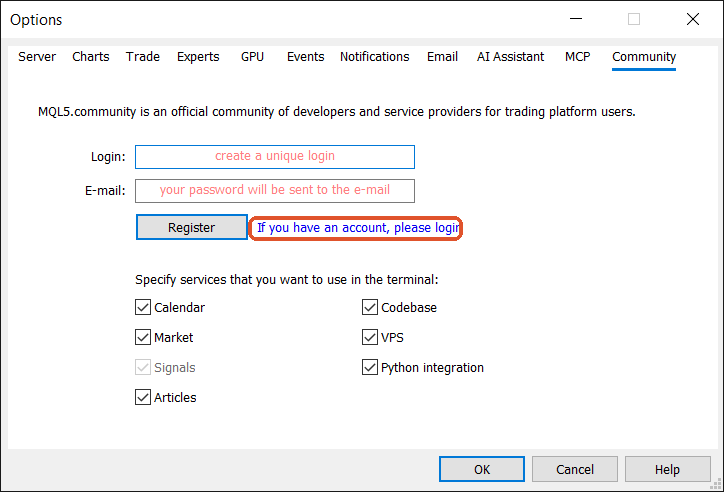
Link your MQL5 account. Open Tools > Options (Ctrl+O), Community tab, click "If you have an account, please login", enter your login and password and press OK. Without an account, enter a login and your e-mail address and press Register; the password arrives by e-mail.
Buy or rent. Open the Market tab of the Toolbox (Ctrl+T), search for Stopline Trade Manager EZ and press Buy or Rent, or buy on the product page with the same account. The terminal downloads the EA into MQL5\Experts\Market\ . An activation binds it to a computer (hardware and operating system), not to a trading account.
Enable Algo Trading. An Expert Advisor sends orders only while Algo Trading is on: press it on the toolbar (Ctrl+E); a green triangle means on.

Attach the EA. In the Navigator (Ctrl+N) expand Expert Advisors > Market and drag Stopline Trade Manager EZ MT5 onto a chart of the symbol you trade, or double-click it. A chart runs one Expert Advisor at a time.
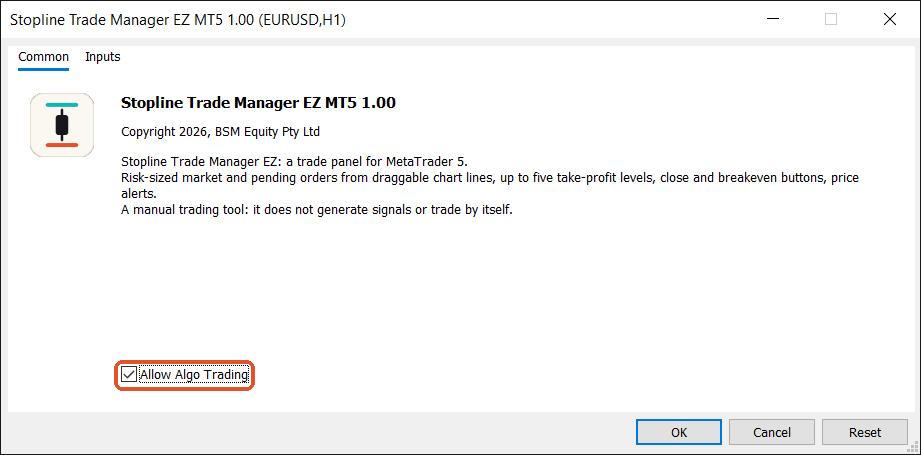
The input dialog. On the Common tab tick Allow Algo Trading; without it the EA draws its window, but every order is refused and the health dot turns amber. The Inputs tab holds the starting values in nine groups; the window changes the everyday ones later and remembers them per symbol. Press OK (F7 reopens the dialog): the EA's name shows in the top-right corner of the chart with a hat icon, blue while Algo Trading is allowed, and the window opens.
Another computer, updates, removal. On another computer, link the same account, select Purchased on the Market tab and press Install; each new computer, reinstalled operating system or hardware change uses one activation. Updates are free (an Update button in Purchased), and your settings and presets are kept. To remove the EA, right-click the chart, select List of Expert Advisors, select the EA and remove it.
On a Mac. Install MetaTrader 5 for macOS from MetaQuotes or your broker (macOS 10.15.7 Catalina or later, Intel and Apple silicon; accept the Mono and Gecko packages). Shortcuts use Control, not Command; F7 may need Fn; right-click is a two-finger click. The data folder is ~/Library/Application Support/net.metaquotes.wine.metatrader5/drive_c/Program Files/MetaTrader 5 . The window uses Tahoma instead of Segoe UI (PingFang or Hiragino for Chinese and Japanese). Each Mac is one activation.
MetaTrader 4 note. The toolbar button is AutoTrading (Ctrl+E; green on, red off) and the Market tab is in the Terminal window (Ctrl+T), where Purchased lists your products for installing and updating. In the dialog (tabs About, Common, Inputs) tick Allow live trading and keep Long & Short; the inputs have no group headings. A smiling face in the chart corner means AutoTrading and live trading are allowed. Remove the EA with right-click, Expert Advisors > Remove. Mac: MetaTrader 4 for macOS (macOS 11 Big Sur or later; packages Wine, Mono, Gecko), data folder under net.metaquotes.wine.metatrader4 .
Quick Start in 60 Seconds
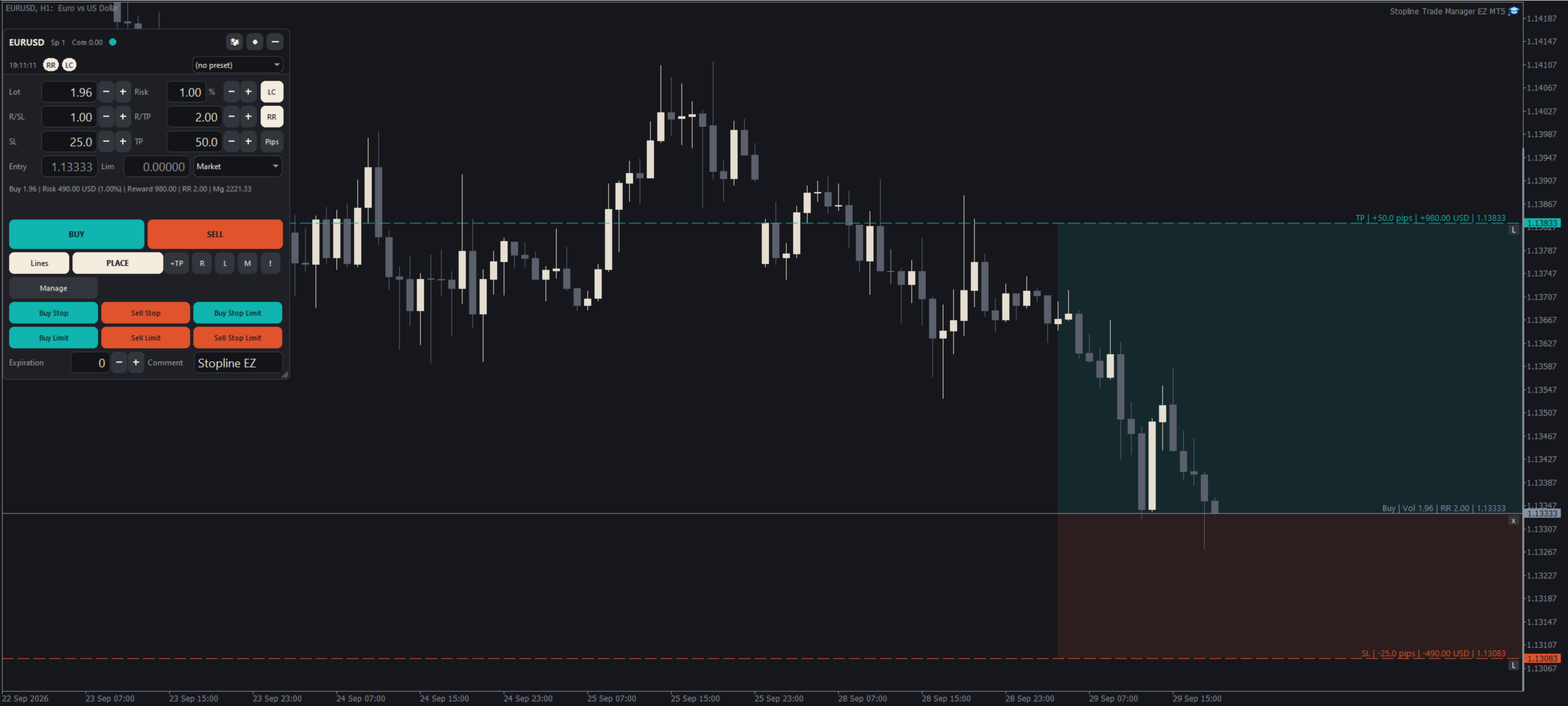
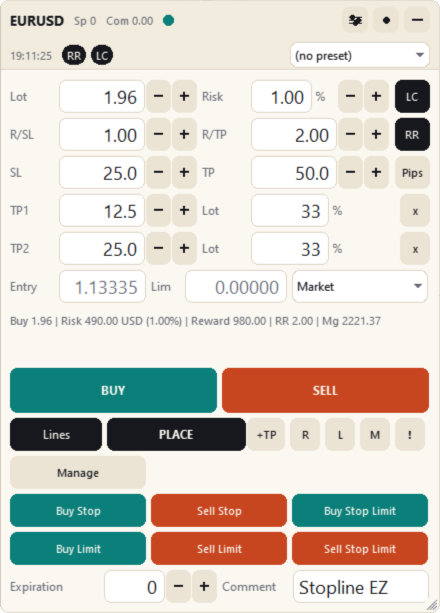
- Attach the EA. The window opens with LC (Lot Calc) on: the lot follows from Risk (1% of the balance by default) and the stop distance. The entry (blue-grey), stop-loss (orange) and take-profit (teal) lines start at 15% and 30% of the visible price range.
- Set the risk and the stop. Type them, or point at the SL or TP line and drag the tab that appears. The labels and the summary line show the lot, the risk in money and percent, the reward and the reward-to-risk ratio (RR).
- Press BUY or SELL. A press against the direction of the lines first flips them; the next press sends. The confirmation lists every detail: Enter confirms, Esc cancels.
- For a pending order, drag the entry line away from the price (the type follows) or pick the type, then press PLACE. BUY and SELL stay unavailable meanwhile, so no market order goes out by mistake; the M button on the window returns to Market.
- To take profit in steps, press +TP for a row with a distance, a share of the lot and a remove button (x), and a dotted TP1 line; up to five levels.
The Window
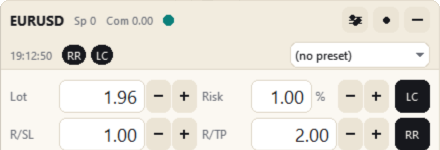
Header. Symbol, spread in points (Sp), commission per lot (Com) and the health dot: teal when ready; amber when Algo Trading is off or the last request failed; orange without a server connection or at the daily loss limit. The sliders button opens the panel settings, the dot button switches between the light and dark theme, and the minus button minimizes the window. Drag the first row to move the window (the position is saved). The second row holds the clock (server, local, both or GMT), the RR and LC chips, lit while the risk/reward link and the lot calculation are on, and a preset list that loads a preset with one click.
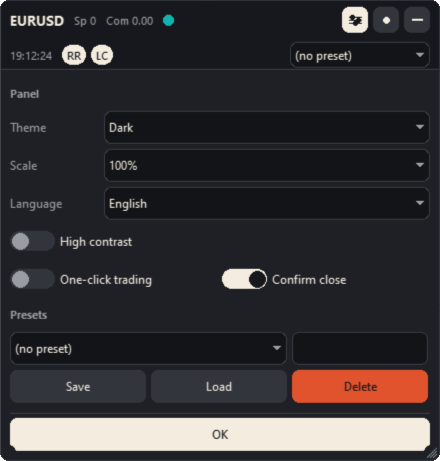
Panel settings. They replace the trade page until you press OK or the sliders again: Theme, Scale (75%, 100%, 125%, 150%), Language (English, Russian, German, French, Spanish, Chinese, Portuguese, Japanese, Italian), High contrast, One-click trading, Confirm close, and Presets with a name field, Save, Load and Delete.
Tooltips, size, themes. Every control shows a hint after half a second; a greyed-out one says why. Drag the bottom-right grip to resize (the width rearranges the rows, the height sets a maximum); a page taller than the chart scrolls with the wheel, the scroll bar or Tab. The window follows the display scaling. Themes: Light, Dark (default), Slate and Midnight, each with High contrast; teal always means buy, take profit and profit, orange sell, stop loss and loss.
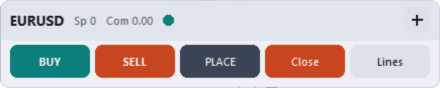
Minimized toolbar (minus button or M): BUY, SELL, PLACE, Close (every position of the symbol) and Lines; plus restores the window.
Planning a Trade
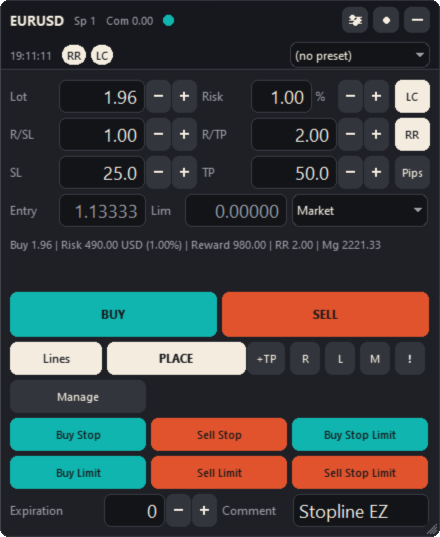
The plan shows twice, in the fields and as lines on the chart, and both always hold the same values.
| Control | What it does | Hotkey |
|---|---|---|
| Lot, Risk, LC | With LC on, the lot is calculated from Risk (a percentage of the risk base or an amount, stepped by the minus and plus buttons) and the stop distance; with LC off you type it. | K (LC) |
| R/SL, R/TP, RR | With RR on, the TP distance is the SL distance times R/TP divided by R/SL, and moving one line moves the other; off, RR only reports. | R |
| SL, TP | Pips from the entry or a price; 0 at start means 15% and 30% of the visible range. | Shift+L, Shift+T at the mouse |
| Pips / Price | Switches the SL and TP fields; moving a line selects Price. | I |
| Entry, Lim | The entry of a pending order (a market order follows the price); the limit price of a stop-limit order. | Shift+P at the mouse |
| Order type | Market, Buy Stop, Sell Stop, Buy Limit, Sell Limit, Buy Stop Limit, Sell Stop Limit. | T |
| Summary, warning | Lot, risk in money and percent, reward, RR, margin; or why the plan cannot be sent now. | |
| BUY, SELL; PLACE | A market order; the pending order of the plan. | B, S; Shift+Enter |
| Lines | Shows or hides the lines (remembered). | N |
| +TP | Adds a take-profit level, up to five. | |
| R, L, M | Reverse the plan; lock SL and TP when the entry moves; magnet the entry to the price. | Shift+R, L, G |
| Exclamation mark | An alert line a few pips above the market. | A at the mouse; Shift+A removes all |
| Manage | Switches the pending-order buttons to position management. | |
| Buy Stop to Sell Stop Limit | Place that order at the entry line. | Shift+B, Shift+S, Shift+U, Shift+J, Ctrl+Shift+B, Ctrl+Shift+S |
| Expiration, Comment | Minutes to expiry (0 = good till cancelled); the order comment. | Shift+E (comment) |
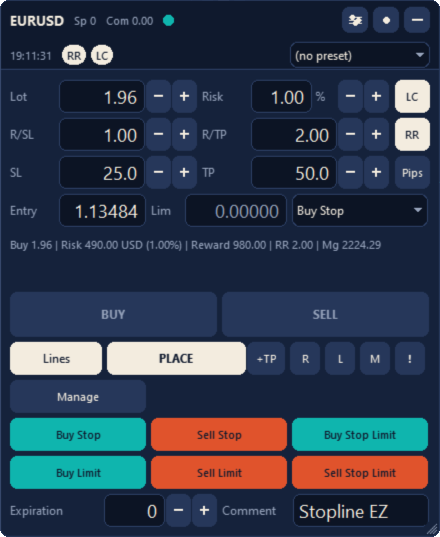
Pending orders. Drag the entry above the price and a buy becomes a Buy Stop (it buys when the price rises to the line), below it a Buy Limit (it buys when the price falls to it); sells mirror this. A Buy Stop Limit places a buy limit at the Lim price, shown by a dotted line, when the stop price trades.
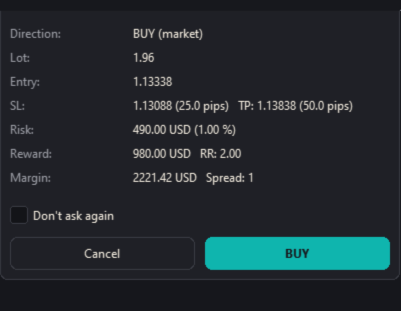
Confirmation. It lists direction, lot, entry, SL and TP (prices and pips), risk and reward in money, RR, margin and spread; Enter sends, Esc cancels. Don't ask again turns on one-click trading (the panel settings turn it off); Confirm close asks before positions are closed.
Take-profit levels. Each +TP row holds a distance or price and the share of the lot to close there; the rest runs to the final TP. A position keeps its levels as dotted "TP1 #ticket" lines you can move; window changes never alter a running trade, and pending orders carry their levels until filled. The EA closes each share when the price reaches its level, so the levels act only while the terminal is running.
Risk and Lot
With LC on, the lot is the risk divided by the loss one lot would make at the stop: the stop distance in ticks times the tick value, plus the commission per lot. It is rounded down to the volume step, so the real risk never exceeds your setting; a risk too small for the minimum lot is reported and BUY and SELL stay unavailable.
Risk base: a fixed amount; a percentage of the balance (default), equity or free margin; of a custom base; of the balance at the start of the previous day, week or month; or of the maximum lot the free margin allows. Commission per lot is added to the loss per lot, Add spread adds the spread to the stop distance, the tick value is the one the account books (Custom tick value overrides it), and Pip size is Auto (10 points on 3- or 5-digit symbols, else 1) or fixed.
| Guard | Effect |
|---|---|
| Lot limit | Keeps every calculated lot between Min and Max; a Min above the calculated lot raises it, and the plan says the risk is then above your setting. |
| Free margin check | Refuses an order the free margin cannot carry. |
| Max open trades | No new position once this number is open. |
| Max exposure per symbol | Reduces a new lot so the symbol's open volume stays within the limit. |
| Daily loss guard | At the day's loss limit, new entries are blocked until the next server day and the dot turns orange. |
| Spread limit, trading session | No order while the spread is above the limit or outside the symbol's session. |
The account's own limits (pending-order count, volume limit, stop and freeze level) are checked before every order too; a refused order is not sent, and a message names the limit.
Managing and Closing Positions
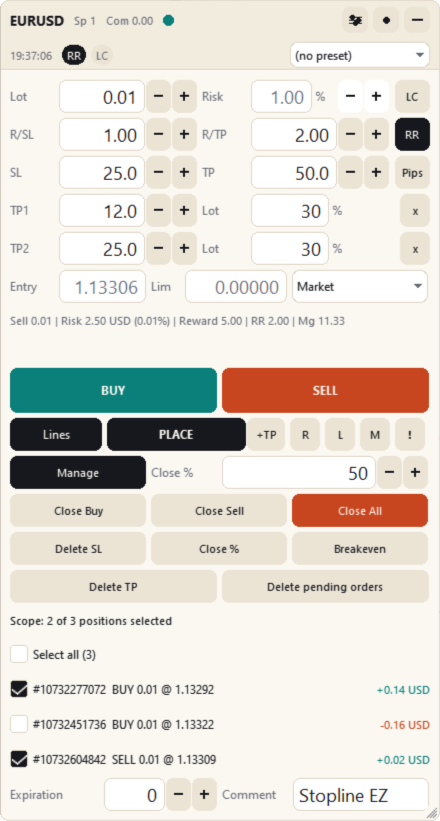
Manage mode. Manage lists up to ten open positions of the chart symbol (tick box, ticket, side, lot, entry, live result) and shows Close Buy, Close Sell, Close All (Shift+C), Delete SL, Delete TP, Close % with its field (C; 1 to 9 close 10% to 90%), Breakeven (E), Delete pending orders (X) and Select all. They act on the ticked positions, or on every position of the symbol when none is ticked; a scope line says which ("Scope: 2 of 5 positions selected"). Ctrl+click a position label (it shows [x]) to select it on the chart. The selection is not saved; it also drives the hotkeys.
Breakeven now moves the stop loss of each position in the scope to its entry plus the offset of the input Stop beyond the entry (points, in the position's favor). A position still too close to the entry for the broker's stop level keeps its stop, with a message.
Chart Lines, Labels and the Position Menu
Moving a line. Point at a line: a tab in its color appears with its name (Entry, SL, TP2, Alert) and the line thickens. Drag the tab; it shows the price (and pips for SL and TP) while the lot, risk and reward follow. This works for the planning lines, the take-profit levels, a position's own levels and alerts. A line dropped where it cannot go, such as an SL above a buy's entry, returns with a message; the SL or TP tab turns to an orange outline there. The input Drag tab on a line under the mouse turns tabs off; double-click selection also works (or Select objects by single mouse click in Tools > Options > Charts). Q selects the next line, Shift+Up and Shift+Down move it one step.
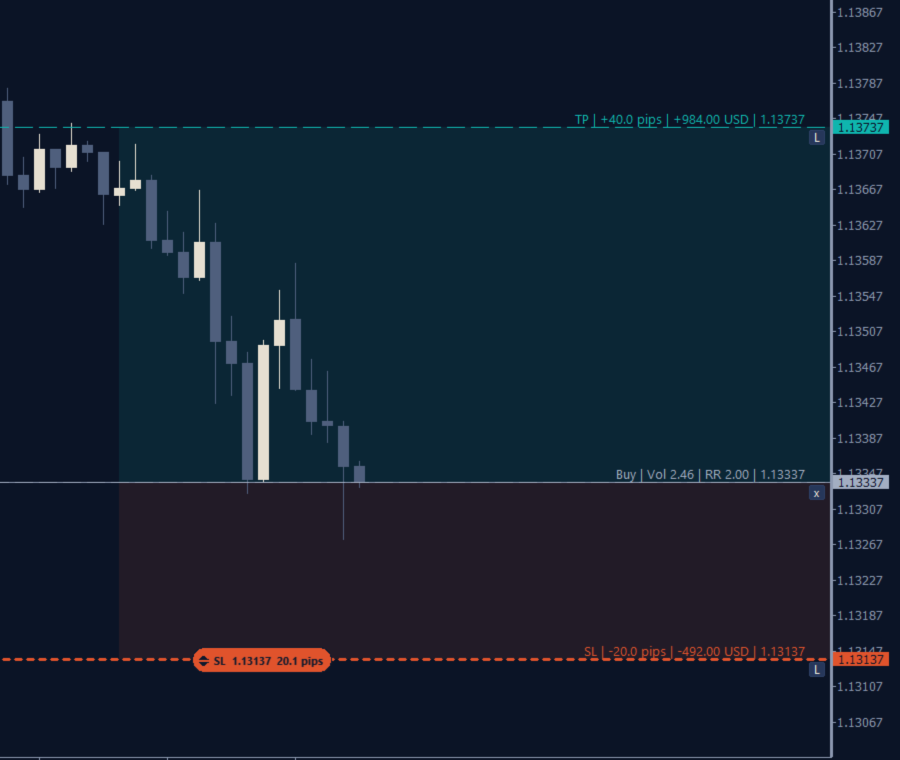
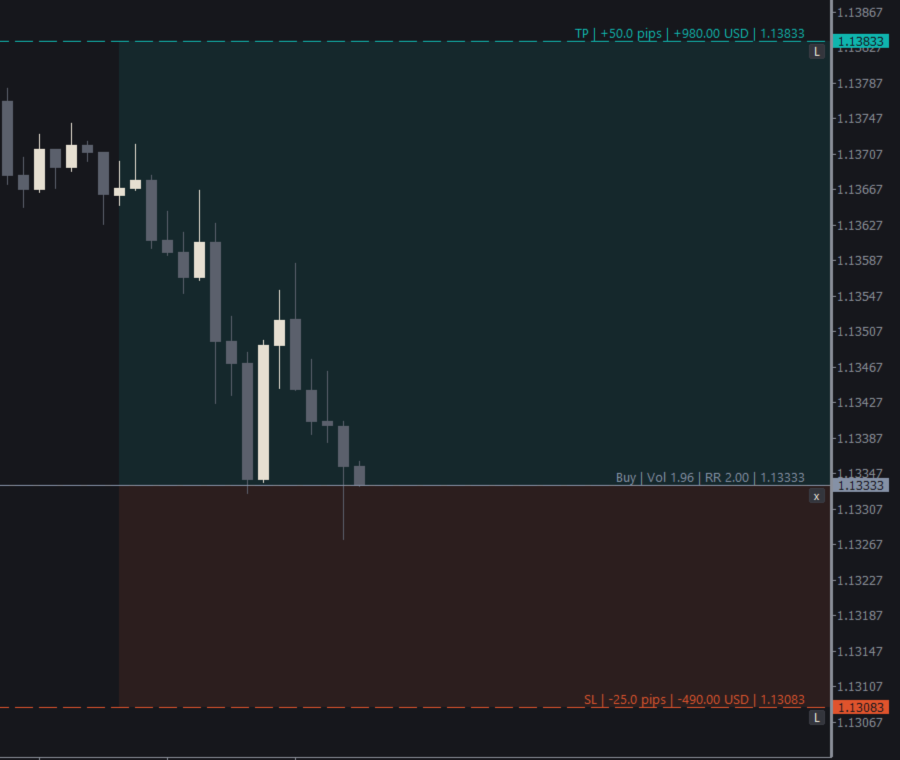
Planning lines. Entry (blue-grey), SL (orange) and TP (teal) with shaded zones. The labels show direction, volume, price, pips, the result in money and percent, and the RR. A locked line keeps its price while the ratio follows. Line buttons: L locks the TP or SL, x on the entry hides the lines. The input SL/TP from highest/lowest of N bars places them beyond the extremes of the last N bars.
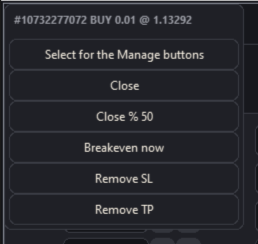
Position menu. Each position has a label such as "#ticket BUY 0.10 +12.30 USD"; a click opens its menu: Select for the Manage buttons, Close, Close % 50 (half the current volume), Breakeven now, Remove SL and Remove TP.
Other objects: the stop-out line and dotted expiration markers of pending orders; H hides the terminal's own trading levels. The EA deletes only its own objects (names starting with TA<chart id>_ ), never your drawings.
Alerts and Notifications
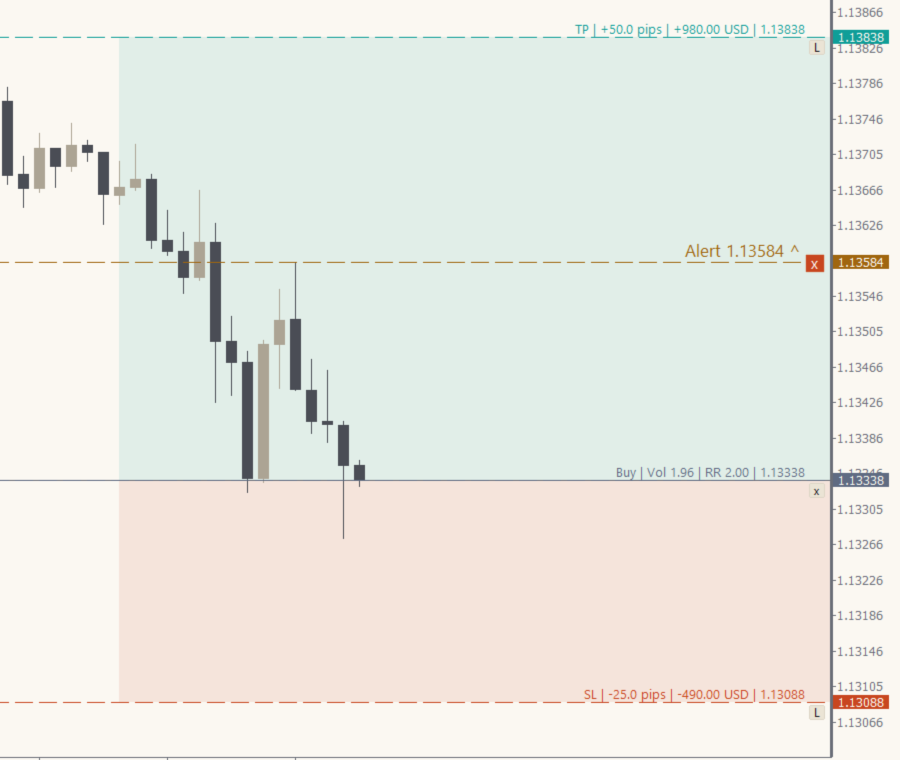
Alerts. The exclamation-mark button, or A at the mouse, places an amber dashed alert line that fires when the Bid crosses it and is removed after its last repeat; x deletes it, Shift+A removes all. Delivery is a sum: 1 pop-up, 2 sound, 4 push, 8 e-mail (default 3), with repeats; push and e-mail need the terminal's Notifications and Email settings.
Notifications at the top right of the chart report every action and problem, such as trade errors, the spread limit, a missing cross rate, Algo Trading off or the daily loss limit; click to dismiss.
Settings, Presets and Accounts
Where settings come from. Inputs are the starting values. With Save the panel settings per symbol on, window changes are saved per symbol and win on a restart, timeframe change or reinstall of the same version; inputs changed in the dialog overwrite them; with it off, every start uses the inputs. Presets are named sets you save and load on the panel settings page or from the header list.
Hedging, netting, prop firms. On hedging every order is its own position with its own ticket, label and take-profit levels; on netting deals merge, and an opposite deal reduces or reverses the position. The EA enforces your limits, not your firm's rules, so leave a margin. The daily loss guard counts today's closed result plus the managed floating result; at the limit (an amount or a % of the balance) it blocks new entries until the next server day, but closes nothing. Max open trades, Max exposure per symbol, Lot limit, the previous-day balance base, Spread limit and the session check complete the set.
Tester, Files and Troubleshooting
Strategy Tester. Visual mode draws the window, but the tester passes no clicks or typing, so it cannot be operated. A non-visual test opens one minimum-volume BUY with SL and TP and closes it one hour later, because the Market's automatic check requires a trade.
Files (File > Open Data Folder, Ctrl+Shift+D): in MQL5\Files\StoplineTradeManagerEZ\ the folders Settings (per symbol), Presets and State (take-profit levels and alerts, kept over a restart). You can add .set input files to MQL5\Presets\ .
Troubleshooting. "Set a stop loss to size the lot": LC needs a stop, or turn LC off and type the lot. "No tick value / cross rate": open the conversion pair in the Market Watch or set Custom tick value. "Risk too small for the minimum lot": raise the risk or widen the stop; the lot never rounds up above your risk unless Lot limit min sets a floor. "... caps the lot at ...": a limit reduced the lot. "SL too close" or "Level is inside the freeze zone": move the line further from the price, or wait. BUY and SELL unavailable: a pending type is selected; choose Market. Hotkeys do nothing: click the chart so no field has the keyboard. Boxes instead of Chinese or Japanese: install Microsoft YaHei UI and Yu Gothic UI. The Experts tab shows what the EA does; Log level sets the detail.
Hotkeys
Each hotkey is an input (B, Shift+S, Ctrl+Shift+X, Num1, NumPlus, Shift+Up; empty turns it off). Alt combinations belong to the terminal, so none uses Alt. Hotkeys pause while a field has the focus or a confirmation is open.
| Default | Action |
|---|---|
| B, S | Buy or sell at market |
| Shift+B, Shift+S; Shift+U, Shift+J | Buy Stop, Sell Stop; Buy Limit, Sell Limit |
| Ctrl+Shift+B, Ctrl+Shift+S | Buy Stop Limit, Sell Stop Limit |
| Shift+Enter; T | Place the pending order; cycle the order type |
| N; U, J | Show or hide the lines; show buy or sell lines |
| Shift+C; C; 1 to 9 | Close all; close the Close % value; close 10% to 90% |
| X; E | Delete the pending orders of the symbol; breakeven now |
| A, Shift+A | Alert at the mouse; remove all alerts |
| Shift+E | Edit the order comment |
| M; H | Minimize the window; hide the trading levels |
| R, K | RR on or off; Lot Calc on or off |
| G, L | Entry to the price; lock SL and TP (TP or SL alone: no default) |
| Q, Shift+Up, Shift+Down | Select the next line; move it one step |
| Shift+T, Shift+L, Shift+P | TP, SL or entry at the mouse |
| Shift+R; I | Reverse the lines; prices or pips |
| Shift+D | Light or dark theme (one-click toggle: no default) |
| Tab, NumPlus, NumMinus | Highlight the next field; step it (Esc clears) |
Inputs
Defaults, in dialog order:
- Panel: Theme Dark; Panel size 100%; Language English; High contrast off; Panel corner top left, offset 20, 40; Start minimized off; Clock Server; Tooltips on.
- Trade: Magic number 20260929 (0 = every position of the symbol); Order comment Stopline EZ; One-Click trading off; Confirm before closing positions on; Max deviation 30 points; Asynchronous trade operations on; Re-anchor SL / TP to the fill price on; Spread limit off, 50 points; Trade only inside the symbol's session on.
- Risk: Lot from risk (LC) on; Fixed lot 0.10; Risk base % of balance; Risk value 1.0; step 0.25; Custom base 10000; Commission per lot 0 (round trip); Add spread off; Custom tick value 0 (as booked); Pip size Auto; Lot limit off, 0.01 to 10; Free margin check on; Max open trades 0; Max exposure 0 lots (0 = unlimited); Daily loss guard off, 3, percent of balance.
- RR: RR lock on; R/TP 1.0; R/SL 1.0.
- Lines: SL / TP in pips; Default SL and TP 0 (automatic); highest/lowest of N bars 0 (off); label font 8 (6-14 pt). On: entry follows the market, zones, drag tab, expiration markers, lines at start. Off: hide the terminal's trading levels.
- Breakeven now: Stop beyond the entry 0 points.
- Alerts: delivery 3; 3 repeats, 30 seconds apart; sound alert.wav.
- Hotkeys: see the table above.
- System: Log level Information; Save the panel settings per symbol on.
MetaTrader 4 Differences
Stopline Trade Manager EZ MT4 is a separate product with the same functions. Installation differs as in the note above; folders start with MQL4 , and File > Open Data Folder has no shortcut. The rest follows from how MetaTrader 4 handles orders:
- No netting: every order is a separate position; the asynchronous operations input does not exist.
- Stop-limit orders are held by the EA until the stop price trades, then placed as limit orders; until then they are not in the Terminal window's Trade tab and need the terminal running and connected.
- Sending: one request at a time, so the window waits while an order is sent.
- Partial close: the rest reopens under a new ticket (same SL, TP and magic, comment "from #old ticket"); the EA follows it and keeps its take-profit levels.
- Stop level: many servers refuse stops or pending orders closer than the symbol's stop level; breakeven keeps this distance.
- Expiration: usually at least 10 minutes; some brokers allow none.
- Server clock: moves only with ticks; with the market closed it adds the time since the EA started to the last tick.
- Line labels stay English in Russian, Chinese and Japanese, because MetaTrader 4 draws chart text in the Windows character set; the window shows every language.
- Keys MetaTrader 4 uses, such as F6, never reach the EA; single-click selection is in Tools > Options > Objects.
Frequently Asked Questions
Does it open trades by itself? No. Every entry is yours. On its own it only closes the shares of the take-profit levels you set, and makes the single trade of a non-visual tester run.
On how many computers? On as many as the activations shown on the product page. An activation is tied to a computer and its operating system, not to a trading account.
Several charts? Yes, one copy per chart; settings are saved per symbol.
Other Expert Advisors? Yes, on their own charts. The EA marks its orders with its magic number; Magic number 0 covers every position of the symbol.
Why does the lot differ from my calculation on gold or an index? A published tick value that differs from the booked one (the EA says so once), rounding down to the volume step, or a risk below the minimum lot. Custom tick value overrides the broker's.
Does the daily loss guard close trades? No. It blocks new trades until the next server day.
Do take-profit levels and alerts work with the terminal closed? No; they need the terminal running.
Support and Updates
Ask in the Comments tab of the product page or by private message on MQL5; every question is answered within 24 hours. With a problem, please include the version (shown in the Experts tab when the EA starts), the symbol and the lines of the Experts tab around the problem. Updates are free.
Trading on margin carries a high level of risk and can lose more than you expect; Stopline Trade Manager EZ is a tool for placing and managing your own trades and gives no signals, advice or promise of results.