
Product link:
https://www.mql5.com/en/ market/product/191385
Economic news releases are among the most challenging conditions for automated trading and trade copying. Events such as Non-Farm Payrolls (NFP), CPI inflation data, FOMC interest-rate decisions, central-bank announcements, and major economic reports can cause extremely rapid price movements and sudden changes in market conditions.
For an MT5 Trade Copier, these periods require particular attention because the Sender and Receiver accounts may not receive exactly the same execution conditions.
A trade that is executed normally on the Sender may arrive at the Receiver when the market has already moved significantly. At the same time, spreads can widen, available liquidity can change, and execution prices can become less predictable.
This article explains how traders can use the risk-management and filtering capabilities of an MT5 Trade Copier such as COPYLATOR to manage copying during high-impact economic news.
Why Economic News Is Different
Under normal market conditions, prices generally move within relatively predictable liquidity conditions. During major news releases, however, the market can change within seconds.
Several things can happen simultaneously:
- Price moves rapidly in either direction.
- Bid/Ask spreads can expand.
- Available liquidity can decrease.
- Execution prices can differ from expected prices.
- Pending orders can be triggered unexpectedly.
- SL and TP levels can be reached very quickly.
- Latency becomes more important.
These conditions can create a meaningful difference between the Sender's trade and the Receiver's trade.
Sender Price vs. Receiver Price
One of the fundamental characteristics of trade copying is that the Receiver does not control the exact historical market price at which the Sender executed the trade.
Suppose a Sender opens a Buy position immediately after an economic announcement. If the market moves sharply before the Receiver executes the copied order, the Receiver may receive a substantially different entry price.
The result can be:
- A better entry than the Sender.
- A worse entry than the Sender.
- A larger spread cost.
- Different effective risk/reward characteristics.
- In extreme conditions, an order that cannot be executed as expected.
This is why news-event management is especially important when copying trades between accounts.
1. Spread Widening
One of the most important risks during economic announcements is spread expansion.
A symbol that normally has a relatively small spread can temporarily experience a much wider Bid/Ask difference when liquidity changes rapidly.
For example, a currency pair that normally has a spread of a few points may temporarily show a significantly larger spread during a major announcement.
If a Receiver opens a position while the spread is unusually high, the trade begins with a larger transaction cost.
This can materially change the effective risk/reward profile of the copied trade.
2. Using the Maximum Spread Filter
One of the most useful protections for news conditions is a maximum spread filter.
COPYLATOR allows traders to define a maximum acceptable spread measured in points.
If the spread is above the configured threshold when a trade is received, the copier can reject or skip that copied trade rather than opening a position under excessively wide-spread conditions.
For example, a trader may configure a maximum spread threshold appropriate for the instrument and broker.
The important point is that the threshold should be selected according to the actual symbol's normal spread and trading conditions. A value that is suitable for EURUSD may not be appropriate for XAUUSD or another instrument.
Points vs. Pips
Traders should also remember that the COPYLATOR maximum spread setting is measured in points, not pips.
On a typical five-digit Forex quote, 30 points corresponds to approximately 3.0 pips. The exact relationship depends on the symbol's quotation format.
3. Time Filters Around Major News
A spread filter is useful when market conditions become abnormal, but traders can also take a more proactive approach by restricting copying during predefined periods.
COPYLATOR provides Day and Time Filters that can be used to control when copying is allowed.
The time window is configured using GMT.
For example, a trader who does not want to copy trades during a specific high-risk period could define a time window around the expected announcement.
News-risk window: 13:25 – 13:35 GMT
During this period, copying can be restricted according to the configured filter settings.
This approach can be useful when a trader already knows the scheduled time of a major economic release.
4. Why a Time Filter Is Not a News Calendar
An important distinction should be made between a time filter and an economic-news calendar.
A time filter works according to the schedule configured by the trader. It does not automatically understand the importance of every economic event or dynamically determine whether a particular announcement will create volatility.
Therefore, traders who use time filters for news protection should check the relevant economic calendar and configure their trading windows accordingly.
5. Lot Management During High Volatility
Another way to manage news-related exposure is through position sizing.
COPYLATOR supports several lot-management methods, including:
- Fixed Lot
- Lot Multiplier
- Balance-Ratio Scaling
- Maximum Lot Cap
Reducing the copied position size during periods of elevated volatility can reduce the nominal exposure of the Receiver account.
However, traders should understand that smaller lot size does not eliminate execution risk, spread risk, or slippage. It simply reduces the volume exposed to those conditions.
6. Maximum Lot Cap as an Additional Protection
The Maximum Lot Cap can provide another layer of volume control.
For example, if balance-ratio scaling or a lot multiplier would normally produce a large position, the maximum lot setting can prevent the copied volume from exceeding the configured ceiling.
This can be useful when trading conditions are unstable or when a Receiver account has strict exposure limits.
The maximum lot cap controls trade volume; it is not a guarantee of a specific monetary or percentage risk.
7. Pending Orders During News Events
Pending orders require special attention around major economic announcements.
Orders such as:
- Buy Limit
- Sell Limit
- Buy Stop
- Sell Stop
can potentially be triggered when the market moves rapidly through their price levels.
A strategy that normally uses pending orders may therefore behave very differently during a high-volatility announcement.
Traders who do not want pending orders copied during specific periods can use appropriate filtering and trading-session restrictions, depending on their strategy and configuration.
8. SL and TP Behavior During Fast Markets
Stop Loss and Take Profit synchronization is another important consideration.
COPYLATOR supports real-time SL/TP synchronization, including the ability to synchronize protective levels after a trade has already been opened.
However, traders should remember that synchronization does not guarantee identical execution results across different accounts.
If the Receiver enters at a significantly different price because of rapid market movement, the distance between the Receiver's actual entry price and the synchronized SL/TP levels can have a different practical effect.
During extremely fast markets, price gaps and liquidity conditions can also affect how protective orders are executed.
9. Slippage and Execution Differences
Slippage is another major issue during economic announcements.
Slippage occurs when the actual execution price differs from the price expected at the moment an order is sent.
During normal conditions, the difference may be relatively small. During major announcements, however, the market can move several price levels before an order is executed.
This means that even if the copier transmits the trade correctly, the Receiver's final execution can still differ from the Sender's execution.
A trade copier can manage the transmission and configuration of trades, but it cannot guarantee identical execution prices across separate accounts and brokers.
10. Drawdown Protection During News
News-related volatility can also interact with account-level risk controls.
COPYLATOR provides Daily Drawdown and Total Drawdown protection based on the configured Equity or Balance setting.
When the configured drawdown condition is triggered, new copying can be blocked. Depending on the configuration, existing positions can also be closed and pending orders deleted.
This provides an additional account-level protection layer when market conditions cause losses to accumulate rapidly.
However, drawdown protection should be viewed as a risk-control mechanism rather than a guarantee against losses. Market execution conditions can affect the final result of closing positions.
11. Dashboard Monitoring
Monitoring the copier during important market events can provide useful information.
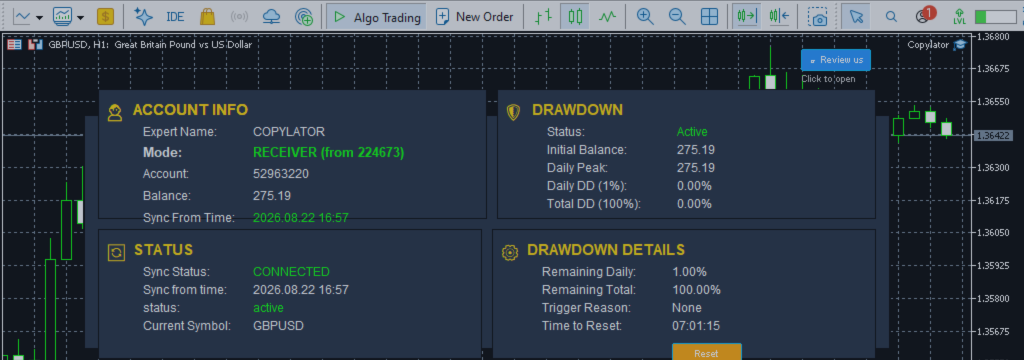
The COPYLATOR dashboard can display operational information such as account details, synchronization status, Receiver status, and other relevant copier information.
During high-volatility periods, traders can use this information to verify that the terminals and copying configuration are operating as expected.
12. VPS and News Trading
Continuous terminal operation becomes particularly important for traders who rely on automated copying around the clock.
If an MT5 terminal is shut down or disconnected when a Sender trade occurs, the Receiver may not process the trade at the expected time.
A properly configured VPS is therefore strongly recommended for continuous copy trading.
However, a VPS does not eliminate market risk, spread widening, or slippage. Its primary benefit is maintaining the trading terminals online and connected.
13. Should You Always Stop Copying During News?
Not necessarily.
Some trading strategies are specifically designed around economic announcements and depend on high-volatility conditions.
For such strategies, completely blocking all news-period trades could eliminate the very opportunities the strategy is designed to capture.
The correct approach depends on the strategy, trading instruments, broker conditions, and risk tolerance.
A spread filter or time filter can therefore be used selectively rather than automatically blocking every major announcement.
News Trading: Two Different Approaches
| Approach | Description |
|---|---|
| News Avoidance | Temporarily restrict copying around major announcements. |
| News Trading | Allow copying during news because the strategy is specifically designed for high volatility. |
Neither approach is universally superior. The appropriate choice depends on the underlying trading strategy and the execution characteristics of the accounts involved.
Recommended Protection Layers
For traders who prefer to avoid the most extreme news conditions, a layered approach can be useful:
- Check the economic calendar before major trading sessions.
- Use a Time Filter around selected high-impact events.
- Use a Maximum Spread Filter to reject trades when spreads become excessive.
- Control lot size using appropriate lot-management settings.
- Use a Maximum Lot Cap where appropriate.
- Review pending-order behavior before major announcements.
- Configure Drawdown Protection according to the account's risk limits.
- Keep MT5 terminals online when continuous copying is required.
- Test the configuration on a demo account before using it with real funds.
Demo Testing Is Especially Important
News-event behavior should be tested before relying on a configuration with real money.
A useful test should examine the complete trade lifecycle:
- Trade opening
- Market execution
- Spread conditions
- SL synchronization
- TP synchronization
- Position modification
- Position closing
- Pending-order behavior
- Drawdown response
This gives the trader a better understanding of how the copier and the specific broker environment behave under different market conditions.
Important: Filters Do Not Guarantee Profitability
Spread and time filters are risk-management tools. They do not guarantee profitable trades.
A filter can prevent a trade from being copied because the spread is too high, but it cannot determine whether the underlying strategy will ultimately win or lose.
Likewise, avoiding a news announcement can reduce exposure to extreme execution conditions, but it can also cause a trader to miss a profitable opportunity.
The purpose of these tools is to give traders greater control over when and under what conditions copying is allowed.
Conclusion
Economic news releases create a unique challenge for MT5 trade copying because the Sender and Receiver may experience very different execution conditions.
Rapid price movements, spread expansion, slippage, liquidity changes, and pending-order triggers can all affect the final result of a copied trade.
With COPYLATOR – MT5 Trade Copier, traders can combine several control mechanisms to manage these conditions, including Maximum Spread filtering, Day and Time Filters, flexible lot management, Maximum Lot Cap, pending-order controls, real-time SL/TP synchronization, and Drawdown Protection.
The goal is not necessarily to avoid every news event. Instead, traders can decide which market conditions are acceptable for their strategy and configure the copier accordingly.
A well-tested combination of filters and risk controls can make a multi-account copy-trading setup more controlled and predictable, particularly during periods when market conditions change rapidly.
Product link:
https://www.mql5.com/en/ market/product/191385