The Grid Bot “Compounding Illusion”
I want to talk a bit about what I like to call the “Compounding Illusion” when it comes to grid bots.
I feel like 90% of developers sell you the same dream:
Start with $1,000, compound everything, and somehow turn it into $500,000 in a year.
Yes, you can see that in backtests.
But that’s exactly the point:
It’s a backtest illusion.
Then most of them hide behind the classic “Trading involves risk / past performance is not a guarantee of future results” disclaimer and basically wash their hands of everything that happens after.
The remaining 10% — probably even less — actually explains to you what can realistically happen, what the risks are, and how a grid should actually be managed.
No risk management system in the world is realistically going to turn $1,000 into $500,000 in a sustainable way.
Not even in 10 years.
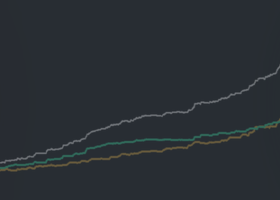
The illusion comes from compounding inside a backtest, where every profit increases the lot size, then the next profit increases it again, and so on.
On paper, it becomes exponential very quickly.
In real life, risk, withdrawals, changing market conditions, broker limits, psychology and plain bad luck exist.
Gold Grids vs Forex Grids
There is also a big difference between two types of grid systems:
GOLD GRIDS vs FOREX GRIDS
Gold Grids
Gold grids are generally much more aggressive.
A strong move can hit your hard SL, destroy the basket, or even wipe the account overnight while you’re sleeping.
Forex Grids
Forex grids, on the other hand, are usually more chill and slower.
That absolutely does NOT mean they are safe — they still carry real risk — but most of the time they give you more room and more time to understand what’s happening and decide what to do.
As explained in more detail here by another trader:
https://www.mql5.com/en/blogs/post/767250
Using Grid Bots at Higher Risk
If you really want to use the full potential of a grid bot, in my opinion you need to understand that higher risk can make sense only if it comes with an actual plan.
Not blindly increasing risk.
You need to know:
- When you’re withdrawing.
- How much you’re withdrawing.
- How often you’re doing it.
- What you’re going to do with those profits once they leave the trading account.
At the same time, I personally believe that a good grid bot CAN absolutely be used on a personal long-term account, but at extremely low risk.
For me, we’re talking about something like:
0.01 lots per $10,000 minimum
...assuming the bot itself is actually solid.
And something I’ve noticed over and over again:
The people with the biggest accounts are usually the ones running the smallest lot sizes.
At the end of the day, it also depends on how much profit is enough for you.
Someone happy with 2–3% per month can manage risk very differently from someone trying to double an account every month.
My Personal Grid Setup
For the grid users, the grid haters, and the people still sitting somewhere in the middle, this is how I personally manage my accounts.
Main Account — Approximately $33,000 Balance
Gold Grids
- Approximately 0.01 lots per $4,000
- 20% hard SL
- My goal is to gradually decrease risk as the account grows
- Once I reach around $100,000, I plan to move closer to 0.01 per $10,000
Forex Grids
- Approximately 0.01 lots per $2,000
- 20% hard SL
- Once the account reaches around $100,000, I’ll probably reduce that to around 0.01 per $5,000
TP/SL EAs
- Approximately 0.01 lots per $4,000
- I’m still building confidence with this type of EA, simply because I’ve always been much more used to grid systems
Gambling Accounts — Approximately $500 Cent Accounts
These are completely separate from my main account and are treated as high-risk / disposable capital.
Gold Grids
- Approximately 0.01 lots per $1,000
- 50% SL
Forex Grids
- I don’t use them here.
TP/SL EAs
- Approximately 0.01 lots per $1,000
- Or roughly 20% account risk, depending on the setup
What I Do With The Profits
On my main account, I withdraw 50% of the monthly profits.
From the amount I withdraw:
- 50% goes into long-term assets, mainly S&P 500 / Nasdaq
- 50% goes to my bank account
The other 50% of the monthly profit stays inside the trading account, allowing the account to continue growing without relying on full compounding.
For the gambling accounts, I follow the 80/20 rule explained in the article I linked above.
The main idea behind all of this is very simple:
I don’t want all of my trading profits to remain exposed to trading risk forever.
A profit is not really secured until at least part of it leaves the trading account.
This is simply how I personally approach grid trading and risk management. It is not financial advice, and every trader should adapt risk to their own capital, experience and tolerance for drawdown.
Luca Barone
Founder, LUBOTFX
Full-time Trader and Funds Manager