Could the Next Financial Superpower Be a Technology Company

Could the Next Financial Superpower Be a Technology Company
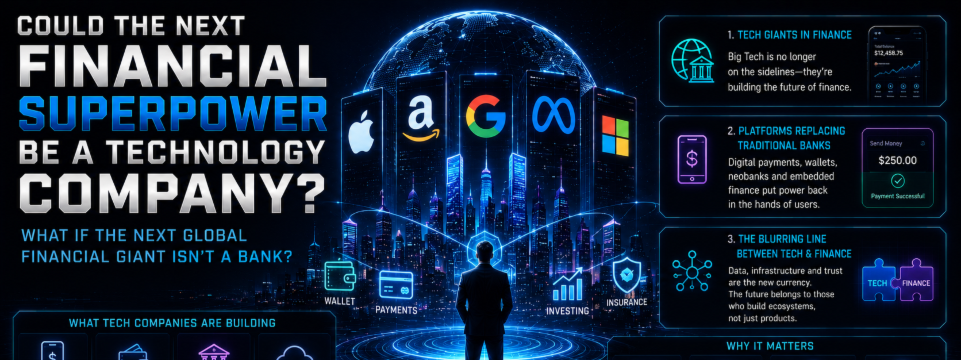
What if the next global financial giant is not a bank. This is not speculative framing anymore. Real, well known payment and technology companies are actively filing for genuine national bank charters right now, a regulatory level convergence between tech and finance considerably more concrete than the product level similarity that has existed for years already.
Part One: The Real, Current Blurring of Tech and Finance
Recent months have seen a genuinely striking wave of applications for federal trust bank charters from companies most people would never have described as banks a few years ago. Stablecoin infrastructure providers, payment processors, and crypto native firms have filed with the relevant United States banking regulator in rapid succession, a cluster of applications arriving within a remarkably short window rather than spread gradually over years. This matters because a bank charter is not a marketing claim, it is a genuine legal and regulatory status carrying real supervisory obligations and real privileges, and companies whose core business began as payment processing or crypto infrastructure are now actively pursuing that exact status.
Part Two: Digital Wallets and Payment Platforms as the Entry Point
The path here is traceable and genuinely logical rather than sudden. A company begins by processing payments, then progresses to holding customer balances, then to issuing payment cards tied to those balances, then to offering something functionally close to a named account. A well known global payments company now issues its own dollar backed digital currency through regulated infrastructure, a concrete, current example of a payments platform evolving into something resembling a currency issuer in its own right. Industry discussion increasingly frames this progression plainly, wallets now hold balances, issue cards, and offer named accounts, functionally resembling bank accounts well before any formal charter is ever granted, meaning the charter application stage often arrives as a formalization of capability the company already effectively offers rather than a dramatic leap into entirely new territory.
Part Three: Traditional Finance Is Not Standing Still
Here is the honest, important balance most coverage of this trend misses. This is not simply technology companies disrupting a passive banking industry. Major established financial institutions, large global banks and asset managers among them, are simultaneously building their own stablecoin and tokenization infrastructure, competing directly on the same new technological layer rather than waiting to be disrupted or attempting to acquire disruptors after the fact. Long established payment networks are deploying stablecoin based payment rails alongside their traditional infrastructure. This is genuine convergence from both directions at once, not a one way invasion, and understanding that balance matters more than a simple technology versus banking narrative suggests.
Part Four: How the Boundaries Are Genuinely Shifting
The traditional categorical distinction between a bank and a technology or payments company is eroding at the legal and regulatory level, not merely at the level of which app a customer happens to use. This is the genuinely structurally significant development. Given that both incumbent finance and technology companies are building toward the same underlying infrastructure layer simultaneously, current evidence points toward a genuinely blended landscape rather than a single, clean winner emerging from either camp. The more interesting and more likely outcome is not one dominant technology superpower replacing banking outright, but an increasingly indistinguishable convergence where the meaningful question becomes which specific institutions, regardless of their original industry label, build the most trusted, most widely adopted financial infrastructure layer.
Part Five: What This Means for the Broader Market Structure
This convergence connects directly to other structural shifts covered elsewhere in this series, tokenization and the extension of continuous, always on trading beyond crypto alone. As payment and technology companies build genuine financial infrastructure alongside traditional institutions doing the same, the overall pace of infrastructure innovation, faster settlement, programmable money, continuous global availability, accelerates further, reinforcing exactly the kind of rapidly evolving, technologically driven market structure this entire series has been mapping across many different angles.
Frequently Asked Questions
Are technology companies actually becoming banks, or is this just marketing? It is genuinely real at the regulatory level. Multiple well known payment and technology companies have filed for actual national bank charters with United States regulators, a legal and supervisory status considerably more concrete than simply offering banking like features through an app.
Is this trend only happening with crypto native companies? No. While crypto infrastructure firms are prominently involved, established payment networks and traditional financial institutions are simultaneously building the same underlying infrastructure, making this a genuinely two way convergence rather than an isolated crypto phenomenon.
Does this mean traditional banks are being replaced by tech companies? Current evidence suggests convergence rather than replacement. Major established financial institutions are actively building the same stablecoin and tokenization infrastructure themselves, competing directly rather than standing still while technology companies disrupt them.
What is the clearest real world example of this convergence? A well known global payments company issuing its own dollar backed digital currency through regulated infrastructure represents a concrete, current example of a payments platform evolving into a currency issuer in its own right.
The Question Was Never Bank Versus Tech Company
The more accurate framing is not whether a technology company will eventually replace traditional banking outright. It is that the categorical line between the two is genuinely dissolving at the regulatory level, with both traditional finance and technology companies converging toward the same infrastructure layer simultaneously. Understanding this convergence accurately matters directly for anyone tracking where financial market structure, and the pace of its ongoing transformation, genuinely heads next.
Explore the broader ICONIC.FX ecosystem, built to operate intelligently within exactly this rapidly evolving financial landscape, at iconicfx.tech.
Risk Disclaimer. Trading foreign exchange, cryptocurrencies, commodities and other leveraged financial instruments carries a high level of risk and may not be suitable for all investors. The high degree of leverage can work against you as well as for you. Past performance is not indicative of future results. Automated trading systems, indicators and Expert Advisors do not guarantee profits and can produce losses. ICONIC.FX provides software tools only and does not provide investment advice, portfolio management or financial recommendations. You are solely responsible for your own trading decisions. Seek advice from an independent licensed financial advisor if you have any doubts.