DKB Vanguard Weekly Autonomous Execution EA
- エキスパート
-
Kerron O'neil Boothe
 私は、ファイナンス、テクノロジー、コンピュータサイエンス、イノベーション・マネジメント、経済学、ビジネス、国際関係を横断する学術的背景を持つ、経験豊富なトレーダー、クオンツ戦略開発者、そしてExpert Advisor(EA)開発者です。
私は、ファイナンスとテクノロジー分野のPhD、日本で取得したイノベーション・マネジメントのMBA、ドイツで取得したコンピュータサイエンスの修士号、さらに国際関係・政治学の学士号を取得しています。この多分野にわたる教育背景は、金融市場の研究や自動売買システムの開発において、非常に幅広い分析基盤を提供しています。 - バージョン: 3.3
- アクティベーション: 5
DKB Vanguard Weekly Autonomous Execution EA is a higher-timeframe trading system built around one central idea: identify where price is actually doing something meaningful, determine where historically proven reaction zones exist, and wait for price to reach a statistically attractive location before acting.
The EA combines historical rejection levels, multi-timeframe trend structure, pullback analysis, candlestick behaviour, exhaustion, trendline context, and portfolio risk control into one autonomous execution framework.
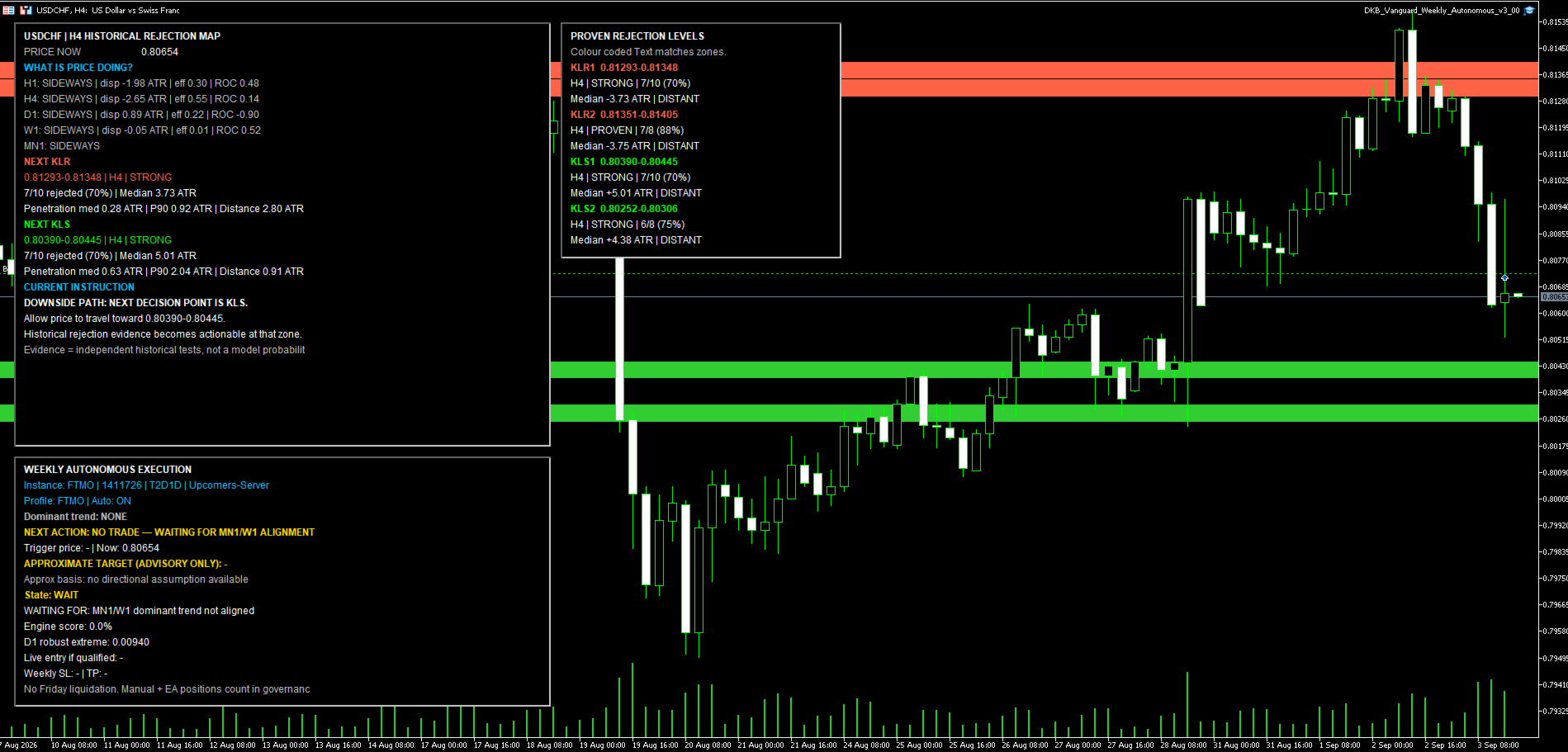
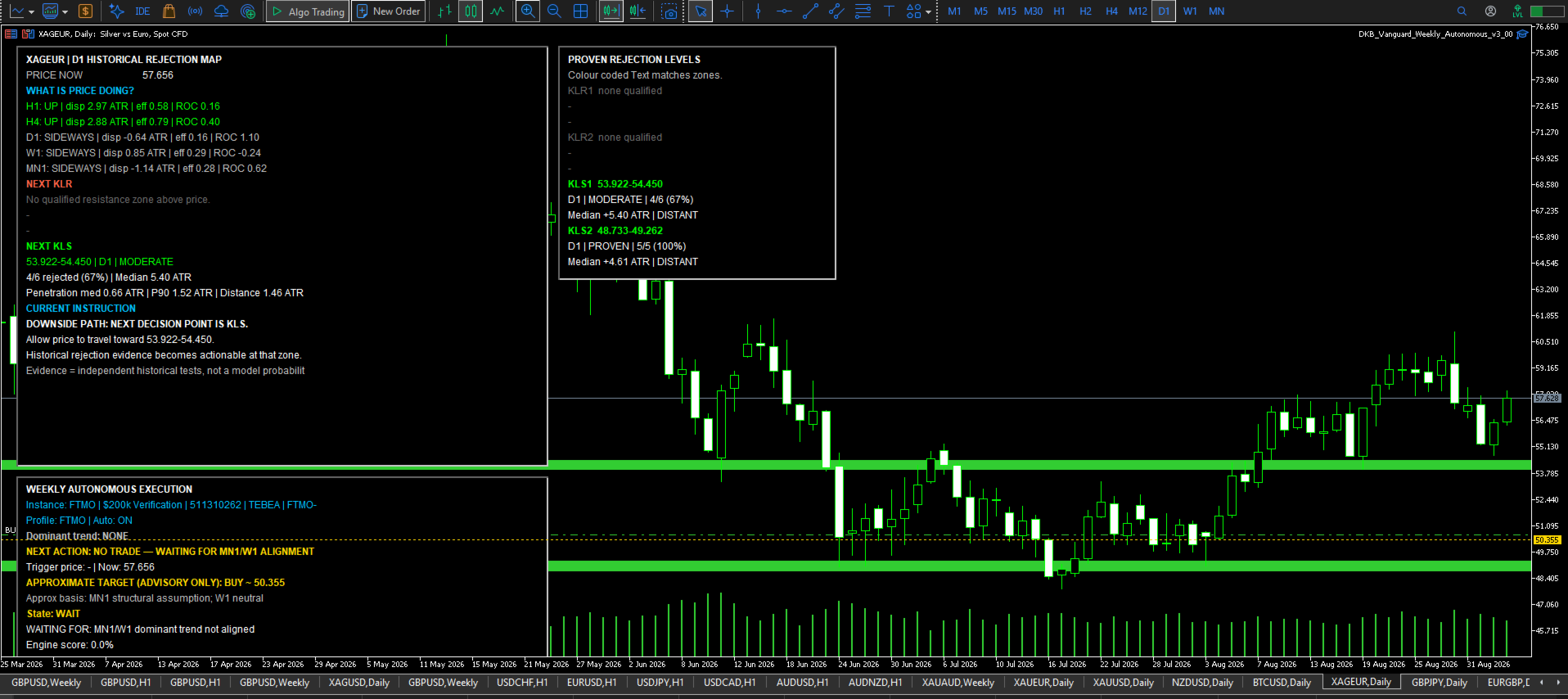
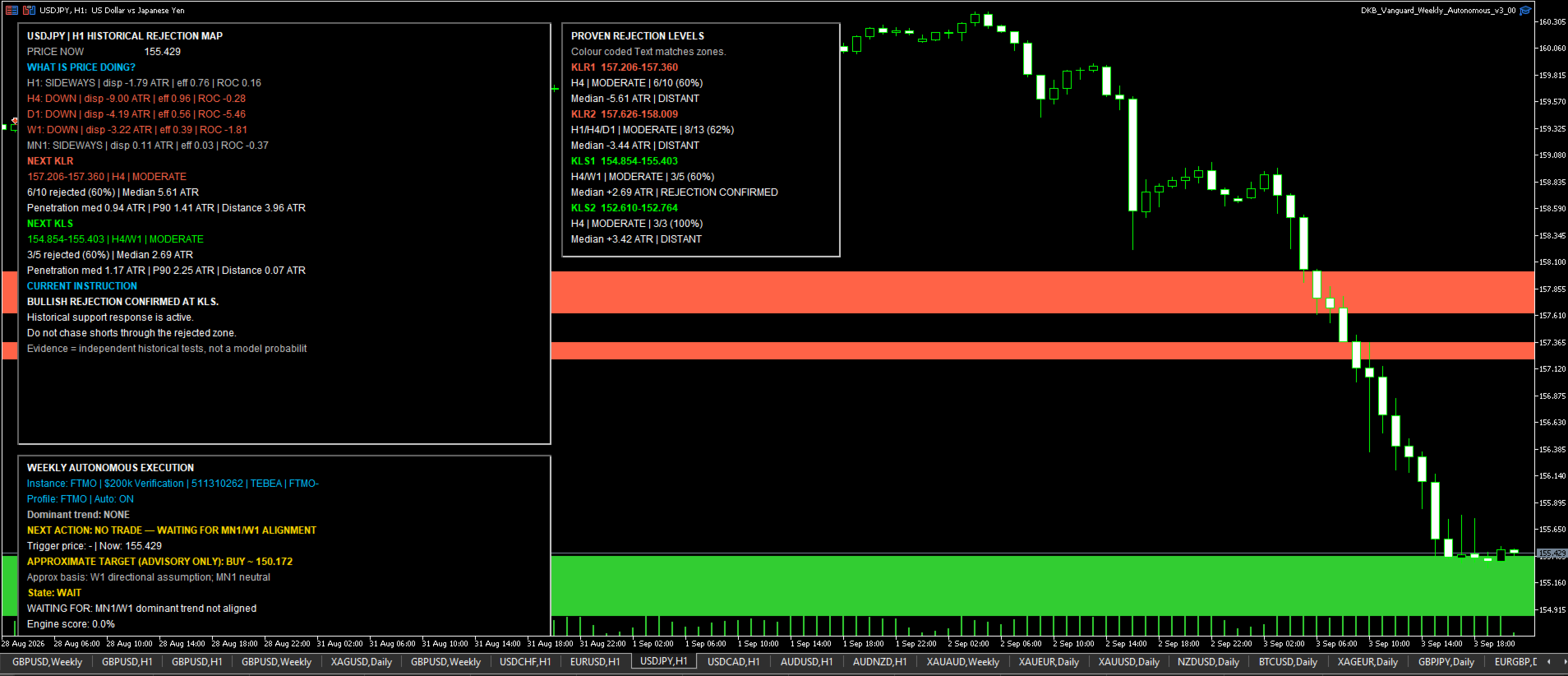
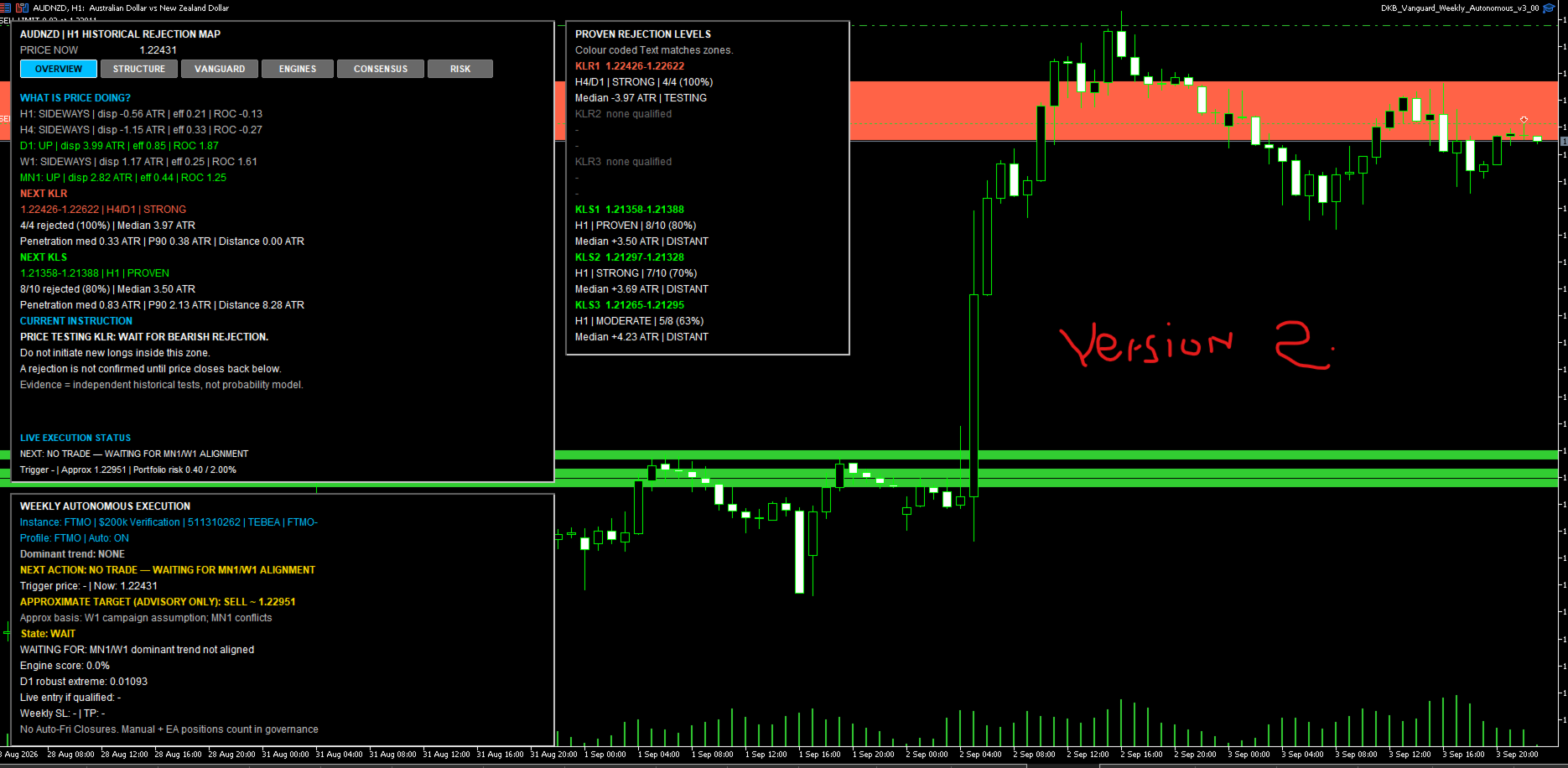
At its core, the system maps repeatedly tested support and resistance zones—referred to as KLS and KLR levels—and evaluates how price historically reacted at those areas. It then uses this information to determine where a future entry may offer a better risk/reward opportunity.
The EA is designed for traders who prefer patient, selective entries rather than constant high-frequency activity.
Main Features
- Historical Rejection Mapping
- Identifies support and resistance zones that have repeatedly produced meaningful price rejection.
- Measures historical rejection rate, reaction distance, penetration depth and level quality.
- Grades levels as Moderate, Strong or Proven.
- Multi-Timeframe Price Direction Engine
- Evaluates price behaviour across H1, H4, D1, W1 and MN1.
- Measures directional displacement, efficiency, rate of change and supporting market structure.
- Displays whether price is currently moving UP, DOWN or SIDEWAYS.
- Weekly Trading Framework
- Uses higher-timeframe structure to define the dominant trading direction.
- MN1 provides broader structural context.
- W1 defines the primary trading campaign.
- D1 is used for execution refinement and pullback confirmation.
- Extreme Entry Logic
- The EA does not automatically enter simply because price reaches support or resistance.
- It can wait beyond historically observed penetration levels before considering an entry.
- Historical P90 penetration data is used to identify unusually attractive entry zones.
- Pullback Analysis
- Measures whether price has moved far enough against the dominant trend to offer a meaningful better-price opportunity.
- Additional positions are permitted only when price improves materially.
- Candlestick Analysis
- Evaluates D1 candlestick behaviour including:
- bullish and bearish engulfing patterns,
- long-wick rejection candles,
- directional candle structure,
- rejection quality.
- Evaluates D1 candlestick behaviour including:
- Exhaustion Analysis
- Measures adverse movement against the dominant trend.
- Helps distinguish between normal directional movement and potentially exhausted pullbacks.
- Trendline Analysis
- Detects rising support and falling resistance structures.
- Adds dynamic structural context to horizontal support/resistance analysis.
- Controlled Multiple Entries
- Allows a maximum configurable number of same-direction positions.
- Additional entries must always occur at a better price than existing positions.
- Manual trades and trades opened by other Expert Advisors can also be considered.
- Robust Second-Entry Spacing
- Reviews recent D1 candles.
- Filters the largest daily ranges.
- Uses the median of the strongest historical daily moves to determine whether price has moved far enough to justify another entry.
- Portfolio Risk Control
- Monitors total account exposure before opening a new trade.
- Supports configurable portfolio-wide risk limits.
- Calculates position size from the available risk budget and planned stop distance.
- Weekly-Scale Stop Loss and Take Profit
- Stop-loss distances are designed around higher-timeframe volatility rather than short-term market noise.
- Take-profit targets can reference the next opposing historical rejection area.
- Manual Trade Awareness
- The EA does not operate in isolation.
- Existing manual trades can be included when evaluating:
- position count,
- best existing entry,
- available portfolio risk,
- additional-entry eligibility.
- Approximate Target Forecast
- When full higher-timeframe alignment is not yet available, the EA can calculate a clearly labelled:
- APPROXIMATE BUY TARGET, or
- APPROXIMATE SELL TARGET.
- These levels are advisory only and are never treated as executable signals until the full entry conditions are satisfied.
- When full higher-timeframe alignment is not yet available, the EA can calculate a clearly labelled:
- Qualified Execution Marker
- When a genuine entry setup exists, the EA displays the exact level it is waiting for directly on the chart:
- WAITING TO BUY @ price
- WAITING TO SELL @ price
- When a genuine entry setup exists, the EA displays the exact level it is waiting for directly on the chart:
- Detailed Dashboard
- Displays:
- current price behaviour,
- higher-timeframe direction,
- nearest proven support and resistance,
- historical rejection statistics,
- current trading instruction,
- autonomous execution status,
- next intended action,
- approximate target,
- qualified execution trigger,
- reason for waiting or blocking.
- Displays:
- Chart-Based Decision Zones
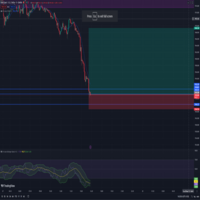
- Proven KLS/KLR areas are drawn directly on the chart for immediate visual reference.
- Push Notifications
- Optional mobile notifications for meaningful level-state changes such as:
- approaching,
- testing,
- rejection confirmed,
- broken.
- Notification logic is state-based to avoid repeated rapid-fire alerts.
- Notifications can also identify the trading account/terminal instance that generated the message.
- Optional mobile notifications for meaningful level-state changes such as:
- Broker-Friendly Notification and Execution Control
- Cooldowns and state tracking reduce unnecessary repeated activity.
- Designed to avoid constant resubmission or repetitive alert behaviour.
Trading Philosophy
DKB Vanguard is not designed to chase price.
It attempts to answer three questions:
1. What is price doing?
Using multi-timeframe direction, structure and momentum.
2. Where is price likely to react?
Using historically validated rejection zones.
3. Is the current price attractive enough to act?
Using pullback depth, historical penetration, candlestick behaviour, exhaustion and trend context.
The objective is to trade from better locations, preferably in the direction of the dominant higher-timeframe structure.
Suitable For
DKB Vanguard can be used on:
- Forex pairs
- Precious metals
- Indices
- Cryptocurrencies
- Other MT5 instruments with sufficient historical data
It can be applied to virtually any MT5 trading account, subject to the broker's symbol specifications, execution rules and available historical data.
Important
This Expert Advisor is an automated trading system. Historical rejection behaviour and statistical measurements do not guarantee future market reactions. Market conditions can change, and losses are possible.
Users should test the EA thoroughly in the MT5 Strategy Tester and on a demo account before deploying it with live capital.
DKB Vanguard is designed to wait for price—not chase it.