Even Keel
- エキスパート
-
Tom Buder
 Independent developer of automated trading systems for MetaTrader 5. Trading experience since 2000 and robot development since 2006. Professional background in computer science, business administration, marketing, risk management and business continuity. I focus on transparent, risk-aware Expert
 - バージョン: 2.0
- アクティベーション: 10
Even Keel trades mean reversion across a portfolio of instruments at the same time. It looks for values that have moved unusually far away from their own recent middle, takes a position against that move, and closes when the distance has come back in. The result comes from the sum of many small, largely independent recoveries rather than from one big call.
Please read this before you test it. Even Keel is a portfolio system, not a single-symbol EA. It needs about 370 daily bars of history per instrument before it will trade that instrument at all, and it needs a broad instrument catalogue to work from. A short test on one symbol will therefore show little or no activity — that is the warm-up doing its job, not a fault. Test it over several years, on an account whose broker offers a wide range of instruments.
It measures in the instrument's own volatility
200 points mean something different on an index than on a currency pair. Every distance Even Keel works with is expressed relative to that instrument's own typical daily range. That is what makes shares, commodities, indices and currencies comparable inside one portfolio.
It finds its own instruments
There is no symbol list to install, no CSV file, no path to configure. The EA resolves its instruments from your broker's catalogue by name and by category path, and it copes with the fact that brokers name things differently — a value may be US30, #US30 or UsaInd and still be recognised. What it selected, and what it rejected, it writes to the journal.
If you want to narrow or widen that, five optional include fields and one exclude field accept plain substrings such as "Shares" or "EURGBP". Leave them empty and the EA uses the preset's own selection.
One chart is enough. The chart's symbol and timeframe do not matter.
Not optimised, not trained
Most systems are built by turning parameters until the equity curve looks good over the past. Such settings describe the past very well and the future not at all.
Even Keel was not built that way. No genetic optimiser, no machine learning, no parameter search on the equity curve. The settings come from individually tested decisions, each with a reason that stands independently of the curve it produces.
That is why the EA ships fixed. You choose a preset and a risk scale. Everything else is built in — not to withhold it from you, but because every extra dial is one more way to fit a past that will not repeat.
Backtest results
Default preset "Balanced", at the risk scale the EA ships with (8.45):
- Period: 2016-01-01 to 2026-07-22 (10.1 years), evaluated from 2016-06-01
- Tester model: 1-minute OHLC
- Deposit / currency / leverage: 100,000 EUR / EUR / 1:30
- Data source: FxPro MT5 historical data
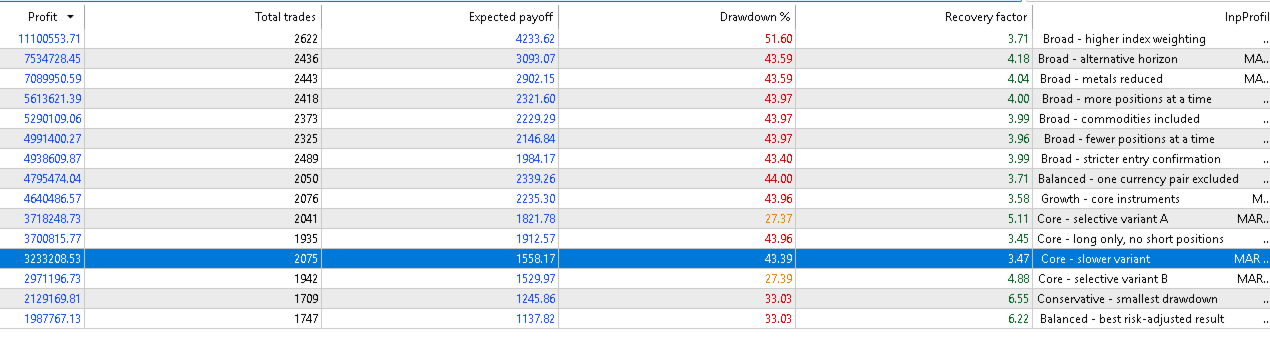
- Net profit: 1,987,767 EUR — 34.9 % per year
- Maximum drawdown: 33.0 %
- Return divided by drawdown (MAR): 1.06 — recovery factor 60.2
- Position groups closed: 1,747, of which 95.4 % positive
- Peak used margin: 85.3 %
Lower the risk scale and both sides shrink together. At scale 6.0 the same preset returns 27.5 % per year with a 24.1 % drawdown — less of both. The ratio of return to drawdown barely moves, so the risk scale is how you choose your own exposure, not how you choose a better strategy.
This is a backtest. It is one broker's history, one data set and one parameter set over one period. It is not a forecast, and it is not evidence of future results. A different broker offers different instruments, different spreads and different swaps, and will therefore produce a different outcome.
The remaining fourteen presets are listed in the user guide with their own measured figures. Compared at equal exposure they range from a lower-drawdown variant (MAR 1.08) to broader, higher-turnover variants with drawdowns above 50 %. Higher return in that table always comes with higher drawdown — the presets are trade-offs, not a ranking.
Settings
- Preset — one of fifteen measured configurations. Default: Balanced.
- Risk scale — scales every position size. Default: 8.45.
- Stop opening new positions above X % used margin — safety brake. Default: 90.
- Close positions not opened by this EA when in profit — handles positions from manual trading or another EA. Default: on. It never closes such a position at a loss.
- ...from profit at or above X — threshold in account currency, swap included. Default: 75.
- ...or from profit at or above X % — threshold as a percentage of that position's margin. Default: 10.
- Include filters 1-5 — optional substrings, semicolon-separated. Default: empty.
- Exclude filter — optional substrings, semicolon-separated. Default: empty.
- Magic number — change it to run a second instance. Default: 22072601.
What you should know before buying
These points are part of the method. They are here so you read them before you buy, not after.
- The EA adds to positions. If a value keeps moving the wrong way, it buys a limited number of further tranches. A position can therefore become larger than it was at entry.
- There is no fixed stop-loss per position. Exits happen through the return to the middle, through profit-taking, and through portfolio-level emergency rules.
- Positions are held overnight and over weekends. Your broker's swap, spread, commission and slippage go straight into the result.
- The EA needs free margin. On a tight account it trades less. That is a built-in brake, not a malfunction.
- Quiet periods are normal. The EA waits for unusual distances, and those do not occur every day.
- Losing periods lasting several weeks are possible.
There is no profit promise and no guaranteed hit rate.
Recommendations
- Account: leverage and size such that a portfolio of several simultaneous positions fits comfortably. Start on a demo account.
- Broker: tight spreads across a wide range of instruments. The wider the catalogue, the more candidates the EA has.
- VPS recommended — the EA runs continuously.
- Start with a lower risk scale than you think is right. You can raise it once you have seen the EA work on your own account.