Cinder
- Experts
-
Alex Amuyunzu Raymond
 I’m an experienced MQL5 developer and software engineer specializing in building robust, high-performance algorithmic trading systems for MetaTrader 5. My work goes beyond standard EA development — I design intelligent, scalable solutions that combine market logic, automation, and external
 - Versione: 1.2
- Attivazioni: 5
The Ember That Survives the Fire
The Opening Statement
Most Expert Advisors are sold on the promise of profit. CINDER is sold on the promise of survival. In a market where 70–80% of retail accounts are disclosed as losing money, the only edge that matters is the one that keeps you in the game long enough to use it. CINDER is not a signal generator. It is a risk architecture with a trading strategy attached — a system built from the ground up on the assumption that the trader on the other side of the screen has already been burned once, and will not survive being burned again.
The name is deliberate. A cinder is what remains after everything else has burned away — the ember that still holds heat when the fire is gone. That is the design philosophy. CINDER does not try to be the brightest flame in the market. It tries to be the one that is still glowing after the flashy systems have blown up.
What CINDER Actually Is
CINDER is a professional MetaTrader 5 Expert Advisor engineered for retail and prop-firm traders in the United States, Canada, Mexico, the United Kingdom, and the European Union. It is priced at $899 because it is not a toy. It ships with a modular strategy engine, an institutional-grade risk layer, region-aware execution rules, a live news filter, a session filter, a prop-firm preset, and a multi-panel on-chart dashboard that reports the state of the account, the market, and the risk engine in real time.
Every component exists for one reason: to prevent the account from dying. The trading logic is the delivery mechanism. The risk engine is the product.
The Core Thesis — Why CINDER Exists
Retail traders do not lose because they lack signals. They lose because they lack protection. The academic and regulatory record is unambiguous:
-
Retail order flow is predictable and fadeable. A 2025 study using minute-by-minute EUR/USD retail position data found that retail traders do not adjust ahead of scheduled macro news, then trade contrary to the announcement surprise after the event. Their behavior is driven by lagged returns, not fundamentals. Simple cross-over strategies exploiting this flow were profitable.
-
Loss aversion is asymmetric. Losses hurt roughly twice as much as equivalent gains feel good. This causes retail traders to hold losers too long and cut winners too early — the exact opposite of what a system should do.
-
Leverage induces psychological collapse. Even at 30:1 or 50:1, a 2–3% adverse move on a full-margin position triggers panic. US traders were forced into lower leverage post-CFTC; European traders post-ESMA. The behavior persists regardless of the cap.
-
Session mismatch destroys edge. Most retail traders trade low-liquidity Asian hours on European and US pairs, facing wider spreads and choppy price action. The London–New York overlap carries roughly 70% of daily forex volume; US data releases cluster at 8:30 AM and 10:00 AM EST.
-
Retail traders fade the news and get run over. This is the single most consistent finding across the literature.
CINDER is built to operate in the space those findings create. It does not fight the market. It does not fight the news. It does not fight the broker. It waits for the conditions where retail behavior is structurally wrong, and it positions against it — but only when the risk engine permits.
The Strategy Engine — Three Modules, One Regime Filter
CINDER does not run a single strategy. It runs a regime-aware modular engine. Each module is independently removable, independently configurable, and independently scored. The engine selects which modules are active based on the current market regime, and only fires when the confluence score clears the user-defined threshold.
The Regime Detector classifies the market into one of three states — Trending, Ranging, or High Volatility — using a combination of ADX, ATR percentile rank over a configurable lookback, and a volatility-adjusted linear regression slope. The regime state is published to the dashboard and the log on every evaluation. No module runs outside its appropriate regime.
Module A — Trend Pullback. Active only in Trending regimes. Uses a higher-timeframe EMA structure filter (default H4), waits for a pullback to dynamic structure (EMA or prior swing), and requires a closed-bar confirmation candle on the entry timeframe. Entry is on the closed bar only. No repainting. No look-ahead.
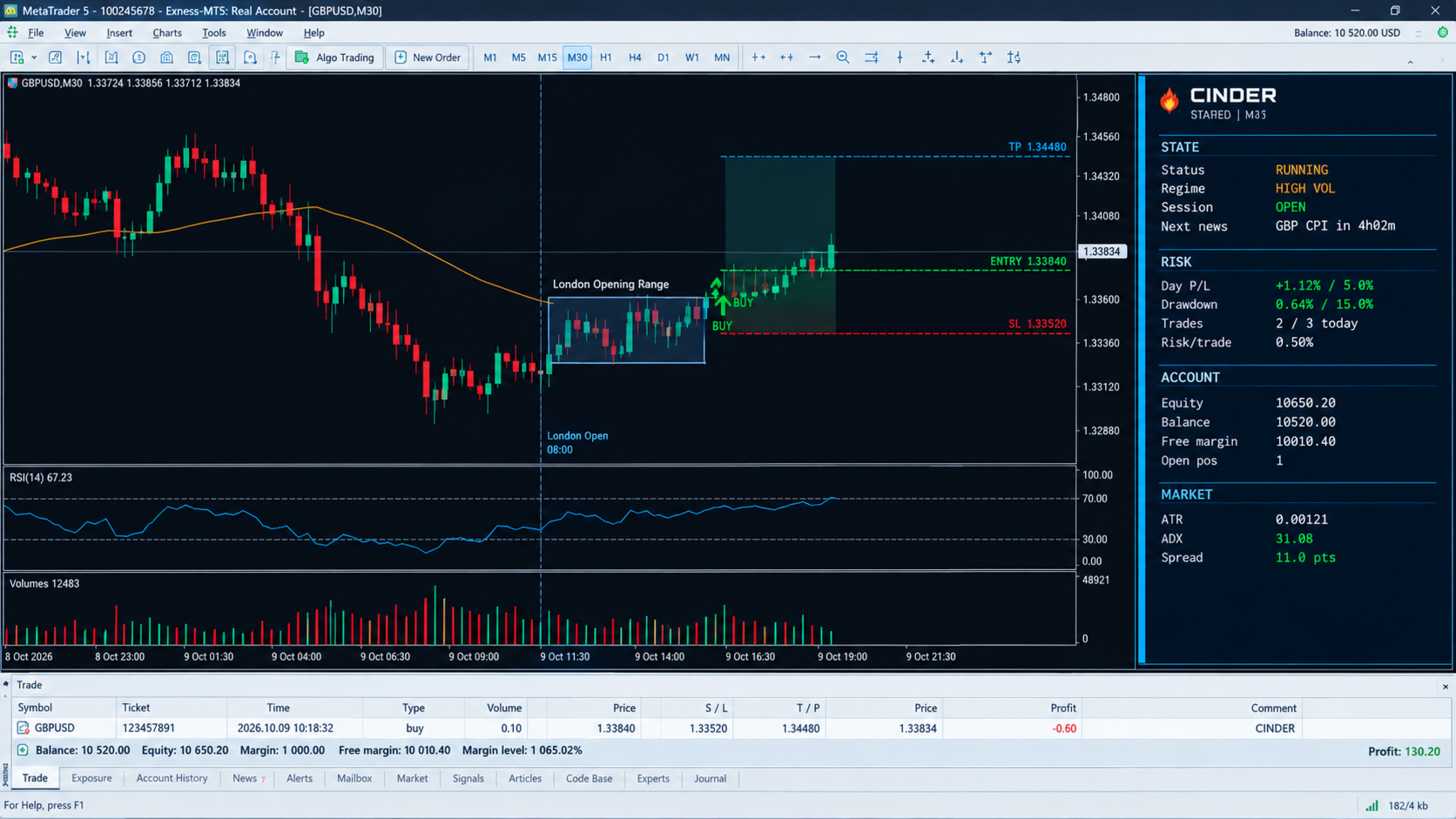
Module B — Session Breakout. Tracks the London and New York opening ranges by server time. Applies a volatility filter (ATR must exceed a configurable percentile), a false-breakout rejection (if price re-enters the range within N bars, the signal is voided), and allows one breakout attempt per session per symbol by default.
Module C — Mean Reversion. Active only in Ranging regimes. Uses an ATR-based strict stop and a hard time-stop that exits the position after N bars regardless of price. One entry per signal. No averaging. No scaling in.
Confluence Scoring. Each module outputs a confidence score from 0 to 100. When confluence is enabled, CINDER only takes a trade if the combined score meets or exceeds the configurable minimum (default 65). If only one module is active, the threshold applies directly. Conflicting directional signals from different modules cancel the trade entirely.
The Risk Engine — The Real Product
This is where the $899 lives.
Position Sizing. Percent-of-equity risk per trade (default 0.5%). Volume is normalized against the symbol's minimum, maximum, and step size. Margin requirement is calculated via OrderCalcMargin before every entry, and the trade is rejected if required margin exceeds a configurable percentage of free margin.
Loss Guards. CINDER enforces a daily loss limit (percentage of day-start equity), a weekly loss limit (percentage of week-start equity), and separate maximum drawdown stops on both equity and balance basis. There are caps on trades per day, simultaneous open trades, and open trades per symbol. Every guard is independent and independently configurable.
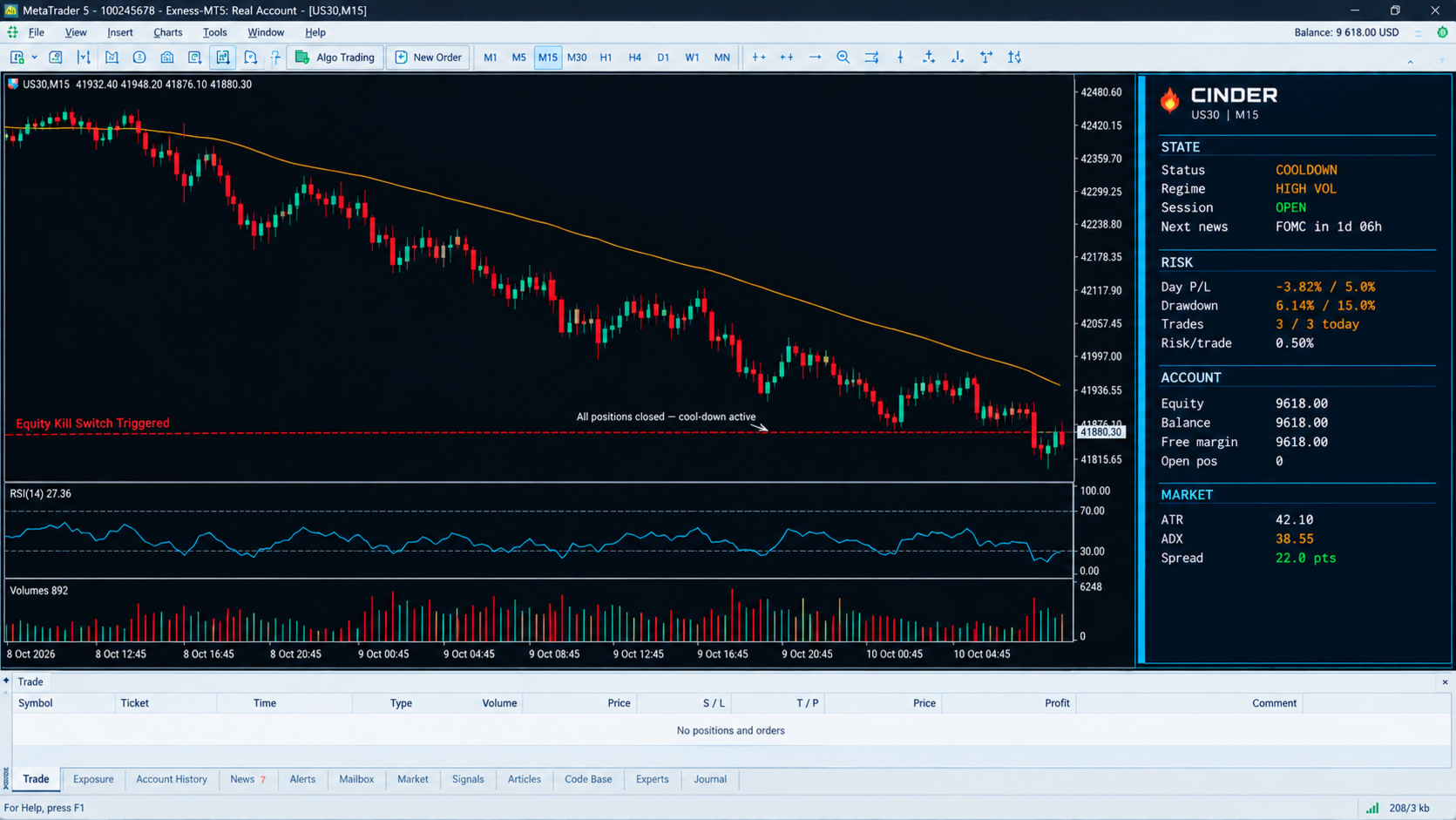
The Equity Kill Switch. If equity drops below a configurable percentage of peak equity, CINDER closes all positions, enters a cool-down period (default 12 hours), and refuses to trade until the cool-down expires. This is the last line of defense and it is not optional.
Trade Management. Break-even at a configurable R-multiple (default 1R, on by default). Optional partial close at a configurable R-multiple (default off). Optional ATR trailing stop (default off). All three are independent. None of them ever move a stop away from price.
Execution Quality. A spread filter rejects entries when the spread exceeds a per-symbol maximum. A slippage tolerance caps deviation in points. Entries are rejected during spread spikes.
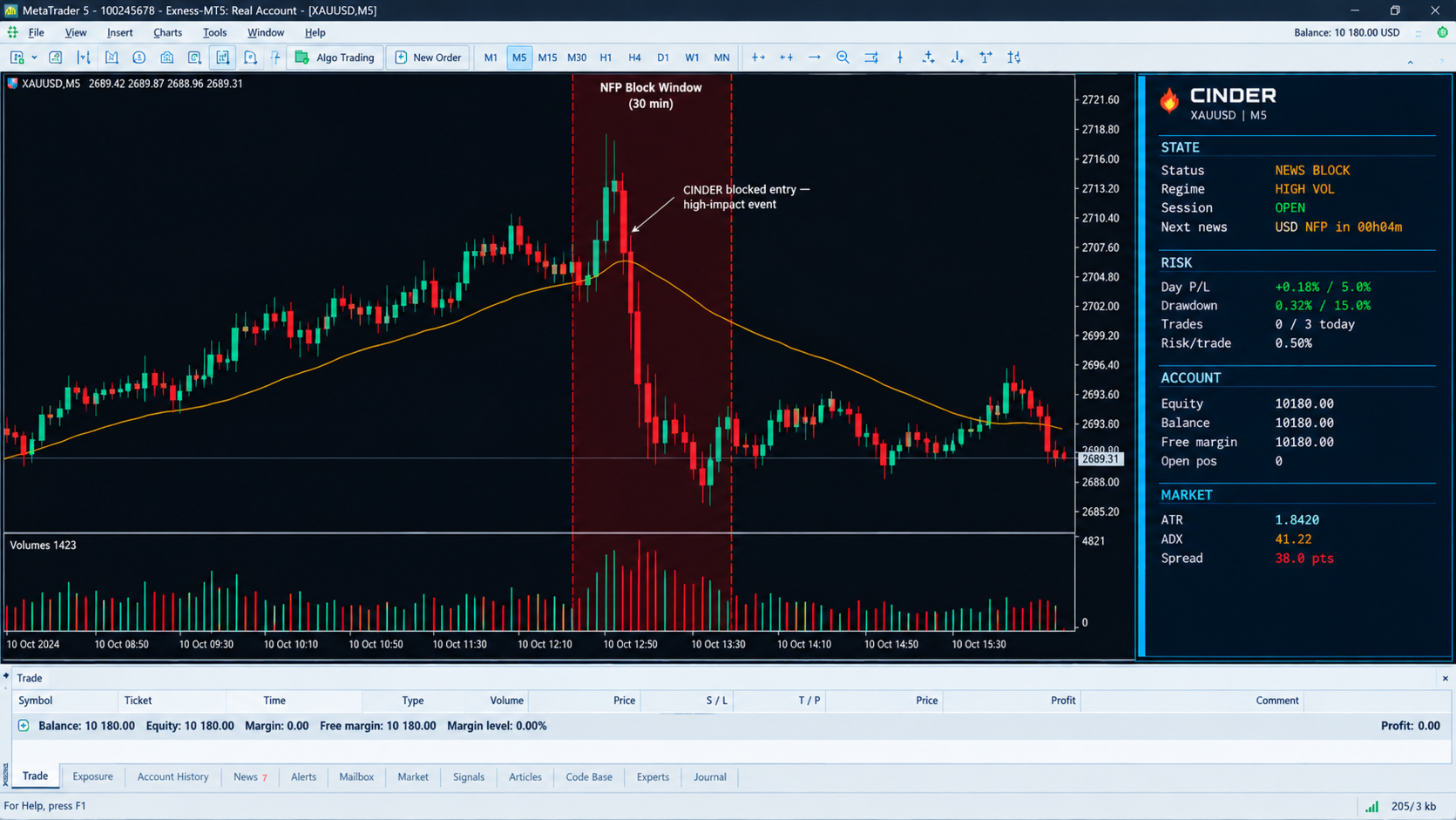
Prop Firm Mode. A single switch tightens every guard simultaneously: daily drawdown 4%, maximum drawdown 8%, no trading within 30 minutes of high-impact news, maximum 2 trades per day. Separate handling for trailing versus static drawdown. Trading halts automatically when the account is within a configurable buffer (default 10%) of any limit.
Region Profiles — US, EU, and Custom
CINDER recognizes that the United States and the European Union are different rule sets, not different products.
US Mode enforces FIFO closing, disables hedging, blocks opposite-direction orders on the same symbol, and sizes positions for 50:1 majors and 20:1 minors. It is the default for traders in the United States, Canada, Mexico, and the Caribbean.
EU Mode allows hedging and sizes for 30:1 majors. It is the default for traders in the European Union and the United Kingdom.
Custom Mode unlocks individual constraints with explicit warnings. It exists for traders who know what they are doing and accept the consequences.
The Filters — News, Session, and Time
News Filter. CINDER reads the MT5 economic calendar via CalendarValueHistory and blocks entries for a configurable window before and after high-impact events (default 30 minutes before, 30 minutes after). The filter is currency-aware: it only blocks events affecting the traded symbol's base, quote, or margin currency. If the calendar is unavailable — which happens on some brokers and in some tester configurations — CINDER logs a warning and either blocks all trading (fail-safe, default) or proceeds with extra caution, depending on the user's configuration.
Session Filter. Trading windows are configurable by broker server time. CINDER detects the broker's GMT offset at initialization by comparing TimeTradeServer() to TimeGMT() , and applies DST handling for US and EU sessions. The default window is 8:00 AM to 5:00 PM server time, which covers the London–New York overlap and the US data release windows.
Time Filters. No new trades are opened after a configurable Friday hour (default 20:00 server). Optional close-all before the weekend to avoid gap risk. No trading during the first N minutes after market open.
The Dashboard — Institutional-Grade, Not a Text Dump
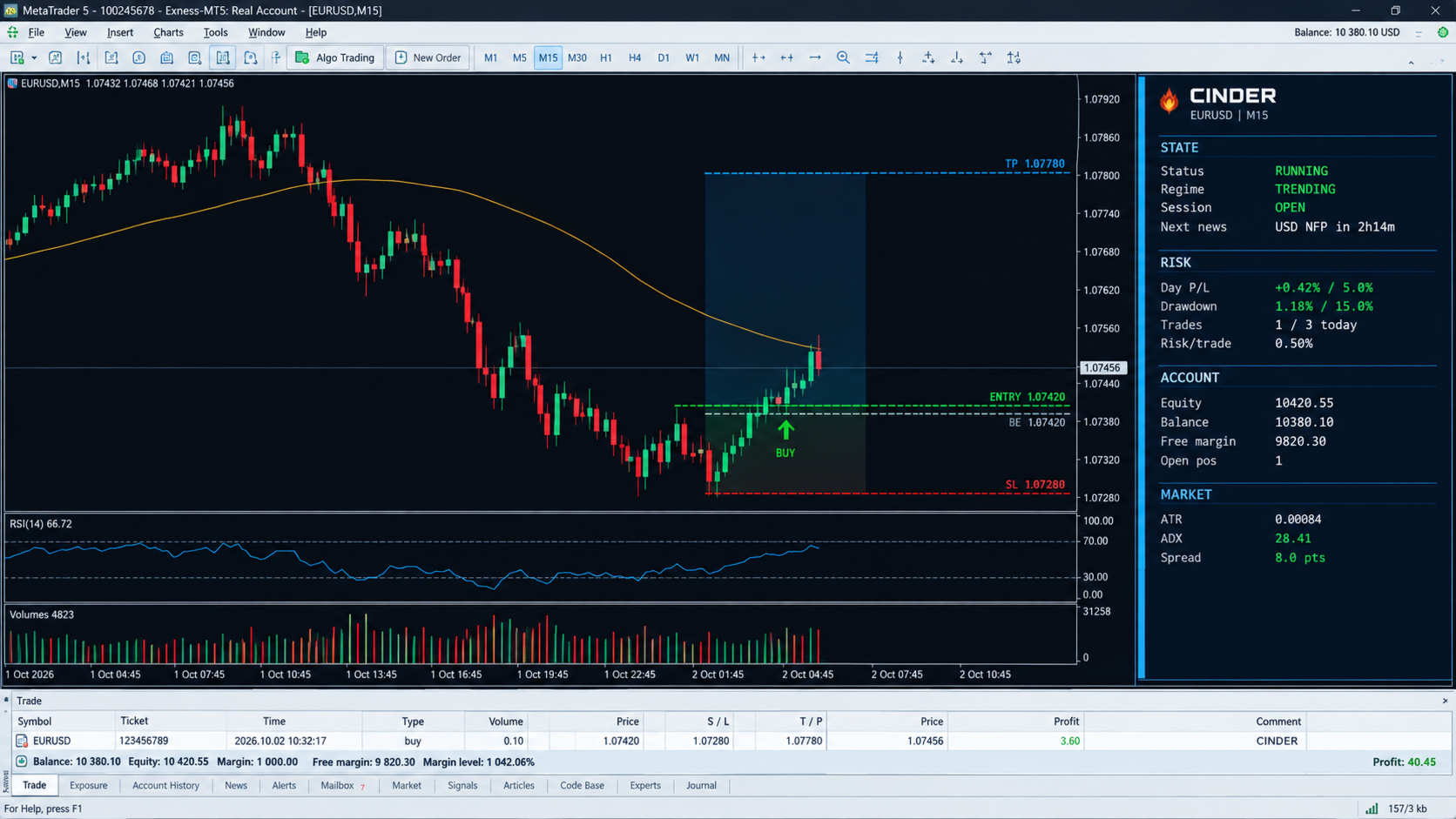
CINDER ships with a multi-panel on-chart dashboard that reports the state of everything that matters in real time. The layout is divided into four sections:
-
STATE — EA status (Running / Halted / Cool-down / News Block / Error), current market regime, session status, and the next high-impact news event with a countdown.
-
RISK — Day P/L against the daily limit, current drawdown against the maximum, trades taken today against the cap, and risk per trade.
-
ACCOUNT — Equity, balance, free margin, and open position count.
-
MARKET — ATR, ADX, and current spread, color-coded against the configured thresholds.
The dashboard uses a dark theme, monospace typography, color-coded values (green for healthy, amber for caution, red for danger), and an accent stripe. It updates every second. It is toggleable. It does not consume meaningful CPU. It is designed to look like something a fund would run, not something a forum vendor would sell.
Robustness and Persistence
CINDER handles requotes, TRADE_RETCODE_* errors, market-closed conditions, partial fills, and disconnects with retry logic and exponential backoff. State — daily loss tracker, weekly tracker, peak equity, cool-down timer, EA state — is persisted via MT5 global variables and survives terminal restarts. On initialization, CINDER validates the symbol, timeframe, account type, broker permissions, and calendar availability. If anything is unsafe, it refuses to start and states the reason in the log.
What CINDER Is Not
CINDER is not a martingale. It is not a grid. It is not an averaging-down system. It does not hedge by default. It does not open opposite positions on the same symbol unless the user explicitly unlocks it in EU or Custom mode. It does not remove, widen, or move a stop away from price. It does not repaint. It does not use look-ahead. It does not use external DLLs. It does not make web requests that would fail MQL5 Market validation. It does not label rule-based logic as "AI." It does not include performance claims in code comments. It does not ship with placeholder functions or // TODO markers.
Who CINDER Is For
CINDER is for the trader who has already lost money to a flashy EA and wants proof of restraint. It is for the prop-firm candidate who needs a system that respects daily drawdown and news restrictions more than it respects profit factor. It is for the US trader who is structurally forced into lower leverage and needs a system that works within those constraints rather than fighting them. It is for the European trader who fears hidden risk and wants full drawdown transparency before committing capital. It is for the trader who understands that the only edge that compounds is the one that survives.
The Closing Line
CINDER — The ember that survives the fire.
Most systems burn bright and die young. CINDER is built to still be glowing when the others are ash.