How to Use Currency Strength Analysis to Find High-Probability Forex Pairs on MT5

How to Use Currency Strength Analysis to Find High-Probability Forex Pairs on MT5
A practical workflow for MetaTrader 5 traders who want to stop guessing which pair to trade and start reading the relative dynamics between currencies.
The problem with trading a single chart in isolation
Most retail traders spend their day on one or two charts, usually EURUSD and GBPUSD. They draw trendlines, mark order blocks, wait for a setup. When the setup appears, they take the trade.
The problem is that EURUSD is not a single asset. It is the ratio of two independent forces: the strength of the Euro and the strength of the US Dollar. A strong-looking breakout on EURUSD can come from three very different situations:
- EUR is genuinely strong, USD is neutral — this is a clean directional move.
- USD is weakening across the board, EUR is actually flat — the move is fueled by the other side and may reverse quickly.
- Both currencies are moving, but mildly — the chart looks impressive but the underlying conviction is low.
If you only look at EURUSD, you cannot tell these three scenarios apart. Currency strength analysis is the tool that gives you that visibility.
What currency strength actually measures
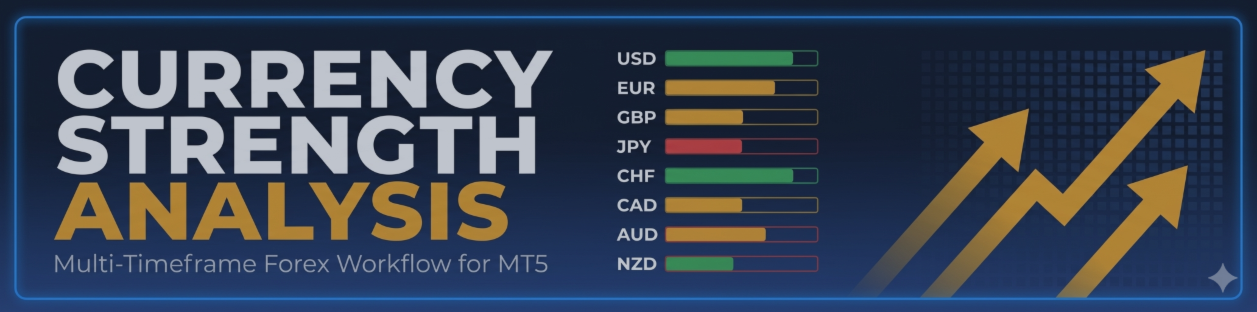
Currency strength is a relative reading that compares each major currency against every other major currency at the same time. The most common setup uses the 8 most-traded currencies: USD, EUR, GBP, JPY, CHF, CAD, AUD, NZD.
These 8 currencies form 28 unique pairs (each currency against each of the others). By looking at all 28 pairs at once, we can assign each currency a score that reflects how it is performing right now relative to the rest of the Forex market.
A normalized scale from 0 to 100 is practical because it is easy to compare at a glance:
- Above 70: the currency is among the strongest in the basket.
- Between 30 and 70: the currency is neutral, mixed, or transitioning.
- Below 30: the currency is among the weakest in the basket.
The raw reading is interesting, but what really matters for trade selection is the differential between two currencies of a pair. A pair where one currency reads 85 and the other reads 15 has a 70-point differential — that is a strong, clean directional setup. A pair where both currencies read around 50 has no differential and is essentially range-bound from a macro perspective.
Why a single-timeframe reading can mislead you
A currency can look strong on H1 because of a news spike, while still being weak on the daily. Entering a long position based only on the H1 reading would mean fighting the higher-timeframe trend — statistically a losing proposition.
This is where multi-timeframe confluence becomes essential. A serious currency strength analysis should answer three questions at once:
- Is the currency strong on the short horizon (M15 to H1)?
- Is it strong on the medium horizon (H4)?
- Is it strong on the long horizon (D1)?
When all three align, the probability of a continuation setup increases significantly. When they disagree, the trade becomes a counter-trend scalp at best.
A practical rule of thumb: take trades only when the two currencies of the pair disagree on at least 2 of the 3 timeframes. If EUR is green (bullish) on H1, H4 and D1, while USD is red (bearish) on H1, H4 and D1, EURUSD long is a textbook high-probability setup.
From currency strength to trade entry: a three-step workflow
Step 1: Scan
Open a multi-currency dashboard and look at the 8 currencies sorted by score. Identify the strongest and the weakest of the session. Ignore anything in the middle — neutral currencies produce neutral pairs, and neutral pairs produce neutral trades.
Step 2: Pair
Pair the strongest currency with the weakest to get the candidate with the largest differential. If the strongest is CAD at 95 and the weakest is JPY at 5, then CADJPY is the pair to study first. The 90-point differential tells you this is where the market has the most conviction right now.
Step 3: Confirm with market structure
A large strength differential is a necessary condition, not a sufficient one. The chart of CADJPY still needs to tell a coherent story:
- Is price breaking structure in the direction of the strong currency?
- Is there a fresh order block or a fair value gap to enter from?
- Is the current candle respecting a higher-timeframe level?
This is where Smart Money Concepts (BOS, ChoCH, order blocks, liquidity sweeps) complete the picture. Currency strength tells you which pair to look at. Market structure tells you when and where to enter.
A common pitfall: chasing moves after the fact
If a currency has already jumped from 40 to 90 in the last hour, you are arriving late. The move is probably already priced in, and the next few hours are more likely to be a retracement than a continuation.
Two practical filters help here:
- Inline history: if your dashboard shows the recent evolution of each currency (a mini-chart of the last 15 to 30 readings), you can immediately tell whether a high score is fresh momentum or a tired overextension.
- Trend arrows: a currency currently at 80 but trending down is not a buy — it is a fade candidate. A currency at 60 but trending up aggressively is often a better long setup than a currency at 75 that is flatlining.
Both filters require a dashboard that stores short history, not just a single snapshot.
Why bother with all this for Forex?
A trader who sticks to one pair is exposed to random news shocks on either side of that pair. A trader who scans all 28 pairs and picks the one with the largest currency differential is, mechanically, putting the odds in their favor before even drawing a single line on the chart.
This does not replace technical analysis, risk management, or a trading plan. It replaces guessing which pair to trade today, which is one of the most expensive habits a Forex trader can have.
Putting it into practice on MT5
The workflow described in this article can be executed manually by switching between 28 charts and computing the averages by hand. This is possible but slow and error-prone, especially during volatile sessions.
A dedicated dashboard saves time and reduces mistakes. Two tools from the TradingTips Dashboard Suite complement each other for this workflow:
- Multi-Currency Strength Dashboard PRO MT5 handles the currency scan, the multi-timeframe confluence, and the pair recommendation. It displays inline history sparklines so you can see whether a strong reading is fresh or stale, and it can export the full snapshot to CSV for journaling. One click on a suggested pair switches the chart to that symbol.
- Market Structure Order Block Dashboard MT5 handles the technical confirmation. Once currency strength has selected the pair, this indicator marks the structure breaks, the fresh order blocks, and the fair value gaps that provide the actual entry zones.
Used together, they cover the two halves of the decision: which pair and where to enter.
Closing thoughts
Currency strength is not a signal. It is a filter. It does not tell you to buy or sell. It tells you which pair is worth your attention right now and which pair is almost certainly a waste of time. Combined with a clean technical framework, it is one of the highest-leverage habits a Forex trader can develop.
Start by observing. Open a currency strength dashboard during the London open and the New York open, and watch how the rankings shift. Identify which pair had the largest differential, and check later how that pair behaved. A few weeks of this kind of observation will teach you more about Forex dynamics than most books.
About the author and related tools
I am a MetaTrader 5 indicator developer and the creator of the TradingTips Dashboard Suite. The Multi-Currency Strength Dashboard PRO MT5 indicator described throughout this article is published on the MQL5 Market:
→ Multi-Currency Strength Dashboard PRO MT5 on MQL5 Market
For questions about the workflow described here, feel free to send me a private message through MQL5 and I will be happy to share the PDF user guide and setup tips.