Trading Video: Monetary Policy Speculation Heats EURUSD Early this Week(based on dailyfx article)
Though the ECB rate decision is due later in the week, speculation on the Euro picked up Monday
A WSJ news headline generated friction when the Fed's Bullard said low yields wouldn't stop a hike
With volatility already elevated, sensitivity to key event risk will be heightened
Though the ECB rate decision
is still days away and the Fed meeting is more than a week out, policy
speculation is generating heavy seas in the FX market. Between the
steady rise in capital market activity levels and an increase in the
frequency of outlier events these past months, investors across asset
classes are growing more sensitive to their exposure should sentiment
suffer a more systemic collapse. Moving forward, the Euro, Dollar, risk
theme and Chinese GDP are items to keep a close eye on. We discuss these
tides' influence on the market in today's Trading Video.
if actual > forecast (or actual data) = good for currency (for NZD in our case)
[NZD - NZIER Business Confidence] = Level of a diffusion index based on surveyed manufacturers, builders, wholesalers, retailers, and service providers. It's a leading indicator of economic health - businesses react quickly
to market conditions, and changes in their sentiment can be an early
signal of future economic activity such as spending, hiring, and
investment.
Chinese Dec retail sales post 11.9% annualized growth
Chinese industrial production up by 7.9% y/y in Dec
New Zealand NZIER business confidence index up from 19 to 23
German and euro zone ZEW economic sentiment figures due
Today’s data dump from China led to a few good moves in the forex
market, particularly among the commodity currencies. AUD/USD is down
0.40% and is trading below the .8200 handle while NZD/USD marked a 0.62%
loss in the past few hours, even though the NZIER business confidence
marked an improvement from 19 to 23.
As it turns out, the Chinese economy grew by 7.3% in Q4 2014,
slightly higher than the projected 7.2% reading. However, this marked
the slowest pace of growth since 1990 and is below the government’s 7.5%
target GDP. The retail sales report also came in better than expected,
as it logged in an annualized 11.9% increase for December, while the
industrial production figure surprised to the upside with a 7.9%
year-over-year gain.
It appears that other forex pairs were also unimpressed by these
figures, as the higher-yielding currencies are looking weaker. GBP/USD
is down 0.24%, USD/CAD is up 0.34%, and USD/JPY is up 0.63%.
Up ahead, the forex calendar
suggests that all eyes could be on the euro pairs today, as the German
and euro zone ZEW economic sentiment readings are up for release. The
German ZEW is expected to climb from 34.9 to 40.1 this month while the
euro zone ZEW could rise from 31.8 to 37.6, both reflecting an
improvement in confidence. However, weaker than expected readings could
lead to a short-term euro selloff so make sure you watch out for the
actual release at 11:00 am GMT.
John and Merlin go over many significant market moving
topics including: FXCM, Swiss National Bank, Global Currencies, Crude
Oil, Bitcoin, Fiat Currencies, Bonds and Much more! Tune in and get your
fix!
if actual > forecast (or actual data) = good for currency (for CNY in our case)
[CNY - Retail Sales] = Change in the total value of sales at the retail level. Tends to have a muted impact because the Chinese economy is not heavily reliant on consumer spending.
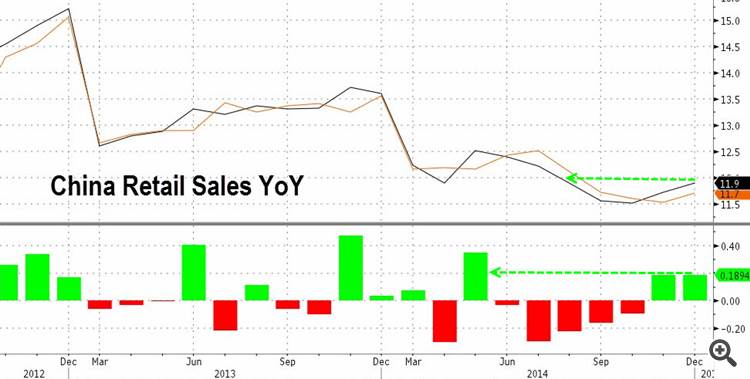
Chinese retail sales growth quickened unexpectedly in December, figures from the National Bureau of Statistics showed Tuesday.
Retail sales rose 11.9 percent year-over-year in December following the
11.7 percent rise in November. Economists had expected sales to increase
at the stable rate of 11.7 percent.
On a month-over-month basis, retail sales grew 1.01 percent in December after the 0.90 percent climb in November.
In the January to December period, sales advanced 12 percent over the corresponding period of the previous year.
NZD/USD drops despite strong N.Z. business confidence data(based on nasdaq article)
The New Zealand dollar dropped against its U.S.
counterpart on Tuesday, despite the release of strong business
confidence from New Zealand, as downbeat Chinese economic growth
data weighed.
NZD/USD hit 0.7709 during late Asian trade, the pair's lowest
since January 15; the pair subsequently consolidated at 0.7723,
declining 0.76%.
The pair was likely to find support at 0.7688, the low of
January 14 and resistance at 0.7810, Monday's high.
NZD/USD 0.7600 Support at Risk on Dismal 4Q New Zealand CPI(based on dailyfx article)
NZD Fails to Benefit From Global Dairy Auction; 4Q CPI to Slow for Second Straight Quarter
USD/CAD Pushes Fresh Monthly Highs Ahead of Bank of Canada (BoC) Meeting
NZD/USD shows a limited reaction to the 3.8% rise in
Whole Milk Power following the Global Dairy Trade auction; may face
additional headwinds over the next 24-hours of trade as the 4Q Consumer
Price Index (CPI) is expected to slow further.
As the Relative Strength Index (RSI) retains the
bearish momentum, downside targets remained favored with the monthly
opening low (0.7617) in focus.
A: The SNB (Swiss National Bank) made an announcement
that caused the CHF (Swiss Franc) to suddenly soar in value. The extent
and speed of the price rise had never happened before to a major global
currency, although there were similar incidents involving the CHF in
2011 and the GBP (British Pound) in 1992. The size and speed of the
change meant that most banks effectively stopped buying or selling the
CHF for several minutes, which had all kinds of bad effects (more on
that later).
Q. What was it exactly that the SNB announced?
A: The SNB announced that they were no longer going to support a cap
of the value in the CHF against the Euro. For more than 3 years, they
would intervene to make sure the CHF was worth no more than 1.2 Euros.
It is relatively easy for a central bank to keep their own currency
weak, but it was getting harder for them to do it, as the price kept
testing 1.20 and the Euro has been weakening dramatically over several
months. The SNB announcement took the market by surprise, as although
there was a logical risk this could happen, as recently as a few days
ago the SNB publicly declared that they had no intention of abandoning
the policy, which now can be seen to be a clear lie. By the way, the SNB
also announced a negative interest rate of 0.75%, meaning depositors
have to pay for the privilege of holding deposits in CHF. This would
usually tend to weaken a currency, at least in the short term.
Q: Why did the SNB Abandon the Cap?
A: There are different interpretations of the SNB’s action
so all explanations are controversial. They said that they no longer
feel the CHF is as overvalued as it was, so maybe they did not feel that
they had to hold the market back so much. However they have also said
that they did not expect the CHF to rise by 15% right away. A deeper
explanation would be that with the recent strong fall in the value of
the Euro, which is by far the currency most strongly linked by trade to
the CHF, it was becoming increasingly difficult and expensive for the
SNB to keep the CHF as weak as the Euro, so they acted to abandon a
position that was becoming untenable. Many have speculated that the SNB
were expecting the ECB (European Central Bank) to announce a program of
Quantitative Easing (QE) later this week, which might well push the
value of the Euro down even further, and at a rapid rate. If the cap had
still been in effect, they would probably have had to have spent a lot
of their reserves buying Euros with CHF.
Q: What will it mean for the price of the CHF going forward?
A: It is hard to say. Usually when the value of a currency moves
strongly up or down quite quickly by this kind of amount, it continues
to move in the same direction for a few more weeks or months at least.
However, there is some feeling that the move has gone far enough, and
that the SNB might act to cap the CHF again at the latest market price,
so it may not continue to increase. In any case, it is quite likely that
in the short-term, the CHF will swing up and down with high volatility.
Q: What will it mean for the prices of other currencies?
A: The move on Thursday seemed to cause some volatility in other
currencies, but that has gone at the time of writing, with nothing but
the CHF moving by very much. It could be argued that now that cash can
flow into the CHF, it might weaken the rise of the USD a little.
Q: Why did Forex traders and brokers lose so much money?
A: Usually, currencies fluctuate in value by very small amounts, far
less than stocks, for example. The Forex market is also usually
extremely liquid. This means that traders can place tight stop losses
and trade with high margin, in the knowledge that if their stop loss is
hit, they will usually not have to pay any slippage. Unfortunately in
this kind of case, the price blew right past almost every stop loss
without stopping, so traders and brokers could not execute any trade
exits until the price of all CHF pairs had moved by far more than 1,000
pips. This meant that instead of exiting at stop losses such as 50 pips
of loss, emergency exits had to be made at more than 1,000 pips or more.
With leverage, most traders in any kind of short CHF trade would have
had their entire deposits wiped out. In fact, many traders suffered
losses beyond that, and are now facing negative account balances, which
brokers may or may not be able or willing to chase. As for brokers
losing money, there are two reasons for this: some brokers hedge their
clients’ trades in the real market, where they also experienced the same
problems even more strongly than their own clients did, meaning they
could not pass on their clients’ losses. The second reason is that
anyone who was in a long CHF trade with a broker, would have made a lot
of money, and the balance of these trades may not have been covered by
the losses of the losers, as the losers would have mostly negative
account balances.
if actual > forecast (or actual data) = good for currency (for NZD in our case)
[NZD - CPI] = Change in the price of goods and services purchased by consumers. Consumer prices account for a majority of overall inflation. Inflation
is important to currency valuation because rising prices lead the
central bank to raise interest rates out of respect for their inflation
containment mandate.
Consumer prices in New Zealand eased 0.2 percent on quarter in the
fourth quarter of 2014, Statistics New Zealand said on Wednesday.
That missed expectations for a flat reading following three straight quarters of 0.3 percent gain.
"Lower
prices for petrol and vegetables were partly countered by higher prices
for international travel and housing-related costs," prices manager
Chris Pike said.
Petrol prices (down 5.7 percent) made the largest
downward contribution. Excluding petrol, inflation added 0.1 percent in
the quarter.
The average price of a liter of 91 octane petrol in
Q4 was NZ$2.00, compared with NZ$2.12 in the previous quarter. By the
end of the December quarter, petrol pump prices were 7 percent below the
average price for the quarter, and as at 16 January were 17 percent
below the average for the quarter.
Seasonally lower prices for
tomatoes, lettuce, and cucumber influenced the fall in vegetable prices
(down 14 percent) - which was a smaller-than-usual December quarter fall
following a mild winter. Vegetable prices are now slightly higher than a
year ago.
Prices for newly built houses excluding land climbed
1.7 percent overall, with Auckland up 2.8 percent and Canterbury up 1.7
percent. Housing rentals added 0.3 percent overall, with Canterbury up
0.9 percent.
NZD/USD rises off 2-week lows despite weak N.Z. inflation data(based on nasdaq article)
The New Zealand dollar rose against its U.S.
counterpart on Wednesday, pulling away from two-week lows despite
the release of disappointing New Zealand inflation data.
NZD/USD hit 0.7783 during late Asian trade, the session high;
the pair subsequently consolidated at 0.7667, gaining 0.35%.
The pair was likely to find support at 0.7620, Tuesday's low and
a two-week low and resistance at 0.7781, the high of January
14.
if actual < forecast (or actual data) = good for currency (for GBP in our case)
[GBP - Unemployment Rate] = Percentage of total work force that is unemployed and actively seeking employment during the past 3 months. Although it's generally viewed as a lagging indicator, the number of
unemployed people is an important signal of overall economic health
because consumer spending is highly correlated with labor-market
conditions. Unemployment is also a major consideration for those
steering the country's monetary policy.
==========
"Comparing September to November 2014 with June to August 2014, the
number of people in employment increased by 37,000 (to reach 30.80
million), the number of unemployed people fell by 58,000 (to reach 1.91
million) and the number of people not in the labour force (economically
inactive) aged from 16 to 64 increased by 66,000 (to reach 9.09
million)."
Allow the use of cookies to log in to the MQL5.com website.
Please enable the necessary setting in your browser, otherwise you will not be able to log in.
You are signed in. Two-factor authentication has been disabled. Set it up again and scan a new QR code, or continue with two-factor authentication disabled.
Trading Video: Monetary Policy Speculation Heats EURUSD Early this Week (based on dailyfx article)
Though the ECB rate decision is still days away and the Fed meeting is more than a week out, policy speculation is generating heavy seas in the FX market. Between the steady rise in capital market activity levels and an increase in the frequency of outlier events these past months, investors across asset classes are growing more sensitive to their exposure should sentiment suffer a more systemic collapse. Moving forward, the Euro, Dollar, risk theme and Chinese GDP are items to keep a close eye on. We discuss these tides' influence on the market in today's Trading Video.
if actual > forecast (or actual data) = good for currency (for NZD in our case)
[NZD - NZIER Business Confidence] = Level of a diffusion index based on surveyed manufacturers, builders, wholesalers, retailers, and service providers. It's a leading indicator of economic health - businesses react quickly to market conditions, and changes in their sentiment can be an early signal of future economic activity such as spending, hiring, and investment.
==========
Asian Session Forex Recap – Jan. 20, 2015
Today’s data dump from China led to a few good moves in the forex market, particularly among the commodity currencies. AUD/USD is down 0.40% and is trading below the .8200 handle while NZD/USD marked a 0.62% loss in the past few hours, even though the NZIER business confidence marked an improvement from 19 to 23.
As it turns out, the Chinese economy grew by 7.3% in Q4 2014, slightly higher than the projected 7.2% reading. However, this marked the slowest pace of growth since 1990 and is below the government’s 7.5% target GDP. The retail sales report also came in better than expected, as it logged in an annualized 11.9% increase for December, while the industrial production figure surprised to the upside with a 7.9% year-over-year gain.
It appears that other forex pairs were also unimpressed by these figures, as the higher-yielding currencies are looking weaker. GBP/USD is down 0.24%, USD/CAD is up 0.34%, and USD/JPY is up 0.63%.
Up ahead, the forex calendar suggests that all eyes could be on the euro pairs today, as the German and euro zone ZEW economic sentiment readings are up for release. The German ZEW is expected to climb from 34.9 to 40.1 this month while the euro zone ZEW could rise from 31.8 to 37.6, both reflecting an improvement in confidence. However, weaker than expected readings could lead to a short-term euro selloff so make sure you watch out for the actual release at 11:00 am GMT.
Weekend Edition with John O'Donnell (based on fxstreet article)
John and Merlin go over many significant market moving topics including: FXCM, Swiss National Bank, Global Currencies, Crude Oil, Bitcoin, Fiat Currencies, Bonds and Much more! Tune in and get your fix!
if actual > forecast (or actual data) = good for currency (for CNY in our case)
[CNY - Retail Sales] = Change in the total value of sales at the retail level. Tends to have a muted impact because the Chinese economy is not heavily reliant on consumer spending.

==========
China Dec Retail Sales Growth Quickens Unexpectedly
Chinese retail sales growth quickened unexpectedly in December, figures from the National Bureau of Statistics showed Tuesday.
Retail sales rose 11.9 percent year-over-year in December following the 11.7 percent rise in November. Economists had expected sales to increase at the stable rate of 11.7 percent.
On a month-over-month basis, retail sales grew 1.01 percent in December after the 0.90 percent climb in November.
In the January to December period, sales advanced 12 percent over the corresponding period of the previous year.
NZD/USD drops despite strong N.Z. business confidence data (based on nasdaq article)
The New Zealand dollar dropped against its U.S. counterpart on Tuesday, despite the release of strong business confidence from New Zealand, as downbeat Chinese economic growth data weighed.
NZD/USD hit 0.7709 during late Asian trade, the pair's lowest since January 15; the pair subsequently consolidated at 0.7723, declining 0.76%.
The pair was likely to find support at 0.7688, the low of January 14 and resistance at 0.7810, Monday's high.
NZD/USD 0.7600 Support at Risk on Dismal 4Q New Zealand CPI (based on dailyfx article)
Q & A About CHF (based on dailyforex article)
Q: What actually happened last Thursday?
A: The SNB (Swiss National Bank) made an announcement that caused the CHF (Swiss Franc) to suddenly soar in value. The extent and speed of the price rise had never happened before to a major global currency, although there were similar incidents involving the CHF in 2011 and the GBP (British Pound) in 1992. The size and speed of the change meant that most banks effectively stopped buying or selling the CHF for several minutes, which had all kinds of bad effects (more on that later).
Q. What was it exactly that the SNB announced?
A: The SNB announced that they were no longer going to support a cap of the value in the CHF against the Euro. For more than 3 years, they would intervene to make sure the CHF was worth no more than 1.2 Euros. It is relatively easy for a central bank to keep their own currency weak, but it was getting harder for them to do it, as the price kept testing 1.20 and the Euro has been weakening dramatically over several months. The SNB announcement took the market by surprise, as although there was a logical risk this could happen, as recently as a few days ago the SNB publicly declared that they had no intention of abandoning the policy, which now can be seen to be a clear lie. By the way, the SNB also announced a negative interest rate of 0.75%, meaning depositors have to pay for the privilege of holding deposits in CHF. This would usually tend to weaken a currency, at least in the short term.
Q: Why did the SNB Abandon the Cap?
A: There are different interpretations of the SNB’s action so all explanations are controversial. They said that they no longer feel the CHF is as overvalued as it was, so maybe they did not feel that they had to hold the market back so much. However they have also said that they did not expect the CHF to rise by 15% right away. A deeper explanation would be that with the recent strong fall in the value of the Euro, which is by far the currency most strongly linked by trade to the CHF, it was becoming increasingly difficult and expensive for the SNB to keep the CHF as weak as the Euro, so they acted to abandon a position that was becoming untenable. Many have speculated that the SNB were expecting the ECB (European Central Bank) to announce a program of Quantitative Easing (QE) later this week, which might well push the value of the Euro down even further, and at a rapid rate. If the cap had still been in effect, they would probably have had to have spent a lot of their reserves buying Euros with CHF.
Q: What will it mean for the price of the CHF going forward?
A: It is hard to say. Usually when the value of a currency moves strongly up or down quite quickly by this kind of amount, it continues to move in the same direction for a few more weeks or months at least. However, there is some feeling that the move has gone far enough, and that the SNB might act to cap the CHF again at the latest market price, so it may not continue to increase. In any case, it is quite likely that in the short-term, the CHF will swing up and down with high volatility.
Q: What will it mean for the prices of other currencies?
A: The move on Thursday seemed to cause some volatility in other currencies, but that has gone at the time of writing, with nothing but the CHF moving by very much. It could be argued that now that cash can flow into the CHF, it might weaken the rise of the USD a little.
Q: Why did Forex traders and brokers lose so much money?
A: Usually, currencies fluctuate in value by very small amounts, far less than stocks, for example. The Forex market is also usually extremely liquid. This means that traders can place tight stop losses and trade with high margin, in the knowledge that if their stop loss is hit, they will usually not have to pay any slippage. Unfortunately in this kind of case, the price blew right past almost every stop loss without stopping, so traders and brokers could not execute any trade exits until the price of all CHF pairs had moved by far more than 1,000 pips. This meant that instead of exiting at stop losses such as 50 pips of loss, emergency exits had to be made at more than 1,000 pips or more. With leverage, most traders in any kind of short CHF trade would have had their entire deposits wiped out. In fact, many traders suffered losses beyond that, and are now facing negative account balances, which brokers may or may not be able or willing to chase. As for brokers losing money, there are two reasons for this: some brokers hedge their clients’ trades in the real market, where they also experienced the same problems even more strongly than their own clients did, meaning they could not pass on their clients’ losses. The second reason is that anyone who was in a long CHF trade with a broker, would have made a lot of money, and the balance of these trades may not have been covered by the losses of the losers, as the losers would have mostly negative account balances.
if actual > forecast (or actual data) = good for currency (for NZD in our case)
[NZD - CPI] = Change in the price of goods and services purchased by consumers. Consumer prices account for a majority of overall inflation. Inflation is important to currency valuation because rising prices lead the central bank to raise interest rates out of respect for their inflation containment mandate.
==========
New Zealand Consumer Prices Dip 0.2% In Q4
Consumer prices in New Zealand eased 0.2 percent on quarter in the fourth quarter of 2014, Statistics New Zealand said on Wednesday.
That missed expectations for a flat reading following three straight quarters of 0.3 percent gain.
"Lower prices for petrol and vegetables were partly countered by higher prices for international travel and housing-related costs," prices manager Chris Pike said.
Petrol prices (down 5.7 percent) made the largest downward contribution. Excluding petrol, inflation added 0.1 percent in the quarter.
The average price of a liter of 91 octane petrol in Q4 was NZ$2.00, compared with NZ$2.12 in the previous quarter. By the end of the December quarter, petrol pump prices were 7 percent below the average price for the quarter, and as at 16 January were 17 percent below the average for the quarter.
Seasonally lower prices for tomatoes, lettuce, and cucumber influenced the fall in vegetable prices (down 14 percent) - which was a smaller-than-usual December quarter fall following a mild winter. Vegetable prices are now slightly higher than a year ago.
Prices for newly built houses excluding land climbed 1.7 percent overall, with Auckland up 2.8 percent and Canterbury up 1.7 percent. Housing rentals added 0.3 percent overall, with Canterbury up 0.9 percent.
NZD/USD rises off 2-week lows despite weak N.Z. inflation data (based on nasdaq article)
The New Zealand dollar rose against its U.S. counterpart on Wednesday, pulling away from two-week lows despite the release of disappointing New Zealand inflation data.
NZD/USD hit 0.7783 during late Asian trade, the session high; the pair subsequently consolidated at 0.7667, gaining 0.35%.
The pair was likely to find support at 0.7620, Tuesday's low and a two-week low and resistance at 0.7781, the high of January 14.
if actual < forecast (or actual data) = good for currency (for GBP in our case)
[GBP - Unemployment Rate] = Percentage of total work force that is unemployed and actively seeking employment during the past 3 months. Although it's generally viewed as a lagging indicator, the number of unemployed people is an important signal of overall economic health because consumer spending is highly correlated with labor-market conditions. Unemployment is also a major consideration for those steering the country's monetary policy.
==========
"Comparing September to November 2014 with June to August 2014, the number of people in employment increased by 37,000 (to reach 30.80 million), the number of unemployed people fell by 58,000 (to reach 1.91 million) and the number of people not in the labour force (economically inactive) aged from 16 to 64 increased by 66,000 (to reach 9.09 million)."