The euro pushed higher against the dollar on Friday, but remained within
striking distance of 14-month lows as the prospects of an early hike in
U.S. interest rates continued to underpin investor demand for the
greenback.
EUR/USD was up 0.33% to 1.2964 late Friday, holding above the 14-month trough of 1.2858 reached on Tuesday.
The pair was likely to find support at the 1.29 level and resistance at around 1.3015.
Expectations that the Federal Reserve is growing closer to raising
interest rates continued to support the dollar, with the European
Central Bank likely to stick to its looser monetary policy stance.
A study by the San Francisco Fed published on Monday indicated that
central bank officials see rates rising sooner than markets expect.
The Fed was expected to cut its asset purchase program by another $10
billion at its upcoming policy meeting next week which would keep it on
track for winding up the program in October, and to start raising
interest rates sometime in mid-2015.
Data on Friday showing that U.S. retail sales rose in August and another
report showing that consumer sentiment rose to a 14-month high in
September underlined the view that the economic recovery is deepening.
The single currency has remained under pressure since the ECB
unexpectedly cut rates to record lows on September 4 and unveiled new
easing measures in a bid to shore up inflation in the euro area.
The euro rose to two month highs against the weaker yen on Friday, with
EUR/JPY up 0.56% in late trade. For the week the pair gained 2.17%.
The yen fell to more than six year lows against the dollar on Friday amid expectations for more stimulus from the Bank of Japan.
BoJ Governor Haruhiko Kuroda said Thursday that the bank would be
prepared to immediately loosen monetary policy or implement other
measures if its 2% inflation target becomes difficult to meet.
In the week ahead, investors will be focusing on the outcome of
Wednesday’s Fed policy meeting. Fed Chair Janet Yellen was to hold a
press conference following the meeting. Tuesday’s report on the ZEW
German business sentiment index will also be closely watched.
Monday, September 15
In the euro zone, Germany’s Bundesbank is to publish its monthly report.
The U.S. is to release reports on manufacturing activity in the Empire State and industrial production.
Tuesday, September 16
The ZEW Institute is to release its closely watched report on German economic sentiment, a leading indicator of economic health.
The U.S. is to produce data on producer price inflation.
Wednesday, September 17
The euro zone is to release revised data on consumer price inflation.
The
U.S. is to produce data on consumer prices. Later Wednesday, the
Federal Reserve is to announce its federal funds rate and publish its
rate statement. Fed Chair Janet Yellen is to hold a press conference
following announcement.
Thursday, September 18
The U.S. is to produce a flurry of economic data,
including reports on initial jobless claims, building permits, housing
starts and manufacturing activity in the Philadelphia region.
if actual > forecast (or actual data) = good for currency (for USD in our case)
[USD - Industrial Production] = Change in the total inflation-adjusted value of output produced by manufacturers, mines, and utilities. It's a leading indicator of economic health - production reacts quickly
to ups and downs in the business cycle and is correlated with consumer
conditions such as employment levels and earnings.
With manufacturing output falling for the first time since January,
the Federal Reserve released a report on Monday showing that U.S.
industrial production unexpectedly decreased in the month of August.
The
report said industrial production edged down by 0.1 percent in August
after inching up by a downwardly revised 0.2 percent in July.
The
modest drop came as a surprise to economists, who had expected
production to climb by 0.3 percent compared to the 0.4 percent increase
originally reported for the previous month.
The unexpected drop in
industrial production came as manufacturing output fell by 0.4 percent
in August after rising by 0.7 percent in July.
The Fed noted that
the production of motor vehicles and parts tumbled by 7.6 percent in
August after jumping by more than 9 percent in July.
Meanwhile, the report also said mining output rose by 0.5 percent in August after dipping by 0.3 percent in the previous month.
Utilities
output also surged up by 1.0 percent in August after plunging by 2.7
percent and 2.0 percent in July and June, respectively.
if actual > forecast (or actual data) = good for currency (for EUR in our case)
[EUR - German ZEW Economic Sentiment] = Level of a diffusion index based on surveyed German institutional investors and analysts. It's a leading indicator of economic health - investors and analysts are
highly informed by virtue of their job, and changes in their sentiment
can be an early signal of future economic activity
Germany's investor confidence weakened less-than-expected in
September, reports said Tuesday citing data from the Centre for European
Economic Research/ZEW.
The ZEW economic sentiment index fell to
6.9, which was above economists' forecast for a score of 5. In August,
the index reading was 8.6.
The current conditions index of the
survey, meanwhile, tumbled to 25.4, which was well below the consensus
expectation of 40. In August, the reading was 44.3.
The Eurozone economic sentiment index of the survey eased to 14.2 in September. In August, the reading was 23.7.
EURUSD Technical Analysis: Short at 1.3644(based on dailyfx article)
EURUSD Technical Strategy: Short at 1.3644
Support: 1.2864, 1.2794, 1.2708
Resistance:1.2981, 1.3057, 1.3104
A daily close above the 14.6% Fibonacci retracementat
1.2981 exposes the 23.6% level at 1.3057. Alternatively, a turn below
the 50% Fib expansion at 1.2864 opens the door for a test of the 61.8%
threshold at 1.2794.
Trading the News: Federal Open Market Committee (FOMC) Interest Rate Decision(based on dailyfx article)
Federal Open Market Committee (FOMC) Widely Expected to Deliver Another $10B Taper
Will There Be a Larger Dissent as the Fed Looks to End QE in October?
The Federal Open Market Committee (FOMC) interest rate decision may spur
a bearish reaction in the dollar (bullish EUR/USD) if the central bank
remains reluctant to move away from the zero-interest rate policy
(ZIRP).
What’s Expected:
Why Is This Event Important:
Even though the Fed is widely expected to conclude its asset-purchase
program at the October 29 meeting, we would need a more hawkish twist to
the forward-guidance for monetary policy to favor further USD strength.
The dollar may come under pressure should we get more of the same from
the Fed, and the greenback may face a larger correction over the
remainder of the month should Chair Janet Yellen see greater scope to
retain the highly accommodative policy stance for an extended period of
time.
Nevertheless, sticky inflation paired with the uptick in wage growth may
spur a greater dissent within the committee and push the FOMC to lay
out a more detailed exit strategy as the central bank looks to move away
from its easing cycle.
How To Trade This Event Risk
Bearish USD Trade: FOMC Remains Reluctant to Normalize Monetary Policy
Need green, five-minute candle following the policy statement to consider a long EUR/USD position
If market reaction favors a bearish dollar trade, buy EUR/USD with two separate position
Set stop at the near-by swing low/reasonable distance from cost; at least 1:1 risk-to-reward
Move stop to entry on remaining position once initial target is met, set reasonable limit
Need red, five-minute candle to favor a short EUR/USD trade
Implement same strategy as the bearish dollar trade, just in the opposite direction
Potential Price Targets For The Release EUR/USD Daily
Risks Larger Topside Correction as the Relative Strength Index (RSI) Threatens Bearish Momentum
Interim Resistance: 1.2990 (23.6% retracement) to 1.3025 (23.6% expansion)
Interim Support: 1.2858 (Monthly low) to 1.2870 (50.% expansion)
Impact that the FOMC rate decision has had on EUR/USD during the last meeting
Period
Data Released
Estimate
Actual
Pips Change
(1 Hour post event )
Pips Change
(End of Day post event)
JUL 2014
07/30/2014 18:00 GMT
0.25%
0.25%
+14
+20
July 2014 Federal Open Market Committee (FOMC) Interest Rate Decision EURUSD M5 : 32 pips price movement by USD - Federal Funds Rate news event:
The Federal Open Market Committee (FOMC) voted to reduce its
asset-purchase pace to $25B from $35B in July amid the sharp economic
rebound in the second quarter. However, the Fed also highlighted the
significant underutilization of labor resources and reiterated that it
is appropriate to maintain the current fed fund rate for a considerable
period of time even after the quantitative easing program ends. The
Fed’s dovish tone dragged on the greenback, with EUR/USD climbing above
1.3400, but we saw limited follow-through behind the initial reaction as
the pair ended the day at 1.3395.
if actual > forecast (or actual data) = good for currency (for USD in our case)
[USD - CPI] = Change in the price of goods and services purchased by consumers. Consumer prices account for a majority of overall inflation. Inflation
is important to currency valuation because rising prices lead the
central bank to raise interest rates out of respect for their inflation
containment mandate.
With a substantial decrease in energy prices more than offsetting
higher prices for food and shelter, the Labor Department released a
report on Wednesday showing an unexpected drop in U.S. consumer prices
in the month of August.
The Labor Department said its consumer
price index dipped by 0.2 percent in August after inching up by 0.1
percent in July. The modest drop came as a surprise to economists, who
had expected consumer prices to come in unchanged.
A former Broker at FXCM, David Warner is now teaching Forex
classes for Online Trading Academy. Coming from a traditional investment
background, David shares some of the major things he has learned over
the years with Power Trading Radio listeners. Later Merlin and
David take a look at a couple currency pairs for potential trading
opportunities and suggestions on how to trade economic data releases.
EUR/USD Vulnerable to Hawkish Fed- Outlook May Hinge on T-LTRO(based on dailyfx yotube channel)
The EUR/USD may look beyond the FOMC policy meeting to break out of the rate as the ECB implements the targeted long-term refinancing operation (T-LTRO).
[EUR - Targeted LTRO] = Total value of money the ECB will create and use to loan to Eurozone banks. It provides liquidity to banks which usually leads to lower long-term interest rates and stimulates growth.
The Euro may correct higher against the US Dollar
after forming a bullish Piercing Line candle pattern coupled with
positive RSI divergence. A daily close above trend line resistance at
1.2951 exposes the September 16 high at 1.2994. Alternatively, reversal
below above the 1.2858-71 area marked by the September 9 low and the
14.6% Fibonacci expansion opens the door for a test of the 23.6% level
at 1.2796.
G20 Meetings, Mario Draghi’s speech, German Ifo Business
Climate, US New Home Sales, US Durable Goods Orders, US Unemployment
Claims are the main highlights this week. Here is an outlook on the
major events coming our way.
Last week Scotland voted NO on independence from the UK in the
historic referendum. The NO campaign’s victory was more decisive than
the opinion polls had suggested, leaving the 307-year union in place.
UK’s Prime Minister David Cameron acknowledged the Scots’ demand to
have more power in the UK legislation and form a new constitutional
settlement for the entire UK. Markets reacted with relief, bank shares
climbed sharply after the market opened. Sterling initially gained in
reaction to the result, rising 0.3 % higher to $1.6442, but later fell
back against the dollar. Will the UK economy speed up growth in the
coming months?
G20 Meetings: Sat-Sun. Finance
ministers from the G20 countries gathered in Australia to discuss
measures to improve economic growth in the Eurozone by an additional
two per cent by 2018. Measures to fight black money and tax avoidance
were also discussed in this forum. Last week’s meeting resolutions will
initiate the next meeting at Brisbane in November.
Mario Draghi speaks: Monday,
13:00. ECB President Mario Draghi is scheduled to testify before the
European Parliament’s Economic and Monetary Committee, in Brussels.
Draghi may talk about the need for investments alongside Governmental
aid. Volatility is expected.
German Ifo Business Climate:
Wednesday, 8:00. German business sentiment declined for a fourth
straight month in August down to 106.3 from 108 in July, amid concerns
about the Ukraine crisis and the impact of sanctions imposed by the
Eurozone against Russia. The value of German shipments to Russia
plunged 15.5% to 15.3 billion euros in the first six months of the
year, with major declines in car and machinery shipments. Exports also
fell due to smaller orders from Russia. Economists expected a higher
reading of 107.1. The lukewarm growth in the Euro area also contributed
to the decline in German business sentiment. Another drop to 105.9 is
expected now.
US New Home Sales: Wednesday,
14:00. Sales of new single-family homes declined for a second straight
month in July to a seasonally adjusted annual rate of 412,000, from
422,000 posted in the previous month. Nevertheless, the housing market
is on a growth trend. Larger stock of properties and tame prices will
help boost demand in the coming months. New homes sales data is
considered volatile, despite the decline new home sales were up 12.3
from July last year. Sales of new single-family homes is expected to
rise to 432,000.
US Core Durable Goods Orders: Thursday,
12:30. U.S. durable goods orders surged in July by a seasonally
adjusted 22.6%, after a revised gain of 2.7% in the previous month
while core orders declined unexpectedly by 0.7% following a 1.9%
increase in June. The mixed data confused markets. Commercial aircraft
orders hit the roof with a 318% increase, after Boeing signed a record
number of contracts for new jetliners in July. Cars and trucks sales
went up 10.2%. However, core durable goods orders, excluding volatile
transportation items, missing forecasts for a 0.5% gain. Core durable
goods orders rose by 3% in June. U.S. durable goods orders is expected
to plunge 17.7% while Core orders are predicted to rise 0.7%.
US Unemployment Claims: Thursday, 12:30.
The number of Americans filing initial claims for unemployment
benefits plunged unexpectedly last week to 280,000 from 316,000 in the
prior week, indicating the lukewarm figures in August were a temporary
relapse. Economists expected a small decline to 312,000. US economy
has broad-based growth including the housing sector. The number of
layoffs continue to fall. The four-week moving average declined by
4,750 to 299,500. The number of jobless claims is expected to reach
294,000 this week.
The euro pushed higher against the dollar on Friday, but remained within striking distance of 14-month lows as the prospects of an early hike in U.S. interest rates continued to underpin investor demand for the greenback.
EUR/USD was up 0.33% to 1.2964 late Friday, holding above the 14-month trough of 1.2858 reached on Tuesday.
The pair was likely to find support at the 1.29 level and resistance at around 1.3015.
Expectations that the Federal Reserve is growing closer to raising interest rates continued to support the dollar, with the European Central Bank likely to stick to its looser monetary policy stance.
A study by the San Francisco Fed published on Monday indicated that central bank officials see rates rising sooner than markets expect.
The Fed was expected to cut its asset purchase program by another $10 billion at its upcoming policy meeting next week which would keep it on track for winding up the program in October, and to start raising interest rates sometime in mid-2015.
Data on Friday showing that U.S. retail sales rose in August and another report showing that consumer sentiment rose to a 14-month high in September underlined the view that the economic recovery is deepening.
The single currency has remained under pressure since the ECB unexpectedly cut rates to record lows on September 4 and unveiled new easing measures in a bid to shore up inflation in the euro area.
The euro rose to two month highs against the weaker yen on Friday, with EUR/JPY up 0.56% in late trade. For the week the pair gained 2.17%.
The yen fell to more than six year lows against the dollar on Friday amid expectations for more stimulus from the Bank of Japan.
BoJ Governor Haruhiko Kuroda said Thursday that the bank would be prepared to immediately loosen monetary policy or implement other measures if its 2% inflation target becomes difficult to meet.
In the week ahead, investors will be focusing on the outcome of Wednesday’s Fed policy meeting. Fed Chair Janet Yellen was to hold a press conference following the meeting. Tuesday’s report on the ZEW German business sentiment index will also be closely watched.
Monday, September 15
- In the euro zone, Germany’s Bundesbank is to publish its monthly report.
- The U.S. is to release reports on manufacturing activity in the Empire State and industrial production.
Tuesday, September 16- The ZEW Institute is to release its closely watched report on German economic sentiment, a leading indicator of economic health.
- The U.S. is to produce data on producer price inflation.
Wednesday, September 17- The euro zone is to release revised data on consumer price inflation.
- The
U.S. is to produce data on consumer prices. Later Wednesday, the
Federal Reserve is to announce its federal funds rate and publish its
rate statement. Fed Chair Janet Yellen is to hold a press conference
following announcement.
Thursday, September 18if actual > forecast (or actual data) = good for currency (for USD in our case)
[USD - Industrial Production] = Change in the total inflation-adjusted value of output produced by manufacturers, mines, and utilities. It's a leading indicator of economic health - production reacts quickly to ups and downs in the business cycle and is correlated with consumer conditions such as employment levels and earnings.
==========
U.S. Industrial Production Unexpectedly Edges Down 0.1% In August
With manufacturing output falling for the first time since January, the Federal Reserve released a report on Monday showing that U.S. industrial production unexpectedly decreased in the month of August.
The report said industrial production edged down by 0.1 percent in August after inching up by a downwardly revised 0.2 percent in July.
The modest drop came as a surprise to economists, who had expected production to climb by 0.3 percent compared to the 0.4 percent increase originally reported for the previous month.
The unexpected drop in industrial production came as manufacturing output fell by 0.4 percent in August after rising by 0.7 percent in July.
The Fed noted that the production of motor vehicles and parts tumbled by 7.6 percent in August after jumping by more than 9 percent in July.
Meanwhile, the report also said mining output rose by 0.5 percent in August after dipping by 0.3 percent in the previous month.
Utilities output also surged up by 1.0 percent in August after plunging by 2.7 percent and 2.0 percent in July and June, respectively.
if actual > forecast (or actual data) = good for currency (for EUR in our case)
[EUR - German ZEW Economic Sentiment] = Level of a diffusion index based on surveyed German institutional investors and analysts. It's a leading indicator of economic health - investors and analysts are highly informed by virtue of their job, and changes in their sentiment can be an early signal of future economic activity
==========
German ZEW Investor Confidence Eases Less Than Expected
Germany's investor confidence weakened less-than-expected in September, reports said Tuesday citing data from the Centre for European Economic Research/ZEW.
The ZEW economic sentiment index fell to 6.9, which was above economists' forecast for a score of 5. In August, the index reading was 8.6.
The current conditions index of the survey, meanwhile, tumbled to 25.4, which was well below the consensus expectation of 40. In August, the reading was 44.3.
The Eurozone economic sentiment index of the survey eased to 14.2 in September. In August, the reading was 23.7.
EURUSD Technical Analysis: Short at 1.3644 (based on dailyfx article)
A daily close above the 14.6% Fibonacci retracementat 1.2981 exposes the 23.6% level at 1.3057. Alternatively, a turn below the 50% Fib expansion at 1.2864 opens the door for a test of the 61.8% threshold at 1.2794.
Trading the News: Federal Open Market Committee (FOMC) Interest Rate Decision (based on dailyfx article)
The Federal Open Market Committee (FOMC) interest rate decision may spur a bearish reaction in the dollar (bullish EUR/USD) if the central bank remains reluctant to move away from the zero-interest rate policy (ZIRP).
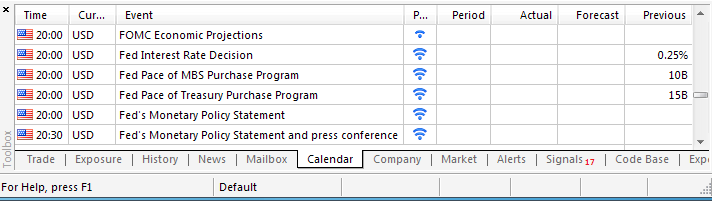
What’s Expected:
Why Is This Event Important:
Even though the Fed is widely expected to conclude its asset-purchase program at the October 29 meeting, we would need a more hawkish twist to the forward-guidance for monetary policy to favor further USD strength.
The dollar may come under pressure should we get more of the same from the Fed, and the greenback may face a larger correction over the remainder of the month should Chair Janet Yellen see greater scope to retain the highly accommodative policy stance for an extended period of time.
Nevertheless, sticky inflation paired with the uptick in wage growth may spur a greater dissent within the committee and push the FOMC to lay out a more detailed exit strategy as the central bank looks to move away from its easing cycle.
How To Trade This Event Risk
Bearish USD Trade: FOMC Remains Reluctant to Normalize Monetary Policy
- Need green, five-minute candle following the policy statement to consider a long EUR/USD position
- If market reaction favors a bearish dollar trade, buy EUR/USD with two separate position
- Set stop at the near-by swing low/reasonable distance from cost; at least 1:1 risk-to-reward
- Move stop to entry on remaining position once initial target is met, set reasonable limit
Bullish USD Trade: Policy Statement Shows Larger Dissent & Shift Away from ZIRP- Need red, five-minute candle to favor a short EUR/USD trade
- Implement same strategy as the bearish dollar trade, just in the opposite direction
Potential Price Targets For The ReleaseEUR/USD Daily
- Risks Larger Topside Correction as the Relative Strength Index (RSI) Threatens Bearish Momentum
- Interim Resistance: 1.2990 (23.6% retracement) to 1.3025 (23.6% expansion)
- Interim Support: 1.2858 (Monthly low) to 1.2870 (50.% expansion)
Impact that the FOMC rate decision has had on EUR/USD during the last meeting(1 Hour post event )
(End of Day post event)
EURUSD M5 : 32 pips price movement by USD - Federal Funds Rate news event:
The Federal Open Market Committee (FOMC) voted to reduce its asset-purchase pace to $25B from $35B in July amid the sharp economic rebound in the second quarter. However, the Fed also highlighted the significant underutilization of labor resources and reiterated that it is appropriate to maintain the current fed fund rate for a considerable period of time even after the quantitative easing program ends. The Fed’s dovish tone dragged on the greenback, with EUR/USD climbing above 1.3400, but we saw limited follow-through behind the initial reaction as the pair ended the day at 1.3395.
if actual > forecast (or actual data) = good for currency (for USD in our case)
[USD - CPI] = Change in the price of goods and services purchased by consumers. Consumer prices account for a majority of overall inflation. Inflation is important to currency valuation because rising prices lead the central bank to raise interest rates out of respect for their inflation containment mandate.
==========U.S. Consumer Prices Unexpectedly Show Modest Drop In August
With a substantial decrease in energy prices more than offsetting higher prices for food and shelter, the Labor Department released a report on Wednesday showing an unexpected drop in U.S. consumer prices in the month of August.
The Labor Department said its consumer price index dipped by 0.2 percent in August after inching up by 0.1 percent in July. The modest drop came as a surprise to economists, who had expected consumer prices to come in unchanged.
AUDIO - Currencies with David Warner
A former Broker at FXCM, David Warner is now teaching Forex classes for Online Trading Academy. Coming from a traditional investment background, David shares some of the major things he has learned over the years with Power Trading Radio listeners. Later Merlin and David take a look at a couple currency pairs for potential trading opportunities and suggestions on how to trade economic data releases.

EUR/USD Vulnerable to Hawkish Fed- Outlook May Hinge on T-LTRO (based on dailyfx yotube channel)
The EUR/USD may look beyond the FOMC policy meeting to break out of the rate as the ECB implements the targeted long-term refinancing operation (T-LTRO).
=============
2014-09-18 09:15 GMT (or 11:15 MQ MT5 time) | [EUR - Targeted LTRO]
[EUR - Targeted LTRO] = Total value of money the ECB will create and use to loan to Eurozone banks. It provides liquidity to banks which usually leads to lower long-term interest rates and stimulates growth.
LTRO = Long Term Refinancing Option
==========MetaTrader Trading Platform Screenshots
EURUSD, M5, 2014.09.18
MetaQuotes Software Corp., MetaTrader 5, Demo
EURUSD Technical Analysis (based on dailyfx article)
The Euro may correct higher against the US Dollar after forming a bullish Piercing Line candle pattern coupled with positive RSI divergence. A daily close above trend line resistance at 1.2951 exposes the September 16 high at 1.2994. Alternatively, reversal below above the 1.2858-71 area marked by the September 9 low and the 14.6% Fibonacci expansion opens the door for a test of the 23.6% level at 1.2796.
G20 Meetings, Mario Draghi’s speech, German Ifo Business Climate, US New Home Sales, US Durable Goods Orders, US Unemployment Claims are the main highlights this week. Here is an outlook on the major events coming our way.
Last week Scotland voted NO on independence from the UK in the historic referendum. The NO campaign’s victory was more decisive than the opinion polls had suggested, leaving the 307-year union in place. UK’s Prime Minister David Cameron acknowledged the Scots’ demand to have more power in the UK legislation and form a new constitutional settlement for the entire UK. Markets reacted with relief, bank shares climbed sharply after the market opened. Sterling initially gained in reaction to the result, rising 0.3 % higher to $1.6442, but later fell back against the dollar. Will the UK economy speed up growth in the coming months?