
Product link:
https://www.mql5.com/en/ market/product/191385
A single trade is missed. The cause may be ordinary: a brief connection interruption, a trading restriction, insufficient margin, an unavailable symbol, or an execution problem.
The condition disappears. The copier resumes operating. The next trade is copied successfully, followed by the next one. Everything appears to be working normally again.
But the missed trade has not been restored.
The Sender and Receiver have experienced different trading histories. Even if every subsequent trade is copied correctly, the two accounts may no longer have the same positions, balance, equity, or exposure.
This is one of the most important characteristics of trade copying to understand: recovering the connection does not automatically recover the trading activity that was missed.
1. A Missed Trade Is More Than a Missed Opportunity
It is tempting to think of a missed trade simply as a lost opportunity.
If the Sender opens a position and the Receiver does not, the Receiver misses whatever profit or loss that position eventually produces.
But the consequences can extend beyond the result of that individual trade.
The two accounts may now have different balances, equity levels, open positions, and available margin. If subsequent position sizes are calculated using account balances, the difference may also influence future copied volumes.
The important distinction is that a missed trade can change the relationship between the accounts, not just the profit or loss associated with one position.
Whether this difference grows, shrinks, or remains relatively stable depends on what happens next.
2. How a Missed Winning Trade Can Affect Future Position Sizes
Consider a simple example.
- Sender balance before the trade: $10,000
- Receiver balance before the trade: $1,000
- Original balance relationship: 1:10
The Sender opens a position that eventually produces a $400 profit.
The Receiver misses the trade.
After the Sender closes the position, the balances become:
- Sender: $10,400
- Receiver: $1,000
The original 1:10 balance relationship no longer exists. The new relationship is approximately 1:10.4.
If the copier uses live balance-ratio scaling, subsequent Receiver volumes may be smaller than they would have been if the winning trade had also been copied.
This is a possible secondary consequence of the missed trade.
However, it is important not to confuse a changed ratio with guaranteed compounding losses. The actual effect depends on subsequent trading results, position-sizing rules, and any other account changes.
3. A Missed Losing Trade Can Produce the Opposite Effect
Now consider the opposite situation.
The Sender opens a trade that eventually loses $300, but the Receiver does not copy it.
After the trade closes:
- The Sender's balance is lower.
- The Receiver's balance remains unchanged by that trade.
The Receiver is now ahead of the Sender in relative balance terms, assuming no other account changes.
With balance-ratio scaling, the Receiver's calculated volume for subsequent trades may become larger relative to the Sender's volume.
This can increase the Receiver's exposure compared with the original sizing relationship.
At first glance, missing a losing trade may appear beneficial. But the resulting difference in account balances can influence later position sizing in ways the Receiver did not deliberately choose.
A missed loss and a missed profit can therefore have opposite effects on the balance relationship, but neither should be treated as automatically good or bad without considering the subsequent trading sequence.
4. The Sequence of Missed Trades Matters
Imagine that the Sender completes seven trades:
- Six losing trades.
- One winning trade.
The Receiver successfully copies all six losing trades but misses the winning trade.
The Receiver's result can be substantially worse than the Sender's, even though the copier successfully handled most of the trading activity.
Now reverse the situation. The Receiver copies the winning trade but misses several losing trades.
The Receiver may perform better than the Sender over that period.
This demonstrates why the number of missed trades alone is not enough to evaluate copying quality.
Ten missed trades do not necessarily have the same impact as ten other missed trades. Their direction, size, timing, and eventual results matter.
A useful reconciliation should therefore identify not only which trades were missed, but also their actual outcomes and their effect on subsequent account exposure.
5. The Missed Close: A Different and Potentially More Urgent Problem
Missing an opening trade and missing a closing instruction are not the same problem.
Suppose the Sender opens a position and the Receiver copies it successfully.
Later, the Sender closes the position, but the Receiver does not process the closing action.
The accounts now have different exposure:
- The Sender no longer has the position.
- The Receiver still has an open position.
The Receiver is now exposed to market movements that no longer affect the Sender through that trade.
If the market moves against the Receiver's remaining position, the Receiver may incur an additional loss. If it moves in the Receiver's favor, the Receiver may gain independently of the Sender.
Either way, the original copying relationship has been interrupted.
This situation deserves prompt attention because an unintended open position can continue accumulating market risk, swap charges, and other costs.
A Receiver should not assume that a successfully restored connection will automatically close every position whose closing instruction was missed. The actual recovery behavior depends on the copier's reconciliation and recovery mechanisms.
6. Why a Delayed Retry Is Not Always a Good Solution
Retry mechanisms can be useful when an order fails because of a temporary connection or execution problem.
However, retrying an order after a delay introduces another consideration: the market price may have changed significantly.
Imagine that the Sender opens a buy position at 1.1000, but the Receiver cannot execute the corresponding order because its terminal is temporarily disconnected.
When the connection returns, the market is trading at 1.1040.
If the original order is submitted at the new price, the Receiver does not have the same entry as the Sender.
The difference may affect:
- The distance to the original stop-loss.
- The potential reward relative to the remaining target.
- The Receiver's immediate floating profit or loss.
- The risk of entering after most of the intended market movement has already occurred.
A delayed retry may therefore restore the existence of a position without restoring the original trading opportunity.
A robust copying design should distinguish between a short execution interruption that can be safely recovered and a delayed order whose original market context has disappeared.
Whether a particular copier supports retry queues, expiration rules, or price-deviation controls must be verified from its actual features and configuration. These capabilities should never be assumed.
7. Filters Can Deliberately Create Differences Between Accounts
Not every trade that fails to appear on the Receiver is the result of a technical failure.
Some differences are created by deliberate restrictions or account conditions.
Examples include:
- Spread restrictions: An order may be rejected or restricted when the available spread exceeds an allowed threshold, if such a filter is configured.
- Trading-session restrictions: A trading system may be configured to operate only during selected hours.
- Symbol availability: The Receiver's broker may use a different symbol name or may not offer the required instrument.
- Margin limitations: The Receiver may not have sufficient free margin to open the position.
- Volume restrictions: The calculated volume may not satisfy the broker's minimum, maximum, or volume-step requirements.
- Account configuration: The Receiver may intentionally use different trading conditions or restrictions from the Sender.
These situations should be classified correctly.
A trade rejected because the Receiver intentionally applies a safety restriction is different from a trade that should have been copied but was missed because of an unexpected technical failure.
Both can create differences between the accounts, but they require different responses.
8. Why the Dashboard Is Not Enough
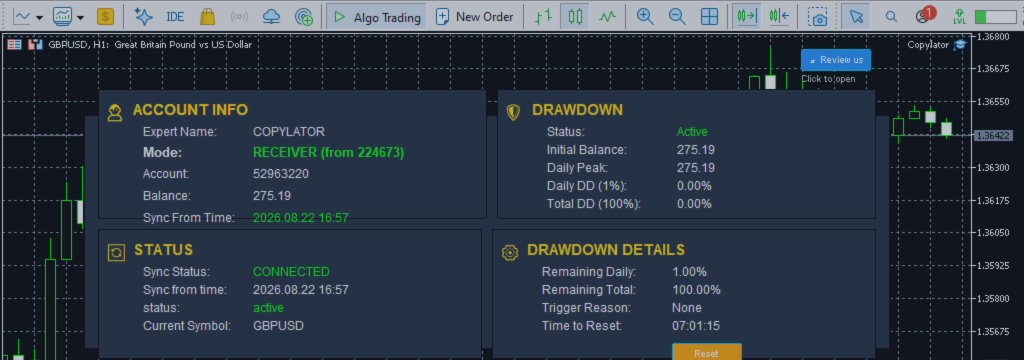
A copier dashboard can show that the system is connected and processing new trading activity.
That is useful, but it does not necessarily prove that every historical Sender action has a corresponding Receiver action.
A connection can be restored while an earlier trade remains uncopied. New trades can execute successfully while an old Receiver position remains unmatched.
For this reason, monitoring should include more than the current connection status.
A complete review should consider:
- Whether new Sender positions are being copied.
- Whether Sender modifications are reflected on the Receiver.
- Whether closing actions are processed correctly.
- Whether unexpected Receiver positions remain open.
- Whether there are rejected or unprocessed orders in the logs.
- Whether the two accounts' trade histories can be reconciled.
The dashboard tells you something about the current operating state. Reconciliation tells you whether the actual trading records correspond.
9. How to Reconcile Sender and Receiver Histories
Reconciliation is the process of comparing the Sender's trading activity with the Receiver's records to identify differences.
A practical review can follow these steps:
- Export the Sender's trading history for the period being examined.
- Export the Receiver's trading history for the same period.
- Identify corresponding trades using the available references, such as copier identifiers, original trade references, comments, timestamps, symbols, and trade direction.
- Identify Sender trades with no corresponding Receiver opening.
- Identify Receiver positions that do not have an expected Sender counterpart.
- Compare opening and closing actions, including partial closes and modifications.
- Investigate the copier logs and account conditions for each discrepancy.
Do not rely exclusively on ticket numbers or comments unless the copier's identification method is known and the relevant references are preserved correctly. Sender and Receiver tickets are not necessarily identical, and broker-side comment handling can vary.
Also distinguish between a deliberately rejected trade and an accidental failure. A complete reconciliation should explain why each difference occurred.
10. Measure the Impact, Not Just the Number of Misses
Counting missed trades is a useful starting point, but it is not a complete measure of copying quality.
Consider recording the following information:
- Missed openings: How many Sender positions were not opened on the Receiver?
- Missed closes: How many Sender closing actions were not reflected on the Receiver?
- Delayed executions: How many copied trades opened significantly later than the Sender's trades?
- Volume differences: How often did the Receiver's volume differ from the expected calculated volume?
- Price differences: How much did the Receiver's entry or exit price differ from the Sender's?
- Reason for each discrepancy: Was it a connection problem, broker restriction, configuration rule, insufficient margin, or another cause?
- Financial impact: What would the difference have meant for the Receiver's account?
This approach provides a more useful picture than a single percentage showing how many trades were copied.
For example, missing one large winning trade may have a much greater financial impact than missing several very small trades. A missed close can also be more urgent than a missed opening because it may leave unintended market exposure.
11. How to Reduce Unnecessary Missed Trades
Several operational practices can reduce avoidable differences between Sender and Receiver accounts.
Verify the Connection
Keep both trading terminals operational and monitor connection interruptions. A brief disconnection should be investigated, particularly if it occurs during active trading periods.
Check Symbol Mapping
Different brokers may use different names for the same instrument. Verify that the required Sender symbols are correctly mapped to the Receiver's available symbols.
Review Margin Availability
Make sure the Receiver has sufficient free margin for the expected positions. A Receiver with insufficient margin cannot be expected to reproduce every Sender trade.
Test Broker Volume Requirements
Minimum lot sizes, maximum volumes, and volume steps can differ between brokers. Confirm that the selected lot-sizing method produces volumes that the Receiver's broker accepts.
Understand Your Restrictions
Filters and trading restrictions should be configured deliberately. A very restrictive setting may reduce unwanted execution, but it can also cause the Receiver's history to differ substantially from the Sender's.
Review Logs After Interruptions
After a connection problem or unexpected execution failure, check the logs and open positions rather than assuming that normal operation has resumed completely.
12. Not Every Difference Should Be Eliminated
There is an important distinction between copying every possible trade and copying trades under a defined set of risk controls.
For example, a Receiver may deliberately avoid an order during an extreme spread expansion. That decision can protect the Receiver from unfavorable execution conditions.
The resulting difference from the Sender is a consequence of the Receiver's chosen restriction.
Trying to eliminate every missed trade by removing all restrictions would not necessarily improve the Receiver's risk profile.
The objective should be to minimize unintended copying failures while preserving deliberate risk controls.
A good configuration is not one that copies every order regardless of conditions. It is one where the Receiver understands which differences are intentional and can identify those that are accidental.
13. The First Month: Establish a Reliable Baseline
The first month of a new copying arrangement is a useful period for evaluating actual behavior.
Instead of judging the setup only by profitability, examine its operational consistency.
Record:
- The number of Sender trades.
- The number of corresponding Receiver trades.
- Any missed or rejected openings.
- Any closing or modification discrepancies.
- Execution delays and price differences.
- Differences in calculated and executed lot sizes.
- The reasons for each identified problem.
This baseline helps determine whether the setup is operating as expected under real broker and market conditions.
If discrepancies appear, investigate them before increasing capital or relying on the arrangement for a larger number of accounts.
14. Summary: Restoring the Connection Does Not Restore the Trade
A missed trade is not automatically recovered when the copier reconnects and begins processing new orders again.
The Sender and Receiver may have different trading histories, account balances, open positions, and future position-sizing calculations.
- A missed winning trade can leave the Receiver behind the Sender.
- A missed losing trade can leave the Receiver ahead of the Sender.
- With balance-ratio scaling, these differences can influence subsequent position sizes.
- A missed closing action can leave an unintended Receiver position exposed to the market.
- A delayed retry may create a position at a significantly different price.
- Deliberate filters and accidental technical failures should be investigated separately.
- Reconciliation is necessary to understand the actual differences between the two accounts.
The most important lesson is that a successful connection does not prove that every trade was copied correctly.
Monitor the system, review its logs, compare the trading histories, and investigate discrepancies before they become larger operational or financial problems.
A trade that was missed cannot simply be assumed to return. The only way to understand its impact is to identify what happened, determine why it happened, and evaluate how it changed the Receiver's account.
Product link:
https://www.mql5.com/en/ market/product/191385


