【+11,034 USD】From a Stalling Dollar Rally to Yen Strength: Can USD/JPY Recover the 159s After U.S. PCE?

November 16–20, 2026
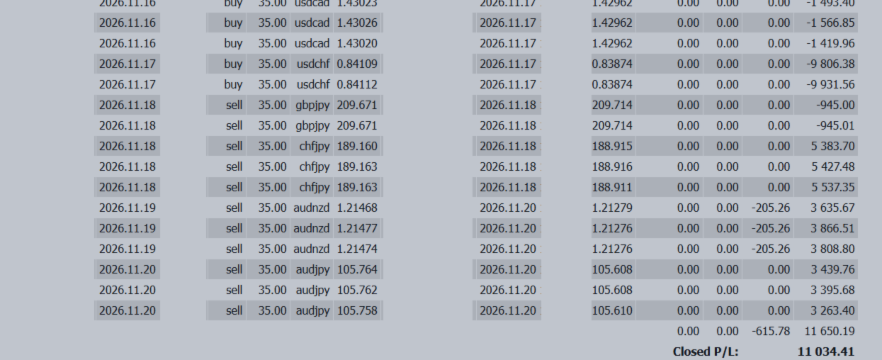
Weekly P&L: +11,034 USD
A midweek shift in where profits were made
This was a week of shifting the focus of our trades.
Early in the week, long positions in USD/CAD and USD/CHF lost money. Later, short positions in CHF/JPY, AUD/NZD, and AUD/JPY contributed to profits, bringing the week to a close at +11,034 USD.
Simply staying with the dollar longs that had worked through the previous week made it difficult to add to profits. In the second half of the week, concerns about equity markets intensified, and buying spread to the yen.
USD/JPY also stalled just below 160 and fell to 158.42 by the end of the week, closing at 158.57. With U.S. yields declining, expectations of further rate hikes alone were not enough to support the pair.
FX Strategy Update | November 23–27
Focus on price action through Wednesday
Next week, Australian CPI and U.S. PCE are both due on the 25th, followed by the U.S. Thanksgiving holiday.
We will look for direction in the first half of the week, reassess after Wednesday’s data, and then trade in a market with fewer participants. Even if a trade is profitable after the releases, whether to hold it into the second half of the week will depend on price action and trading conditions.
In thin markets, even small orders can move prices sharply. A high or low may be broken without follow-through, only for the market to reverse soon afterward.
Conditions for buying a USD/JPY rebound
First, we will watch to see whether selling subsides around 158.42. If the pair recovers into the 159s, whether buyers step in on the next pullback will help guide our view.
If U.S. PCE is firm, Treasury yields rebound, and equities stabilize, conditions would support a USD/JPY recovery. If the pair can hold above 159, it may have room to test 160 again.
On the other hand, if each rebound is met with selling and the pair falls below 158.42 without a strong recovery, we will allow for further yen strength. Tokyo-area CPI and comments from BOJ policymakers could support yen buying if they strengthen expectations for further rate hikes.
Stay cautious if stocks remain weak, even with firm U.S. PCE
For PCE, we will focus on the monthly change in core prices. But a rise in yields in response to stronger inflation could also weigh on equities.
If that happens, the dollar may gain against European currencies while yen buying keeps USD/JPY from advancing. As this week, we will watch for diverging moves between currency pairs where dollar buying dominates and yen crosses where yen buying is stronger.
If inflation cools, we will look for dollar selling to continue alongside lower U.S. yields. If the market initially falls but quickly recovers those losses, we will not rush to add to short positions.
Reassess Aussie-dollar shorts after CPI
The Australian-dollar-related shorts that made money this week may need to be reconsidered after Australian CPI on the 25th.
If firm inflation lifts Australian yields and buying of the Australian dollar continues, we will reassess short positions in AUD/NZD. For AUD/JPY, we will also check how much yen buying remains alongside any Australian-dollar rebound.
AUD/JPY can still fall if the yen strengthens more than the Australian dollar. We will respond by checking how swing highs and lows are changing in each pair.
What to watch
At the start of the week, we will use euro-area PMIs to gauge economic momentum. On the 25th, Australian CPI and U.S. PCE will show whether expectations for monetary policy are shifting. Tokyo-area CPI at the end of the week will be another potential driver of the yen.
Around the U.S. Thanksgiving holiday, we will also consider taking profits earlier than usual or reducing position sizes. For new trades, we will check whether the potential loss remains within our limit after allowing for both the distance to the stop and any wider spreads.
Trading approach for next week
In the first half of the week, we will narrow our focus by tracking how USD/JPY rebounds and whether selling in yen crosses persists. If the trend changes after Wednesday’s data, we will reassess the reasons for holding each position.
If we short several yen crosses, a reversal toward yen weakness could increase losses across those trades at the same time, so we will limit their combined size. If profitable positions face stronger rebounds, we will take profits and review the risk of holding them through the Thanksgiving holiday.
Closing note: Adjust your approach to suit your own circumstances
Some people enjoy coffee but feel anxious or restless after drinking it. An article describes the writer’s personal experience of finding coffee more suitable after adding L-theanine. This is one person’s experience and does not mean everyone will have the same response. It can also be helpful to first observe how you react to options such as reducing caffeine or drinking coffee earlier in the day.
The same is true in trading: the same strategy or rules will not work equally well for everyone. The approach you can sustain depends on market conditions, your capital, the time you have available to trade, and how you handle price movements.
When results fall short, it is tempting to keep trying new indicators or strategies. But first, take stock of what may be making trading difficult. Are you trading too often? Are your position sizes too large? Are you tired from watching the market constantly? Once you identify the cause, adjusting one thing at a time makes it easier to see what changed.
And a method that worked well for you cannot automatically be recommended to everyone. Use your own experience as a starting point, then check it through records and testing. Adapting to the market matters, but so does adapting your approach to your own circumstances and trading conditions. That is part of building a sustainable routine.
Next week, rather than following the latest trend or someone else’s success story, let’s review our own trading and keep making small adjustments toward an approach we can sustain.