Should You Use a Copier to Manage Client Forex Accounts? — COPYLATOR – MT5 Trade Copier

Product link:
https://www.mql5.com/en/ market/product/191385
A trader develops a strategy, builds a track record, and eventually considers managing or distributing trades across other people's accounts. The first client arrives, then a second, and perhaps several more. Each account needs to receive the intended trades, with appropriate position sizing and risk settings.
At this point, an important question appears: should the trader use a trade copier?
The answer is often yes, but the decision is not purely technical. A copier can solve the trade-replication problem, but managing client accounts involves responsibilities that extend well beyond copying orders. The copier is one component of the operation, not the entire business.
What a Trade Copier Actually Solves
A trade copier automates the transfer of trading activity from a sending account to one or more receiving accounts.
Instead of manually opening and managing the same position on every account, the manager can use one Sender and multiple Receivers. Each Receiver processes the incoming trading activity according to its own configuration.
This can reduce repetitive work considerably. Consider a manager operating ten client accounts. Every new trade may require an opening action, followed by stop-loss modifications, possible partial closes, and a final closing action. Repeating these operations manually across all accounts creates a substantial operational burden.
A copier helps automate these repeated actions and reduces the likelihood of mistakes caused by manual duplication.
It can also make a multi-account arrangement easier to scale. However, the actual capacity depends on the number of terminals, computer or VPS resources, broker conditions, configuration, and the manager's ability to monitor the operation.
What the Copier Does Not Solve
A trade copier handles replication. It does not automatically take responsibility for every other part of managing client accounts.
In particular, it does not:
- Decide whether a strategy is suitable for an individual client.
- Determine the appropriate risk level for each account.
- Establish the legal basis for managing or directing another person's trading account.
- Prepare complete client statements or performance reports.
- Handle deposits, withdrawals, fees, or client payments.
- Replace communication, agreements, disclosures, or ongoing client support.
The copier applies the configuration selected by the operator. The manager remains responsible for making sure that the configuration, trading approach, and account arrangement are appropriate.
The Access Question: Who Controls the Receiver?
One of the first structural decisions is who operates the Receiver terminal and controls the client account.
Option 1: The Client Runs Their Own Receiver
In this arrangement, the client operates the Receiver on their own computer or VPS, using their own broker account.
The manager provides the Sender account information and the necessary setup instructions. The client configures the Receiver, including the lot-sizing method and any applicable drawdown limits.
This structure can offer several advantages:
- The client retains direct control over their broker account.
- The manager does not need to hold the client's trading credentials.
- The client can review their own positions and account history.
- Risk settings can be agreed upon and configured for the individual account.
- The manager can focus on the sending strategy and operational support.
However, the arrangement still requires clear agreements about responsibilities, access, monitoring, and what happens when the copier or a trading terminal stops operating.
Option 2: The Manager Runs the Receiver
Another possibility is for the manager to operate the Receiver terminals on a VPS under their control.
This may be more convenient for clients who do not want to manage their own technical setup. However, it also creates additional responsibilities involving account access, credential security, operational control, and the handling of client funds or trading authority.
The legal implications depend on the jurisdiction, the type of access granted, the services provided, and the actual relationship between the parties. A technical arrangement that allows a manager to operate a Receiver does not establish that the manager is legally authorized to do so.
Before choosing this structure, the manager should obtain appropriate legal and regulatory guidance and establish clear written agreements with each client.
The Investor Password: An Important Distinction
MetaTrader 5 supports investor or read-only access for account monitoring, subject to the broker's implementation and permissions.
This type of access can allow someone to inspect account information and trading history without having the permissions required to execute trades.
However, an investor password should not be confused with the credentials needed to operate a Receiver and place trades. Read-only access is generally suitable for observation and verification, not for executing copied orders.
There is also an important distinction between the Sender and Receiver roles. A Sender may be able to obtain the trading information it needs through an investor login where the broker and terminal permit the required access. But a Receiver must have the appropriate trading permissions to execute orders on the client's account.
Therefore, investor access can be useful for monitoring and reconciliation, but it is not a substitute for the trading access required by the receiving account.
Risk Configuration Must Be Individual
Every client account has its own characteristics. Balances, leverage, financial circumstances, trading objectives, and tolerance for losses may differ significantly.
For that reason, applying identical risk settings to every Receiver is not necessarily appropriate.
Each account should have a documented risk configuration based on the agreed trading arrangement. This may include:
- Daily drawdown limits.
- Total drawdown limits.
- Lot-sizing method.
- Maximum lot size.
- Rules for handling open positions when a drawdown threshold is reached.
- Procedures for reviewing and resetting protection.
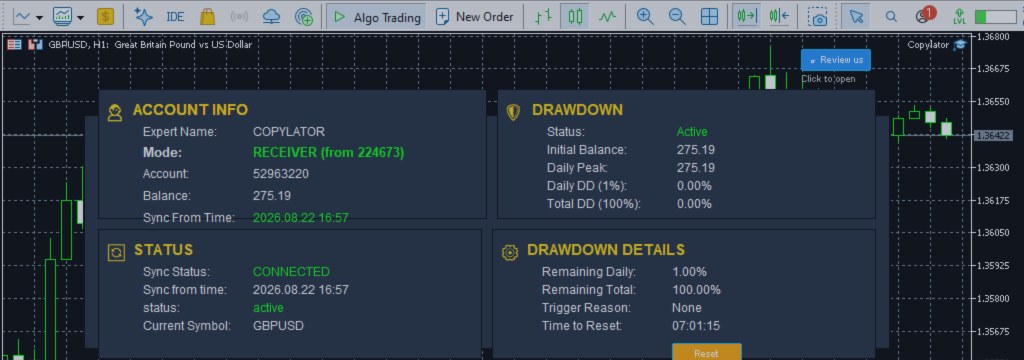
COPYLATOR provides receiver-side drawdown protection. Depending on the configuration, it can block further copying when a daily or total drawdown threshold is reached. The trader can also configure whether positions should be closed and pending orders deleted.
These controls provide a useful mechanism, but they do not guarantee that the final realized loss will remain exactly within the configured threshold. Slippage, gaps, execution delays, and market conditions can affect the final result.
Most importantly, the settings should reflect the client's agreed risk profile rather than simply being copied from another account.
Trade Attribution and Position Identification
When several clients receive trades from the same Sender, the manager needs a reliable way to identify which receiver positions correspond to which sender trades.
Position comments and ticket references can help with this process. COPYLATOR uses trade-identification information to associate copied positions with their corresponding sender activity, supporting subsequent position management.
This is useful when investigating a particular trade, checking whether a modification was applied, or reconciling the Sender's history with a Receiver's history.
However, position comments alone should not be treated as a complete client-accounting or reporting system. A professional operation should retain appropriate records and use a consistent reconciliation process.
The Reporting Responsibility
A copier transfers trading activity. It does not automatically provide every report that a manager may need for clients, accounting, or regulatory purposes.
Managers may need to prepare information such as:
- Opening and closing dates of positions.
- Trading volume and instrument details.
- Realized profit and loss.
- Commissions, swaps, and other trading costs.
- Deposits and withdrawals.
- Drawdown information.
- Differences between the Sender's and Receiver's execution results.
Some of this information can be obtained from MetaTrader 5 account history and exported for further analysis. More extensive operations may require dedicated reporting or client-management software.
The reporting process should also distinguish between the Sender's results and each Receiver's actual performance. Different lot sizes, spreads, commissions, execution prices, and account conditions can produce different outcomes.
A manager should never assume that the Sender's performance figures automatically represent every client's results.
The Regulatory Reality
Managing or directing trades on behalf of other people can involve significant legal and regulatory requirements.
The rules vary by jurisdiction and by the structure of the service. Relevant distinctions may include whether the arrangement involves discretionary account management, investment advice, signal provision, copy trading, pooled investment, or another regulated activity.
Licensing, registration, disclosure, marketing, client classification, custody, and compensation requirements may also differ.
Using a trade copier does not remove these obligations. It changes how trading instructions are transmitted and executed; it does not determine whether the underlying service is legally permitted.
Before connecting client accounts, a manager should establish which rules apply to the intended business model and obtain qualified legal or regulatory advice where necessary.
This should be addressed before the operation begins, not after the first client account experiences a serious loss or dispute.
A Practical Structure for a Small Operation
For an arrangement involving a relatively small number of clients, one possible technical structure is straightforward, provided it is legally appropriate.
- The manager operates a Sender terminal on a reliable computer or VPS.
- Each client operates a Receiver using their own broker account and appropriate trading permissions.
- Each Receiver is configured with the correct Sender account reference.
- Lot sizing and drawdown protection are configured individually for each account.
- The manager and client verify the initial test trades and position-management behavior.
- Account histories are reviewed and reconciled regularly.
- The strategy, risks, fees, responsibilities, and reporting arrangements are documented clearly.
Where the terminals run on separate computers or VPS environments, the communication setup must be supported and configured appropriately. Local Common Folder communication should not be assumed to work automatically across geographically separate machines.
The copier handles the trade replication. The manager remains responsible for the strategy, client communication, compliance, and operational oversight.
The Structure That Creates Problems
A risky arrangement is one in which the manager treats the copier as if it were the entire client-management operation.
For example, the manager may control all Receiver terminals, hold client credentials, select risk limits without proper agreement, and provide no clear documentation explaining how the service works.
This may appear convenient while markets are favorable. But when a drawdown occurs, questions quickly arise:
- Who approved the risk settings?
- Was the client informed about the possible losses?
- Who had authority to change the configuration?
- Who was responsible for monitoring the account?
- Were the actual results reported accurately?
- Was the manager legally permitted to provide the service?
These are not technical questions that a copier can answer. They require proper agreements, governance, records, and operational procedures.
The copier may have performed every copying instruction correctly, yet the overall arrangement can still fail because the responsibilities surrounding it were never properly established.
Should You Use a Copier to Manage Client Forex Accounts?
For a trader who needs to distribute the same strategy across multiple accounts, a copier can be an important operational tool.
It is particularly useful when:
- Several accounts need to receive the same trading instructions.
- Manual repetition creates too much work.
- Each account requires its own lot-sizing configuration.
- Receiver-side drawdown protection is important.
- Consistent handling of stop-loss, take-profit, modifications, and partial closes is required.
But a copier should not be treated as sufficient on its own. The manager must also address client suitability, risk agreements, reporting, security, operational monitoring, and applicable legal requirements.
The number of clients alone does not determine whether a copier is necessary. Trading frequency, account structure, operational complexity, and the manager's responsibilities are equally important.
Summary
A trade copier solves a genuine problem: replicating trading activity across multiple accounts without manually repeating every operation.
It can make multi-account execution more consistent and reduce repetitive work. With flexible lot sizing, symbol mapping, position management, and receiver-side drawdown protection, COPYLATOR provides tools that can support this type of setup.
However, the copier does not decide how much risk each client should take, prepare all required reports, protect client credentials, establish legal authorization, or manage the client relationship.
A sound arrangement separates these responsibilities clearly. The copier handles replication; the manager handles the strategy, documentation, risk policy, communication, and compliance; and each account operates under an agreed and properly configured structure.
The most important distinction is simple: a copier can make client-account trading more manageable, but it cannot turn an incomplete or legally unsuitable management operation into a professional one.
Product link:
https://www.mql5.com/en/ market/product/191385