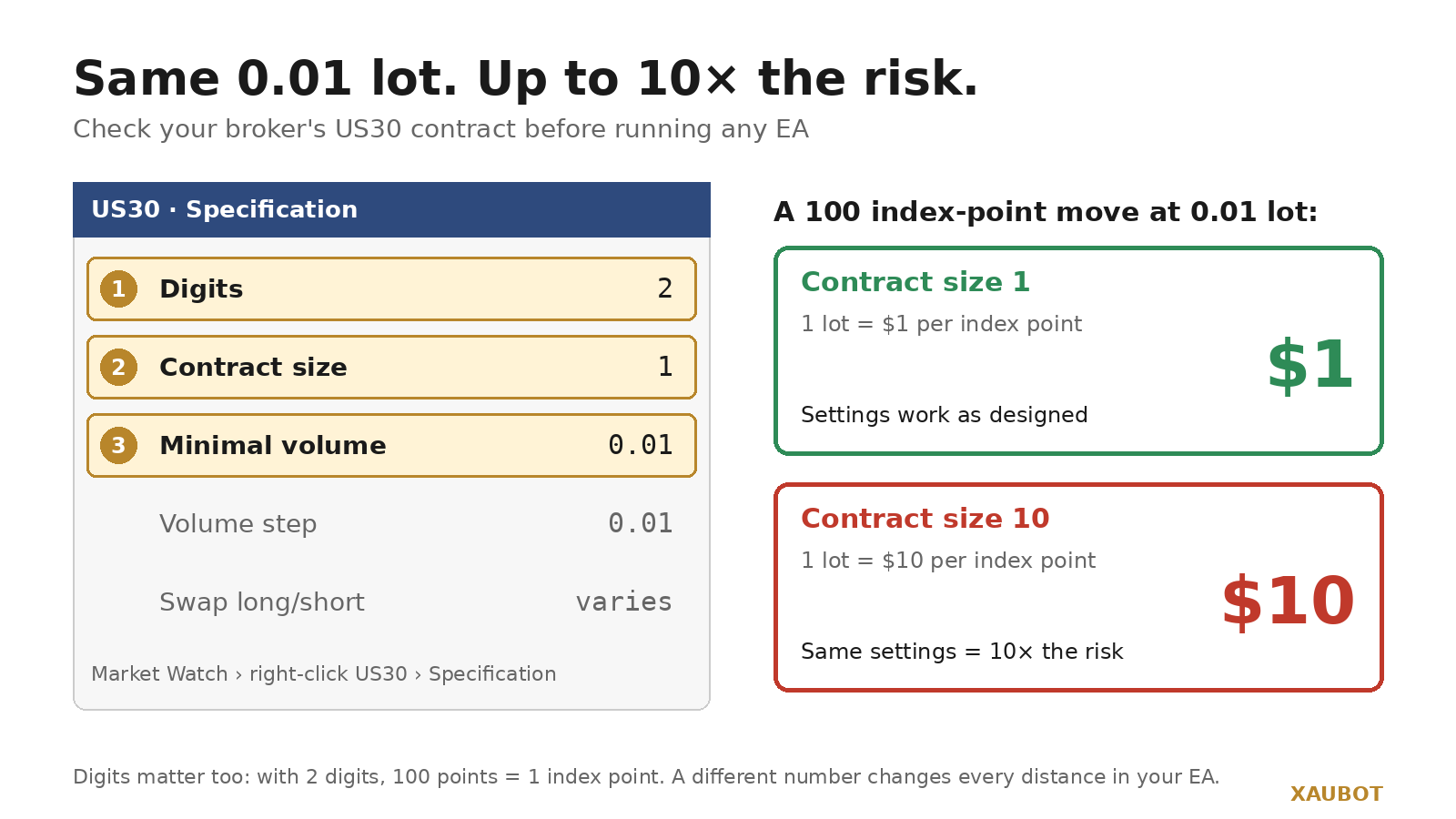
The same 0.01 lot can carry ten times more risk at a different broker. US30 lets you trade 30 of the largest US stocks through a single chart, but unlike Forex pairs, index CFDs are not standardised. Each broker decides how much one lot is worth.
Why it matters
Most US30 EAs are designed around a contract where 1 lot equals $1 per index point. At a broker where 1 lot equals $10 per index point, the same EA with the same settings risks ten times more on every trade. A stop loss that should cost $0.50 suddenly costs $5, and a drawdown limit you thought was safe is reached ten times faster.
The 30-second check
1. In Market Watch, right-click US30 (your broker may call it DJ30, WS30 or US30.cash) and choose Specification.
2. Read three lines: Contract size, Digits and Minimal volume.
3. Compare them with the contract your EA was designed for, usually stated in its manual.
Digits matter too. With 2 digits, 100 points equal 1 index point. If your broker quotes US30 with a different number of digits, every point-based distance in the EA, from stop loss to level gap, changes as well.
What to do if it doesn't match
Don't just guess a smaller lot. Ask the EA's developer which settings match your contract, or choose a broker whose specification matches the design. Also make sure you are on the cash (spot) index, not a dated future.
Two US30 EAs built around this contract
Indiora is a multi-level US30 EA on M5, and Vectron is a US30 scalper with a stop loss on every trade. Both are designed for 1 lot = $1 per index point with 2 digits, and both manuals show exactly how to check it.


![[EURUSD]: Weekly Liquidity Activation Points (LAP), October 12-16, 2026](https://c.mql5.com/6/1035/splash-preview-777305.png "[EURUSD]: Weekly Liquidity Activation Points (LAP), October 12-16, 2026")