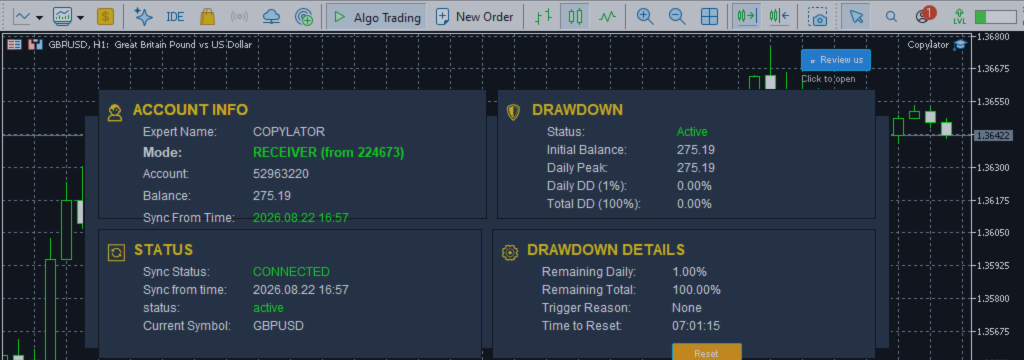
MT5 Trade Copier: The Role of Account Leverage in Copy Trading and Risk Management

Product link:
https://www.mql5.com/en/ market/product/191385
Leverage is one of the most misunderstood concepts in retail trading. In MT5 copy trading, the importance of leverage becomes even greater because the Sender and Receiver accounts may have completely different margin conditions.
Two accounts can copy the same trades, use the same lot size, and follow the same strategy, yet still behave differently if their leverage, contract specifications, or available margin are different.
This is particularly important when a strategy opens multiple positions simultaneously. A Receiver with insufficient available margin may be unable to reproduce all of the Sender's trades, resulting in a portfolio that is materially different from the original strategy.
Understanding the relationship between leverage, margin, lot size, free margin, and drawdown is therefore an important part of designing a reliable MT5 Trade Copier configuration.
1. What Does Leverage Actually Control?
Leverage primarily affects the amount of margin required to open and maintain a position.
It does not simply multiply the profit or loss produced by a particular position.
For example, if the same 0.10-lot EURUSD position is opened at the same price and closed at the same price on two accounts, the price-based profit or loss from that position is generally determined by the position size and price movement, not by whether the account has 1:50 or 1:500 leverage.
What can differ significantly is the amount of margin required to support that position.
Higher Leverage ↓ Lower Margin Requirement ↓ More Free Margin Available Lower Leverage ↓ Higher Margin Requirement ↓ Less Free Margin Available
The exact margin calculation depends on the instrument, contract specifications, account conditions, and broker rules.
2. Why Leverage Matters in Copy Trading
In a normal single-account trading strategy, the trader knows the account's leverage and can size positions accordingly.
In copy trading, however, the Sender and Receiver can have different margin environments.
Sender
Leverage: 1:500
       |
       | Copy Trade
       v
Receiver
Leverage: 1:100
The Receiver may therefore require substantially more margin for the same position.
If the Sender opens many positions at the same time, the difference can become significant.
3. Sender Leverage Does Not Transfer to the Receiver
One of the most important principles in copy trading is that the Receiver operates according to its own account conditions.
If the Sender uses 1:500 leverage, the Receiver does not automatically receive 1:500 leverage because the trade is copied.
The Receiver broker applies the Receiver account's own margin requirements.
Sender: 1:500 leverage ↓ COPYLATOR ↓ Receiver: 1:100 leverage
The Receiver's ability to accept the copied trade is therefore determined by the Receiver's available margin and broker conditions.
4. A Simple Margin Example
Consider two accounts receiving the same trade.
| Account | Leverage | Position |
|---|---|---|
| Sender | 1:500 | 1.00 lot |
| Receiver A | 1:200 | 1.00 lot |
| Receiver B | 1:50 | 1.00 lot |
The position size is identical, but the margin requirement can be substantially different.
As leverage decreases, the amount of capital committed as margin generally increases for the same position, subject to the broker's specific margin rules.
5. Why the First Few Trades Can Be Misleading
Leverage mismatches are often invisible when the copying system is lightly used.
For example:
Trade 1 → Accepted
Trade 2 → Accepted
Trade 3 → Accepted
The trader may conclude that everything is configured correctly.
The problem can appear later:
Trade 1 → Open Trade 2 → Open Trade 3 → Open Trade 4 → Open Trade 5 → Rejected Trade 6 → Rejected Trade 7 → Rejected
The Receiver has reached a margin limitation while the Sender continues operating normally.
6. Multiple Positions Make Leverage More Important
The effect becomes more significant when a strategy opens several positions at once.
For example:
Sender:

EURUSD   0.50
GBPUSD   0.50
USDJPY   0.50
XAUUSD   0.20
US30     0.10
Even if each individual position appears manageable, the combined margin requirement can become substantial.
The Receiver must have sufficient free margin for the entire portfolio, not just for the first trade.
7. What Happens When the Receiver Runs Out of Margin?
If the Receiver does not have sufficient free margin, a copied order may fail to open.
The exact error message and behavior depend on the MT5 environment and broker, but insufficient funds or margin can prevent an order from being accepted.
This creates an immediate divergence:
Sender: 5 positions Receiver: 3 positions
The Receiver is no longer running the same portfolio.
8. Partial Copying Can Change the Strategy Completely
This is more serious than simply missing one trade.
Suppose a strategy normally holds ten positions designed to work together.
If the Receiver can only open six because of margin limitations, the resulting portfolio may have:
- Different diversification
- Different market exposure
- Different correlation
- Different drawdown characteristics
- Different profit and loss distribution
Therefore, insufficient margin can transform a copied strategy into a different portfolio rather than simply reducing its size.
9. Leverage and Lot Size Are Closely Related
Although leverage is not itself a position-sizing method, leverage and lot size interact through margin requirements.
For the same account:
Larger Lot
   ↓
Larger Exposure
   ↓
Higher Margin Requirement
And:
Lower Leverage ↓ Higher Margin Requirement per Unit of Exposure
Combining large lots with low leverage can therefore create substantial margin pressure.
10. Fixed Lot Management
COPYLATOR supports fixed lot sizing.
This can provide predictable Receiver volume.
Fixed Lot:
0.10

Every copied trade:
0.10 lot
However, the trader still needs to verify that the Receiver account has enough margin for the expected number of simultaneous positions.
11. Balance-Ratio Scaling
Balance-ratio scaling can adjust copied volume according to the relationship between account balances.
This can be useful when Sender and Receiver accounts have different capital sizes.
However, balance ratio alone does not guarantee identical margin utilization.
Leverage, contract specifications, symbol price, stop-loss distance, and broker conditions can all affect the actual risk and margin requirement.
12. Lot Multiplier
A lot multiplier can reduce or increase the calculated Receiver volume.
For example:
Sender: 1.00 lot Lot Multiplier: 0.50 Receiver: 0.50 lot
For a lower-leverage Receiver, reducing the lot multiplier can help reduce margin usage.
However, the appropriate multiplier should be determined through risk and margin analysis rather than simply choosing a percentage arbitrarily.
13. Maximum Lot Cap
The Max Lot Size parameter provides another layer of volume control.
For example:
Calculated volume:
2.00 lots

Maximum Lot Size:
0.50 lots

Maximum copied volume:
0.50 lots
This can prevent a single unusually large copied trade from consuming an excessive amount of margin.
It is important to understand that a maximum lot cap controls volume; it does not guarantee a particular percentage risk or margin utilization.
14. Leverage and Max Lot Cap Work Together
For accounts with lower leverage, a conservative maximum lot cap can be particularly useful.
Consider:
Receiver Leverage: 1:50 Maximum Lot: 0.50
versus:
Receiver Leverage:
1:500

Maximum Lot:
2.00
These two configurations can have dramatically different margin characteristics.
The correct limits should therefore be based on the actual Receiver account rather than copied directly from the Sender configuration.
15. Leverage Does Not Equal Risk Percentage
A common misconception is:
Higher leverage = higher risk
The relationship is more nuanced.
Higher leverage gives the account greater capacity to control a larger notional position with less margin, but the actual risk depends heavily on the position size, stop-loss, exposure, instrument, and account equity.
A trader can have a high-leverage account while using relatively small positions.
Conversely, a low-leverage account can still be exposed to substantial risk if it uses large positions relative to account equity.
16. Leverage and Free Margin
Free margin is particularly important for copy trading.
A simplified conceptual relationship is:
Equity
  -
Used Margin
  =
Free Margin
The exact MT5 calculation can include additional account-specific factors, but the principle is straightforward: as positions consume margin, available free margin decreases.
When free margin becomes insufficient, additional copied trades may no longer be accepted.
17. Why Free Margin Should Be Monitored
Instead of checking leverage only once during account setup, traders should monitor actual free margin while the strategy is operating.
This is particularly important during:
- High-volatility periods
- Multiple simultaneous entries
- Large market movements
- News events
- Periods of increased portfolio exposure
A Receiver that normally operates comfortably may experience margin pressure when several positions are opened simultaneously.
18. Leverage and Margin Level
Margin level is another important account-level indicator.
As equity falls relative to used margin, margin level can deteriorate.
If the account reaches the broker's margin-call or stop-out conditions, the broker may intervene independently of the copier.
This distinction is important:
COPYLATOR Drawdown Protection ≠ Broker Stop-Out System
They are separate mechanisms.
19. Broker Stop-Out Can Override the Intended Copying Strategy
Suppose a Receiver has several large positions and the market moves sharply against them.
The broker may close positions when its own margin requirements are breached.
This can happen before a configured COPYLATOR drawdown threshold is reached, depending on the account's conditions.
The result can be a Receiver portfolio that differs substantially from the Sender.
20. Leverage and Drawdown Protection
COPYLATOR provides configurable drawdown protection on the Receiver.
Depending on the selected settings, traders can define daily and total drawdown thresholds and determine what happens when those limits are reached.
However, drawdown protection does not replace margin management.
A trader should therefore consider both:
Account Drawdown Risk
        +
Margin Risk
        =
Overall Receiver Risk
21. Daily Drawdown vs Margin Pressure
A Receiver can experience serious margin pressure even before the configured daily drawdown limit is reached.
For example:
Daily DD Limit: 5% Broker Margin Pressure: Occurs earlier
Depending on the account structure and market movement, broker-level margin intervention can occur independently of the copier's drawdown settings.
Therefore, drawdown limits should be selected with the account's leverage and margin characteristics in mind.
22. Does Matching Leverage Solve Everything?
No.
Matching Sender and Receiver leverage can reduce one source of difference, but it does not make the accounts identical.
Other factors can still differ:
- Account balance
- Equity
- Contract size
- Symbol specifications
- Spread
- Commission
- Swap
- Stop-out level
- Execution conditions
- Maximum volume
- Minimum volume
- Volume step
Leverage matching is therefore useful, but it is only one part of Receiver configuration.
23. What If Receiver Leverage Cannot Be Changed?
Sometimes the Receiver account must operate with lower leverage.
In that case, several configuration changes can be considered.
Reduce Copied Volume
Use a smaller fixed lot or lower multiplier.
Use Balance-Based Scaling Carefully
Adjust the scaling relationship so that the Receiver's position sizes are appropriate for its capital and leverage.
Set a Maximum Lot
Prevent unexpectedly large copied trades.
Reduce Simultaneous Exposure
Use appropriate filters or strategy selection to avoid excessive concurrent positions where the strategy permits.
24. Limiting Simultaneous Positions
A copier cannot always reduce a strategy to its "best" trades without changing the strategy itself.
However, traders can design their copying structure to reduce exposure by:
- Using separate Receiver accounts
- Using direction filters
- Using time filters
- Reducing lot size
- Using a lower lot multiplier
- Applying a maximum lot cap
Each method changes the original exposure in a different way and should therefore be tested.
25. Leverage and Multi-Sender Copy Trading
Leverage becomes even more important when multiple Senders are copied into one Receiver.
Consider:
Sender A → 5 positions
Sender B → 4 positions
Sender C → 3 positions

Total:
12 simultaneous positions
A high-leverage Sender environment may support this portfolio comfortably, while a lower-leverage Receiver may struggle to maintain all positions.
This can result in incomplete copying and significant portfolio divergence.
26. Leverage and Different Symbols
Not all instruments have the same margin requirements.
For example, Forex, metals, indices, and other CFDs can have different contract specifications and margin models.
Therefore, simply comparing the leverage number is not enough.
A proper analysis should also consider the actual instruments being copied.
27. Symbol Mapping and Margin Requirements
When a Sender symbol is mapped to a different Receiver symbol, the Receiver's trading specifications become relevant.
For example:
Sender: XAUUSD Receiver: XAUUSDm
Even though the instruments may represent the same underlying market, the Receiver broker may use different contract specifications and margin requirements.
This should be verified before live deployment.
28. Hedging vs Netting and Margin
Account type can also influence how positions interact.
On a Hedging account, multiple independent positions may exist on the same symbol.
On a Netting account, positions are aggregated into a net position.
The resulting margin treatment can depend on the broker's implementation and the specific positions involved.
Therefore, multi-position copying should always be tested on the actual Receiver account type.
29. Leverage and Reverse Mode
Reverse Mode changes the direction of the copied position, but it does not give the Receiver additional leverage.
If the Receiver has insufficient margin for the resulting position, the trade can still be rejected.
Therefore:
Reverse Mode
    ≠
Additional Margin Capacity
Reverse Mode should be considered part of strategy design, while leverage remains an account-level margin parameter.
30. Leverage and Pending Orders
Pending orders can also contribute to the complexity of a high-exposure copying setup.
Depending on the broker's margin rules, pending orders may have margin implications or may become relevant once triggered.
When a strategy uses numerous pending orders, the Receiver's margin conditions should be tested carefully.
31. Demo Testing With Realistic Leverage
Demo testing is most useful when the test environment resembles the intended live environment.
Where possible, test using:
- The same or comparable leverage
- The same symbols
- The same lot configuration
- The same number of simultaneous positions
- The same account type
- Comparable broker conditions
A demo test with dramatically different leverage may fail to reveal the margin limitations that appear later on the live Receiver.
32. A Practical Leverage Stress Test
Before live deployment, deliberately test the Receiver under a high-exposure scenario.
Step 1: Open several copied positions. Step 2: Add additional positions. Step 3: Monitor Used Margin. Step 4: Monitor Free Margin. Step 5: Monitor Margin Level. Step 6: Observe whether new trades are accepted. Step 7: Review the trade history and copier logs.
The purpose is to understand how the Receiver behaves before the same situation occurs with real funds.
33. Common Leverage Mistakes
Mistake 1: Assuming Sender Leverage Transfers
The Receiver uses its own account and broker margin conditions.
Mistake 2: Looking Only at the Leverage Number
Contract specifications and instrument-specific margin rules also matter.
Mistake 3: Ignoring Free Margin
A high nominal leverage does not help if the account has insufficient equity or excessive existing exposure.
Mistake 4: Using Excessive Lot Sizes
High leverage does not justify unlimited position sizing.
Mistake 5: Testing Only a Few Trades
Margin problems often become visible only when multiple positions are open simultaneously.
Mistake 6: Confusing Drawdown Protection With Margin Protection
COPYLATOR's drawdown protection and the broker's margin/stop-out system are separate mechanisms.
34. A Practical Receiver Configuration Example
Consider a Receiver with lower leverage than the Sender.
Sender:
Leverage = 1:500

Receiver:
Leverage = 1:100

COPYLATOR:
Lot Multiplier = 0.50
Max Lot Size   = 0.50
This does not make the accounts equivalent, but it can reduce the Receiver's position volume and therefore its margin requirements.
The configuration should then be tested using the actual Receiver account balance, instruments, and expected number of simultaneous positions.
35. Leverage and Risk Management Should Be Designed Together
It is better to think about leverage as part of a larger risk system rather than as an isolated broker setting.
Account Equity + Leverage + Position Size + Margin Requirement + Stop Loss + Maximum Exposure + Drawdown Protection ↓ Receiver Risk Profile
Changing one component can affect the behavior of the entire system.
36. Recommended Pre-Live Checklist
- Check Sender leverage.
- Check Receiver leverage.
- Check Receiver account balance.
- Check Receiver equity.
- Check margin requirements for every traded symbol.
- Check minimum and maximum volume.
- Check volume step.
- Check expected simultaneous positions.
- Configure appropriate lot sizing.
- Consider Balance Ratio if applicable.
- Configure Lot Multiplier conservatively.
- Set a suitable Max Lot Size.
- Monitor Free Margin.
- Monitor Margin Level.
- Configure Drawdown Protection.
- Understand the broker's Stop-Out level.
- Test the complete configuration on demo.
- Stress-test multiple simultaneous positions.
- Review rejected-order logs.
Conclusion
Leverage is not simply a number displayed in the trading account. In copy trading, it is an important component of the Receiver's margin capacity.
The Sender may operate successfully with high leverage while a lower-leverage Receiver struggles to reproduce the same portfolio. The result can be rejected orders, incomplete copying, different exposure, and a materially different risk profile.
COPYLATOR can control important aspects of the copying process, including fixed lots, balance-ratio scaling, lot multipliers, maximum lot caps, symbol mapping, SL/TP synchronization, Partial Close, Reverse Mode, time filters, and drawdown protection. However, the Receiver's leverage and broker margin rules remain account-level constraints.
The practical solution is therefore not to assume that the Receiver will automatically behave like the Sender. Instead, traders should evaluate the Receiver's actual margin requirements, select appropriate position sizes, control maximum exposure, monitor free margin, and test the complete configuration under realistic conditions.
Most importantly, a copy-trading setup should be evaluated based on the Receiver's ability to sustain the intended portfolio, not simply on whether the first few copied trades open successfully.
When leverage, lot sizing, margin, and drawdown protection are considered together, traders can build a more controlled and predictable MT5 copy-trading environment.
Product link:
https://www.mql5.com/en/ market/product/191385