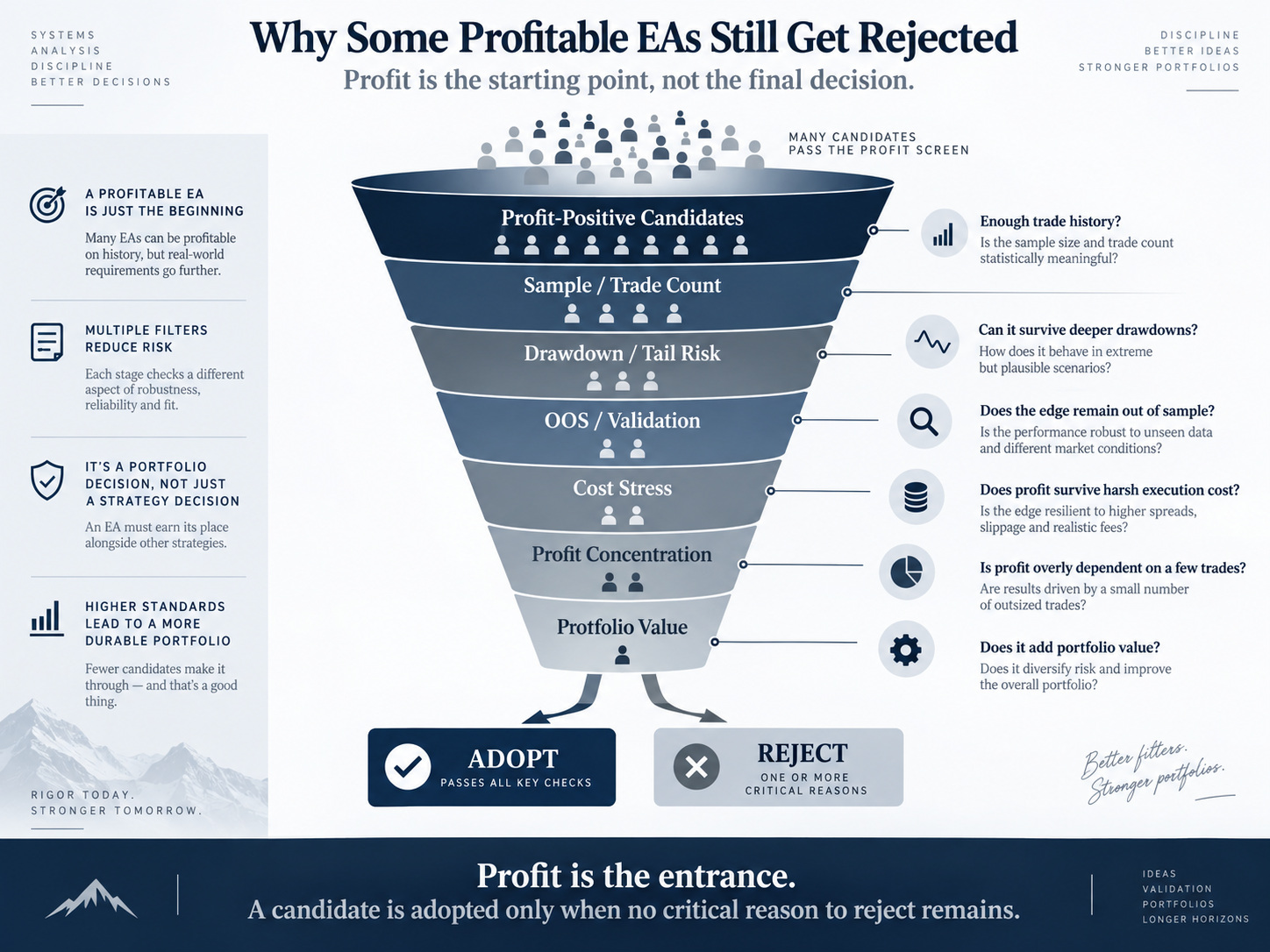
A positive backtest can be a valid reason to investigate an EA without being a sufficient reason to deploy it. The profit might come from too few trades, depend heavily on a handful of outcomes, or disappear under more demanding execution assumptions.
A disciplined review gives the reasons not to use a candidate as much attention as the reasons to like it. Profit remains important, but the selection decision also needs to establish how credible and usable that profit is.
A profitable report can leave important questions unanswered
Imagine a candidate with ten years of history and PF 1.20. The headline result is positive, but a closer review may reveal a small trade sample, substantial drawdown relative to return, or much deeper losses under alternative Monte Carlo paths. Validation or OOS may also show that the apparent edge has weakened.
Other questions concern cost sensitivity and concentration. Does the candidate still retain profit under severe cost assumptions? Does a small group of exceptional trades account for most of the result? Large winners are not automatically a flaw, but heavy dependence on them changes what needs to be understood about the strategy.
The original profit figure stays true through all of these checks. What changes is the case for using the EA. A selection process needs to distinguish a positive result from evidence that meets the intended standard.
AI-generated example of review criteria, not a product qualification record or a limit on future losses.
Portfolio relevance is a separate decision
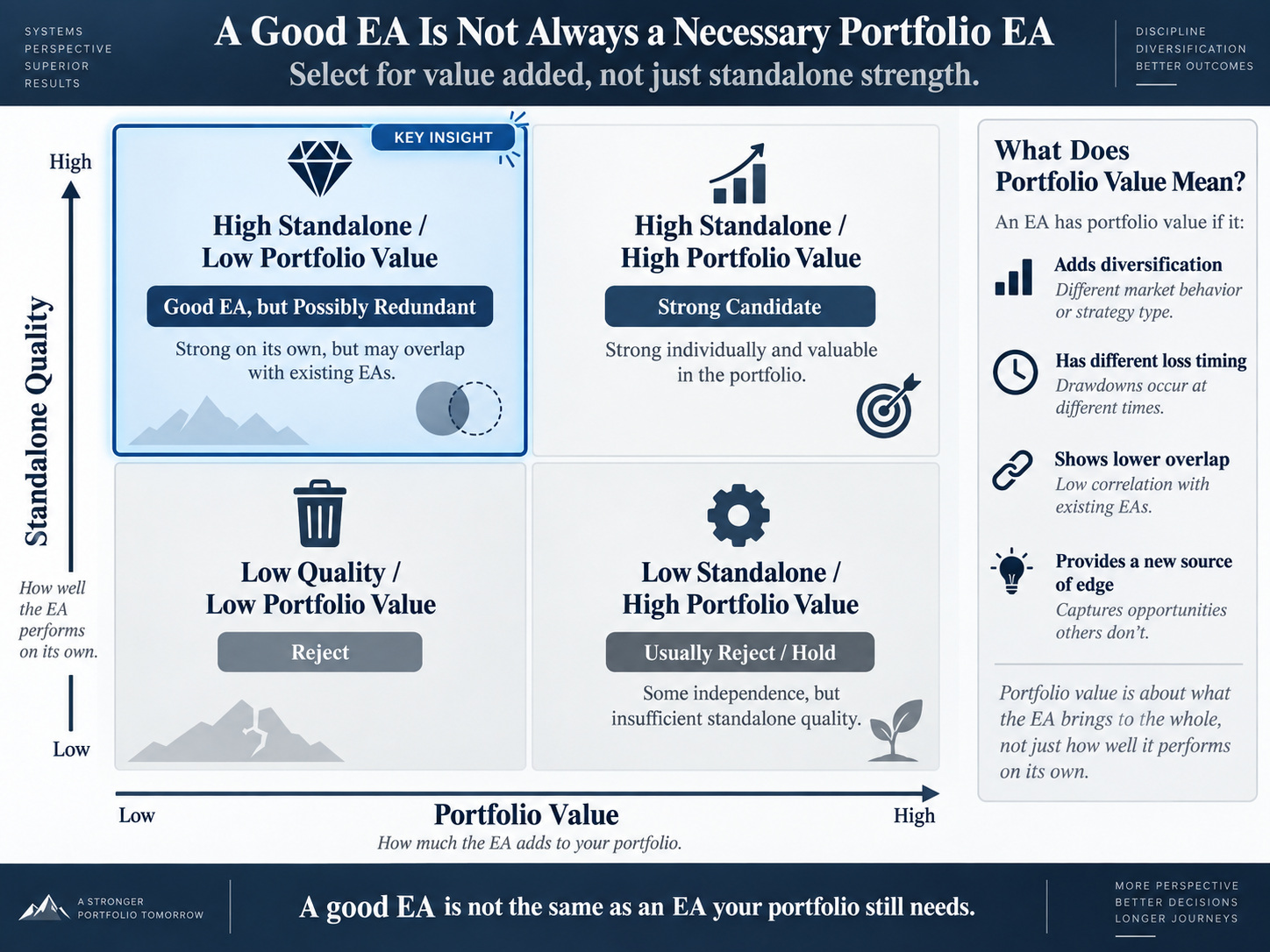
An EA can have acceptable standalone results, reasonable drawdown, credible OOS behavior and good cost tolerance, yet add little to a particular portfolio. If it loses alongside existing strategies, carries similar directional exposure or depends on the same regime, the portfolio may already have enough of that behavior.
In that situation, rejecting the addition does not mean the EA is poor in isolation. It means its marginal contribution is limited. Different loss timing or a less overlapping source of behavior may be more valuable than another small increase in standalone PF.
This distinction also works in the other direction. A candidate does not become acceptable simply because it is different. Standalone quality and portfolio value need separate consideration before they are combined into an adoption decision.
AI-generated example of review criteria, not a product qualification record or a limit on future losses.
Leave room for “not enough evidence yet”
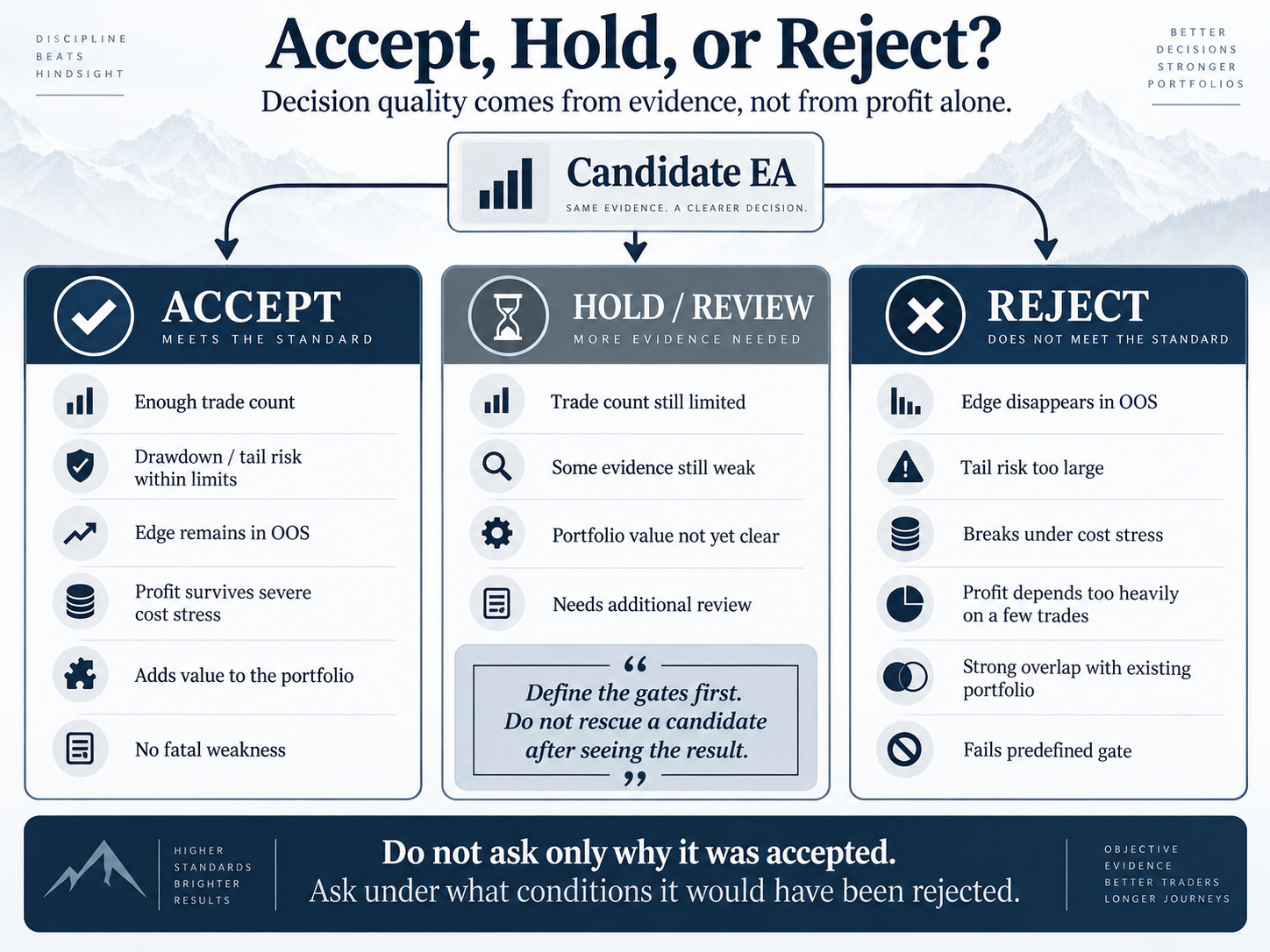
Accept, hold and reject describe different evidence states. Accept means the candidate meets the relevant criteria within the evaluation performed. Hold means an important question remains unresolved, such as a limited sample or uncertain portfolio contribution. Reject means a material weakness or failed criterion has been identified.
“Accept” should not imply that every possible failure mode has been eliminated. Equally, “hold” should identify what additional evidence is needed rather than become an indefinite exception for a favored EA.
AI-generated example of review criteria, not a product qualification record or a limit on future losses.
A candidate that loses its edge out of sample, exceeds the permitted tail risk, collapses under the defined cost stress or adds unacceptable portfolio overlap may warrant rejection. The thresholds and the role of each check should be specified before the result is used to justify an exception.
A near miss is still a decision about the rule
Suppose a hypothetical drawdown limit is 15% and a candidate returns 16%. Raising the limit to 17% may save the candidate, but it is a change made with knowledge of the result. These numbers illustrate the problem; they are not published thresholds for the linked products.
A genuine methodological revision can be reasonable. It should be distinguished from candidate-specific rescue and applied consistently, with the effect on prior decisions made clear.
Making every gate stricter is not the answer either. A requirement should address a relevant weakness, not merely sound demanding. An elaborate set of narrowly fitted criteria can create its own selection problem.
Ask what would have led to rejection
“Selected from 10,000 EAs” says little without the rejection reasons. Removing 9,999 candidates under arbitrary rules does not establish the quality of the survivor. Consistent, relevant reasons such as insufficient evidence, unacceptable drawdown, cost fragility or redundancy are more informative than the rejection rate.
When considering a product, ask under what conditions it would have been rejected. The answer exposes the developer's standards more clearly than another description of why the selected backtest looks attractive. It also gives you criteria to use when examining the evidence for yourself.
Product details and testing conditions
Use these questions to assess the evidence for a product, rather than treating selection language as an endorsement.
Specifications, published historical results and operating limits: EdgeDriven Gold Portfolio — XAUUSD · EdgeDriven Dollar Yen Portfolio — USDJPY.
The examples in this article explain evaluation methods; they are not test results for those products. Historical simulations do not guarantee future results. Leveraged trading can cause substantial losses.